Loading...
Done
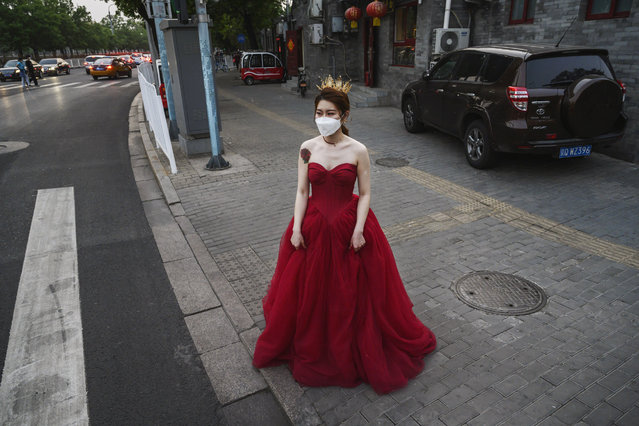
A Chinese woman wears her dress and a protective mask as she waits to change after taking pictures in advance of her wedding near the Forbidden City, on April 30, 2020 in Beijing, China. Beijing lowered its risk level after more than three months Thursday in advance of the May holiday, allowing most domestic travellers arriving in the city to do so without having to do 14 days of quarantine. The Forbidden City will open to a limited number of visitors as of Thursday morning. After decades of growth, officials said China's economy had shrunk in the latest quarter due to the impact of the coronavirus epidemic. The slump in the world's second largest economy is regarded as a sign of difficult times ahead for the global economy. While industrial sectors in China are showing signs of reviving production, a majority of private companies are operating at only 50% capacity, according to analysts. With the pandemic hitting hard across the world, officially the number of coronavirus cases in China is dwindling, ever since the government imposed sweeping measures to keep the disease from spreading. Officials believe the worst appears to be over in China, though there are concerns of another wave of infections as the government attempts to reboot the world's second largest economy. Since January, China has recorded more than 81,000 cases of COVID-19 and at least 3,200 deaths, mostly in and around the city of Wuhan, in central Hubei province, where the outbreak first started. (Photo by Kevin Frayer/Getty Images)

A Chinese woman wears her dress and a protective mask as she waits to change after taking pictures in advance of her wedding near the Forbidden City, on April 30, 2020 in Beijing, China. Beijing lowered its risk level after more than three months Thursday in advance of the May holiday, allowing most domestic travellers arriving in the city to do so without having to do 14 days of quarantine. (Photo by Kevin Frayer/Getty Images)
Details
03 May 2020 00:07:00
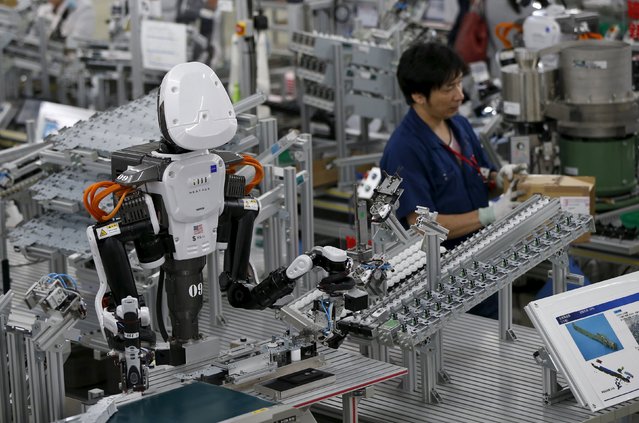
A humanoid robot works side by side with employees in the assembly line at a factory of Glory Ltd., a manufacturer of automatic change dispensers, in Kazo, north of Tokyo, Japan, July 1, 2015. (Photo by Issei Kato/Reuters)

A humanoid robot works side by side with employees in the assembly line at a factory of Glory Ltd., a manufacturer of automatic change dispensers, in Kazo, north of Tokyo, Japan, July 1, 2015. Japanese firms are ramping up spending on robotics and automation, responding at last to premier Shinzo Abe's efforts to stimulate the economy and end two decades of stagnation and deflation. (Photo by Issei Kato/Reuters)
Details
04 Jul 2015 10:59:00
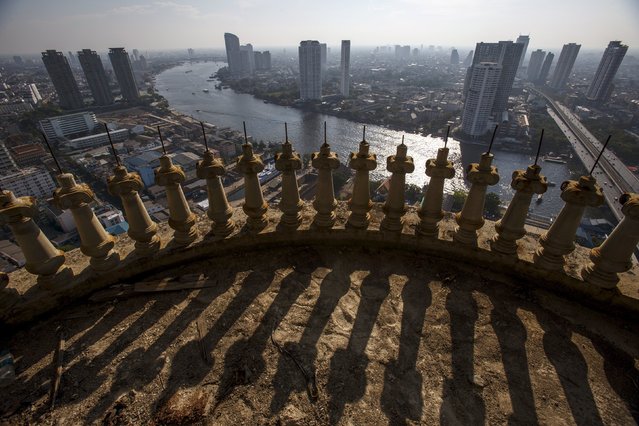
Central Bangkok and the Chao Phraya River are seen from an abandoned skyscraper in Bangkok April 19, 2015. (Photo by Athit Perawongmetha/Reuters)

Central Bangkok and the Chao Phraya River are seen from an abandoned skyscraper in Bangkok April 19, 2015. The abandoned building, known as Satorn Unique, dubbed the “ghost tower” was destined to become one of Bangkok's most luxurious residential addresses but construction was never completed as the Thai economy was hit during the 1997 Asian Financial Crisis. Now, many travellers visit and explore 49-storey skyscraper. (Photo by Athit Perawongmetha/Reuters)
Details
20 Apr 2015 12:33:00
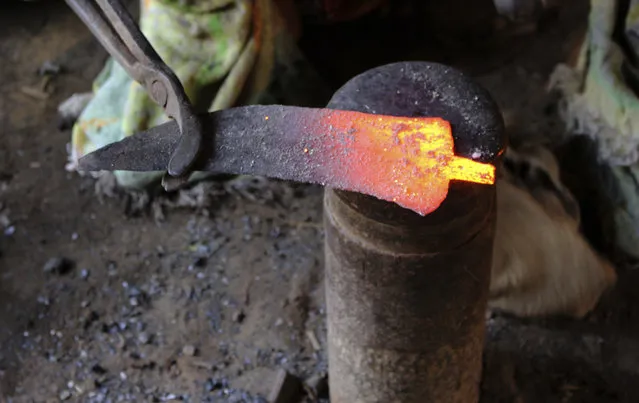
In this October 6, 2018, photo, a craftsman makes daggers or “Jambiyya” in Yemeni Arabic, made out of remains of missiles, at his workshop, in Hajjah, Yemen. (Photo by Hammadi Issa/AP Photo)

In this October 6, 2018, photo, a craftsman makes daggers or “Jambiyya” in Yemeni Arabic, made out of remains of missiles, at his workshop, in Hajjah, Yemen. Missiles raining on Yemen from the jets of the Saudi-led coalition fighting Houthi rebels are killing thousands of civilians and militiamen alike, but amid crashing economy, some Yemenis see the bright side of it: they make daggers out of the fragments of the missiles for ordinary men traditionally wear for prestige and a show of courage. (Photo by Hammadi Issa/AP Photo)
Details
10 Oct 2018 00:01:00
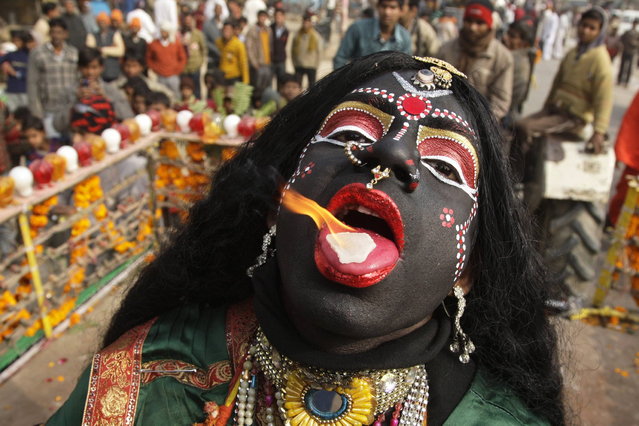
A man dressed as Hindu goddess Kali, the goddess of power, performs with a burning camphor tablet on his tongue during a religious procession ahead of the “Kumbh Mela”, or Pitcher Festival, in the northern Indian city of Allahabad January 6, 2013. During the festival, hundreds of thousands of Hindus take part in a religious gathering at the banks of the river Ganges. The festival is held every 12 years in different Indian cities. (Photo by Jitendra Prakash/Reuters)

A man dressed as Hindu goddess Kali, the goddess of power, performs with a burning camphor tablet on his tongue during a religious procession ahead of the “Kumbh Mela”, or Pitcher Festival, in the northern Indian city of Allahabad January 6, 2013. During the festival, hundreds of thousands of Hindus take part in a religious gathering at the banks of the river Ganges. The festival is held every 12 years in different Indian cities. (Photo by Jitendra Prakash/Reuters)
Details
14 Jan 2013 10:54:00
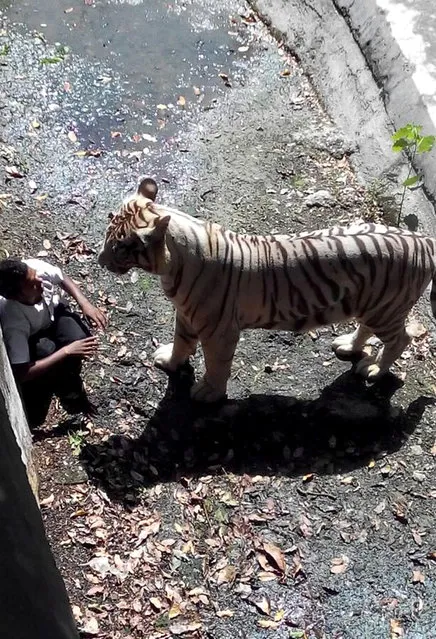
In this handout photograph received from the Delhi Police at the scene of the incident, an Indian schoolboy is confronted by a white tiger inside its enclosure at the Delhi Zoo in New Delhi on September 23, 2014. A white tiger on September 23 attacked and killed a schoolboy who appeared to have jumped or fallen into its enclosure at the zoo in the Indian capital, witnesses said. (Photo by AFP Photo/Delhi Police)

In this handout photograph received from the Delhi Police at the scene of the incident, an Indian schoolboy is confronted by a white tiger inside its enclosure at the Delhi Zoo in New Delhi on September 23, 2014. A white tiger on September 23 attacked and killed a schoolboy who appeared to have jumped or fallen into its enclosure at the zoo in the Indian capital, witnesses said. (Photo by AFP Photo/Delhi Police)
Details
26 Sep 2014 13:32:00


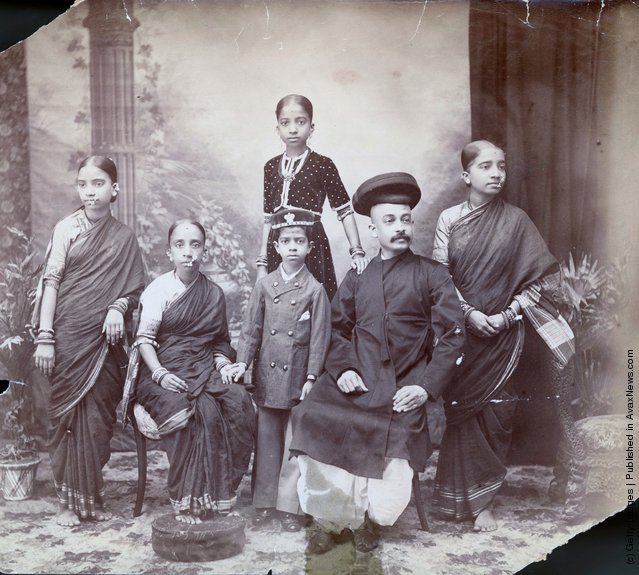
An Indian Brahmin and his family. (Photo by Hulton Archive/Getty Images). Circa 1890
Details
22 Jul 2011 11:08:00
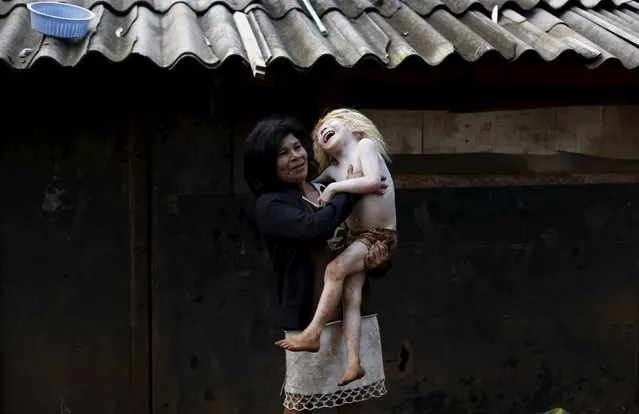
A Guarani Indian woman jokes with her son in the village of Pyau at Jaragua district, in Sao Paulo April 27, 2015. The National Indian Foundation (FUNAI) has recognised 521 hectares of this area as indigenous territory, making it the smallest indigenous reserve in Brazil. Members of the Guarani community have now established a new village outside the demarcation and are being threatened with an eviction through a court order. (Photo by Nacho Doce/Reuters)

A Guarani Indian woman jokes with her son in the village of Pyau at Jaragua district, in Sao Paulo April 27, 2015. The National Indian Foundation (FUNAI) has recognised 521 hectares of this area as indigenous territory, making it the smallest indigenous reserve in Brazil. Members of the Guarani community have now established a new village outside the demarcation and are being threatened with an eviction through a court order. (Photo by Nacho Doce/Reuters)
Details
01 May 2015 12:42:00