Loading...
Done

A military band prepares to play the national anthems before Cuban President Raul Castro welcomes U.S. President Barack Obama at the Palacio de la Revolucion in Havana March 21, 2016. (Photo by Jonathan Ernst/Reuters)

A military band prepares to play the national anthems before Cuban President Raul Castro welcomes U.S. President Barack Obama at the Palacio de la Revolucion in Havana March 21, 2016. Barack Obama on Sunday became the first US president in 88 years to visit Cuba, touching down in Havana for a landmark trip aimed at ending decades of Cold War animosity. (Photo by Jonathan Ernst/Reuters)
Details
22 Mar 2016 11:16:00
The one month old newborn Bongo Antelope

“The western or lowland bongo is a herbivorous, mostly nocturnal forest ungulate and among the largest of the African forest antelope species. Bongos are characterised by a striking reddish-brown coat, black and white markings, white-yellow stripes and long slightly spiralled horns”. – Wikipedia

Photo: The one month old newborn Bongo Antelope Calf ventures out in the cold with his mother in their enclosure at London Zoo on December 9, 2005 in London, England. (Photo by Christopher Lee/Getty Images)
Details
21 Feb 2012 12:17:00
Belarusian workers works at a felt boot factory in Smilovichi, some 35km from Minsk, Belarus, 16 January 2012. (Photo by Tatyana Zenkovich/EPA)

The Smilovichi Felting Factory in Belarus was founded in 1928, when Smilovichi was a small Jewish settlement of craftsmen. Five of those craftsmen organized a small artel (a cooperative association of craftsmen who all live and work together), which produced warm boots called “valenki” for cold weather. Photo: Belarusian workers works at a felt boot factory in Smilovichi, some 35km from Minsk, Belarus, 16 January 2012. (Photo by Tatyana Zenkovich/EPA)
Details
18 Oct 2013 10:02:00
Arctic Fox. (Photo by Trond Eriksen)

“The arctic fox (Vulpes lagopus), also known as the white fox, polar fox, or snow fox, is a small fox native to the Arctic regions of the Northern Hemisphere and is common throughout the Arctic tundra biome. It is well adapted to living in cold environments. It has a deep thick fur which is brown in summer and white in winter. It averages in size at about 85.3 cm (33.6 in) in body length, with a generally rounded body shape to minimize the escape of body heat. – Wikipedia. (Photo by Trond Eriksen)
Details
26 May 2014 14:09:00
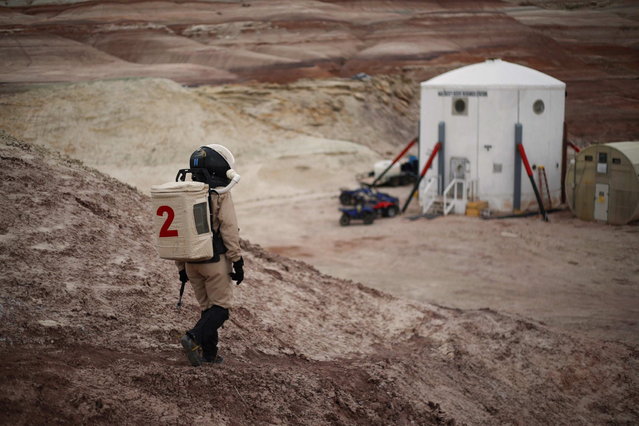
Csilla Orgel, a geologist of Crew 125 EuroMoonMars B mission, makes her way back to the Mars Desert Research Station (MDRS) in the Utah desert March 3, 2013. (Photo by Jim Urquhart/Reuters)

NASA says it could be another 20 years before humans touch down on Mars, but in a sense, the Mars Society has been exploring the red planet for more than a decade – in Utah. Photo: Csilla Orgel, a geologist of Crew 125 EuroMoonMars B mission, makes her way back to the Mars Desert Research Station (MDRS) in the Utah desert March 3, 2013. The MDRS aims to investigate the feasibility of a human exploration of Mars and uses the Utah desert's Mars-like terrain to simulate working conditions on the red planet. Scientists, students and enthusiasts work together developing field tactics and studying the terrain. All outdoor exploration is done wearing simulated spacesuits and carrying air supply packs and crews live together in a small communication base with limited amounts of electricity, food, oxygen and water. Everything needed to survive must be produced, fixed and replaced on site. (Photo by Jim Urquhart/Reuters)
Details
14 Mar 2013 12:11:00
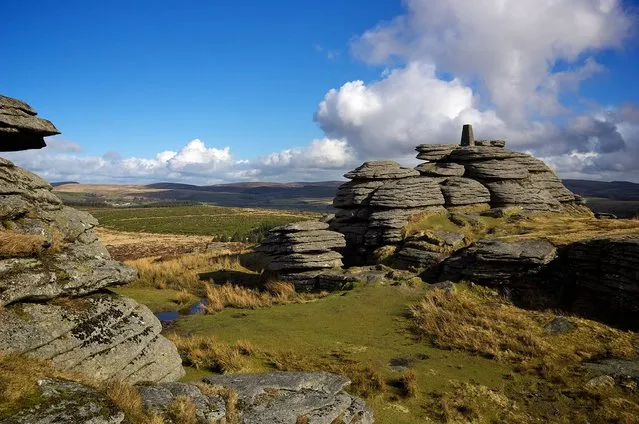
Dartmoor National Park. Located in South Devon and just a 30 minute drive away from Exeter, the Dartmoor National Park features rushing rivers, sprawling moorland and spooky forests. This stunning backdrop was the main reason it was chosen as the setting for Steven Spielberg’s film, Warhorse. (Photo by Diana Jarvis/VisitEngland)

Every year National Parks Week gives visitors a chance to celebrate the incredible woodland spaces around the UK. This year the National Parks Week runs from 28 July – 3 August and there are 10 national parks across England to explore. Each one has created a special event to celebrate the National Parks Week, from picnics and treasure hunt in the park to cycle rides, safari or outdoor art exhibition. (Photo by Diana Jarvis/VisitEngland)
Details
23 Jul 2014 10:15:00
Goodfellow's Tree-Kangaroo

For some reason, everything that comes from Australia is either very cute or very poisonous; sometimes cute and poisonous at the same time. For example, Slow Loris, which you probably have seen eating a ball of rice on YouTube, is actually a very poisonous creature, despite its extreme cuteness. Goodfellow’s tree-kangaroos, on the other hand, are all cuteness and no poison. Just look at its cute little snout and furry paws, as it gingerly scratches its stomach, while sitting on its hind legs! If you don’t find this creature adorable, nothing will be able to thaw your stone-cold heart.
Details
30 Nov 2014 13:38:00
Arctic Hare

The arctic hare, or polar rabbit, is a species of hare which is adapted largely to polar and mountainous habitats. The arctic hare survives with a thick coat of fur and usually digs holes in the ground or under snow to keep warm and sleep. Arctic hares look like rabbits but have shorter ears, are taller when standing, and, unlike rabbits, can thrive in cold climates. They can travel together with many other hares, sometimes huddling with dozens or more, but are usually found alone, taking, in some cases, more than one partner. The arctic hare can run up to 60 kilometres per hour (40 mph). Its predators include the arctic wolf, arctic fox, and ermine.
Details
17 Mar 2014 13:56:00