Loading...
Done
Britain's Prince Harry meets Chewbacca during a visit to the Star Wars film set at Pinewood Studios near Iver Heath, west of London, Britain, April 19, 2016. (Photo by Adrian Dennis/Reuters)

Britain's Prince Harry meets Chewbacca during a visit to the Star Wars film set at Pinewood Studios near Iver Heath, west of London, Britain, April 19, 2016. Prince William and Prince Harry are touring Pinewood to visit the production workshops and meet the creative teams working behind the scenes on the Star Wars films. (Photo by Adrian Dennis/Reuters)
Details
22 Apr 2016 12:56:00
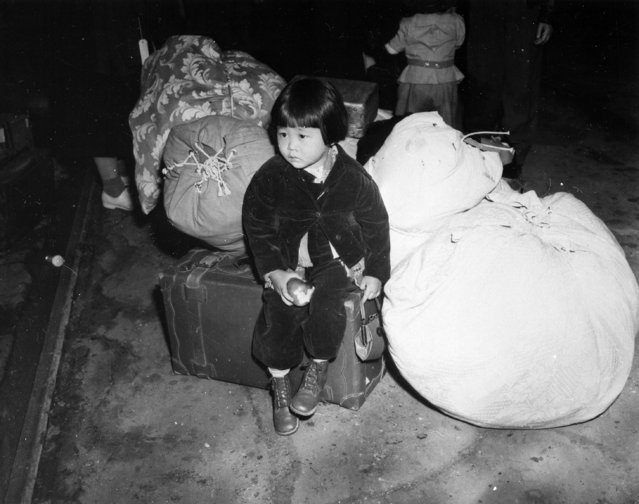
A young evacuee of Japanese ancestry waits with the family baggage before leaving by bus for an assembly center in California, in this April 1942 handout photo. (Photo by Courtesy Clem Albers/Department of the Interior/War Relocation Authority/National Archives/Reuters)

A young evacuee of Japanese ancestry waits with the family baggage before leaving by bus for an assembly center in California, in this April 1942 handout photo. February 19, 2017 marks the 75th anniversary of FDR signing executive order 9066, authorizing the internment of Japanese Americans during World War Two. (Photo by Courtesy Clem Albers/Department of the Interior/War Relocation Authority/National Archives/Reuters)
Details
19 Feb 2017 00:02:00
 World Leaders Gather For D-Day Tribute

Australian World War Two veterans place crosses and flags at graves before attending the French-British ceremony at the British War cemetery in Bayeux, June 6, 2014. REUTERS/Leon Neal/Pool
Details
06 Jun 2014 11:43:00
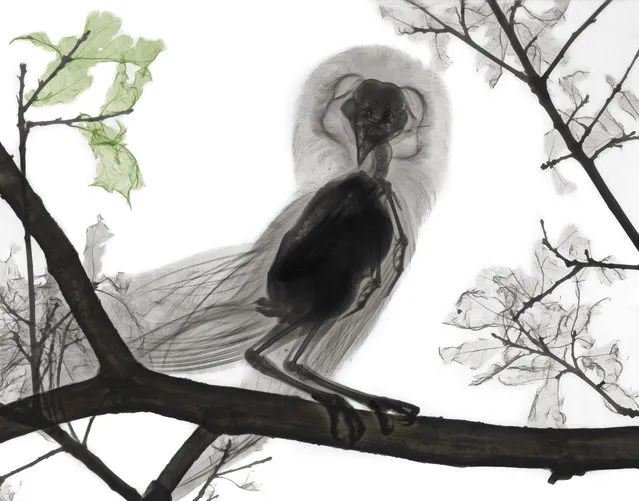
Coloured X-ray of a barn owl. A physicist has used X-ray to create an extraordinary collection of artwork. Arie van't Riets pictures reveal birds, fish, monkeys and flowers in an incredible new light. The 66-year-old, from Bathmen in the Netherlands, began X-raying flowers as a means to teach radiographers and physicians how the machine worked. But after adding a bit of colour to the pictures, the retired medical physicist realised the potential for an exciting new collection of art. (Photo by Arie van't Riet/Barcroft Media)

Coloured X-ray of a barn owl. A physicist has used X-ray to create an extraordinary collection of artwork. Arie van't Riets pictures reveal birds, fish, monkeys and flowers in an incredible new light. The 66-year-old, from Bathmen in the Netherlands, began X-raying flowers as a means to teach radiographers and physicians how the machine worked. But after adding a bit of colour to the pictures, the retired medical physicist realised the potential for an exciting new collection of art. (Photo by Arie van't Riet/Barcroft Media)
Details
08 Jul 2014 13:25:00
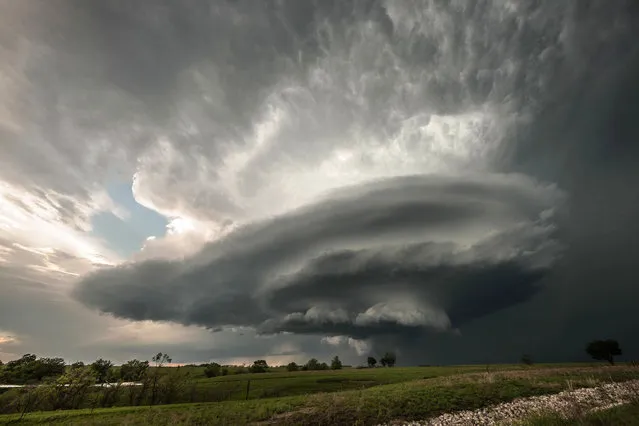
The rotating updraft base of a supercell thunderstorm, and a rear flank downdraft containing rain and hail, backlit by the setting sun, on May 10, 2014, in Climax, Kansas, United States. To most of us, dark clouds on the horizon usually means rain – but here in Kansas, they can also signal the start of a supercell. The huge formations, also known as rotating thunderstorms, are among the most powerful weather phenomenon found over land. (Photo by Stephen Locke/Barcroft Media)

The rotating updraft base of a supercell thunderstorm, and a rear flank downdraft containing rain and hail, backlit by the setting sun, on May 10, 2014, in Climax, Kansas, United States. To most of us, dark clouds on the horizon usually means rain – but here in Kansas, they can also signal the start of a supercell. The huge formations, also known as rotating thunderstorms, are among the most powerful weather phenomenon found over land. They can occur anywhere where the conditions are right, but are normally found in more arid climates. These awe-inspiring supercells were captured south of Climax city by storm chaser Stephen Locke. (Photo by Stephen Locke/Barcroft Media)
Details
18 Jul 2014 12:01:00
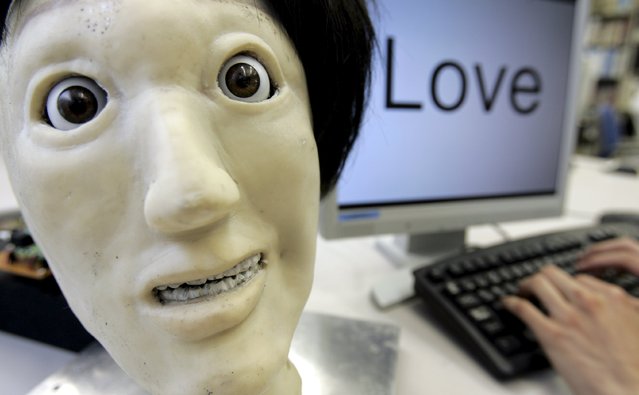
A humanoid robot named Kansei, meaning “sensibility” in Japanese, makes a facial expression depicting “happiness”, next to the word “Love” during a demonstration at a laboratory of Meiji University's Robot and Science Institute in Kawasaki, south of Tokyo in this June 4, 2007 file photo. (Photo by Yuriko Nakao/Reuters)

A humanoid robot named Kansei, meaning “sensibility” in Japanese, makes a facial expression depicting “happiness”, next to the word “Love” during a demonstration at a laboratory of Meiji University's Robot and Science Institute in Kawasaki, south of Tokyo in this June 4, 2007 file photo. Three-fourths of robot installations over the next decade are expected to be concentrated in four areas: transportation equipment, including the automotive sector; computer and electronic products; electrical equipment and machinery. Labor costs have climbed in countries such as China that have been popular for outsourcing production, while technological advances for robots allow them to be more flexible and perform more tasks. (Photo by Yuriko Nakao/Reuters)
Details
17 Apr 2015 09:39:00
Luling, Louisiana US. New evidence contradicts previous claims of the relative safety of glyphosate, the world’s most widely used herbicide, which is manufactured here. It is often used in conjunction with seeds that have been genetically modified to tolerate its application, meaning that anyone consuming these crops is eating a genetically modified plant, and whatever residue of the pesticide that remains. (Photo by J. Henry Fair/Industrial Scars/Papadakis Publisher)

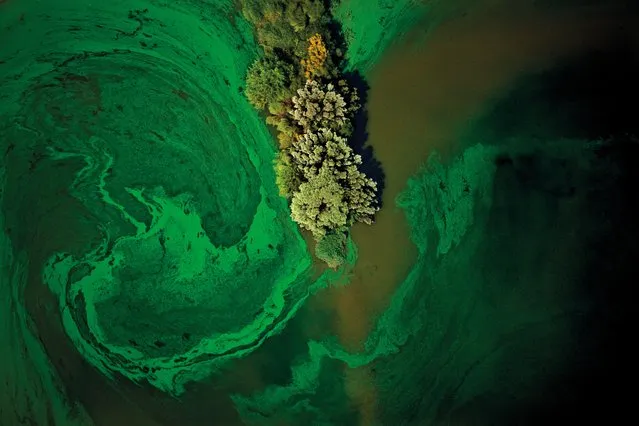
Luling, Louisiana, US. New evidence contradicts previous claims of the relative safety of glyphosate, the world’s most widely used herbicide, which is manufactured here. It is often used in conjunction with seeds that have been genetically modified to tolerate its application, meaning that anyone consuming these crops is eating a genetically modified plant, and whatever residue of the pesticide that remains. (Photo by J. Henry Fair/Industrial Scars/Papadakis Publisher)
Details
25 Oct 2016 10:40:00
Respect, Kronotsky nature reserve, Russia. The photographer’s cat, Ryska – her name means little lynx in Russian – stands outside their cabin and with aggressive posturing warns off a fox. In winter, foxes would regularly visit the cabin searching for food. If one peered in at the window, possible when the snow was deep, Ryska would sit on the other side, fur raised, and growl. When outside, she would hold her ground. The foxes were not always frightened and so encounters could be a sort of dance. (Photo by Igor Shpilenok/Unforgettable Behaviour/NHM)

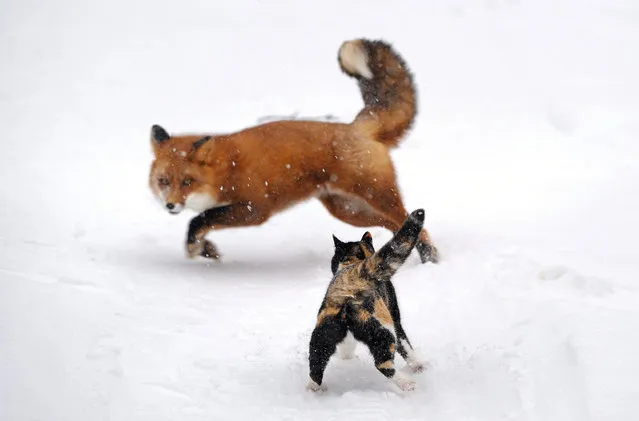
Respect, Kronotsky nature reserve, Russia. The photographer’s cat, Ryska – her name means little lynx in Russian – stands outside their cabin and with aggressive posturing warns off a fox. In winter, foxes would regularly visit the cabin searching for food. If one peered in at the window, possible when the snow was deep, Ryska would sit on the other side, fur raised, and growl. When outside, she would hold her ground. The foxes were not always frightened and so encounters could be a sort of dance. (Photo by Igor Shpilenok/Unforgettable Behaviour/NHM)
Details
08 Apr 2017 09:14:00