Loading...
Done
A child blowing confetti from her hands during a Carnival parade in Cyprus' coastal city of Limassol, Sunday, March 13, 2016. Limassol's long-established parade is Cyprus' biggest and most famous, drawing revelers from across the east Mediterranean island. This year's parade drew huge crowds as people sought lighthearted reprieve from the bailed-out country's recession. The parade marks the start of the 40-day fasting period of Lent in the run-up to the Orthodox Christian Easter. (Photo by Petros Karadjias/AP Photo)

A child blowing confetti from her hands during a Carnival parade in Cyprus' coastal city of Limassol, Sunday, March 13, 2016. Limassol's long-established parade is Cyprus' biggest and most famous, drawing revelers from across the east Mediterranean island. This year's parade drew huge crowds as people sought lighthearted reprieve from the bailed-out country's recession. The parade marks the start of the 40-day fasting period of Lent in the run-up to the Orthodox Christian Easter. (Photo by Petros Karadjias/AP Photo)
Details
14 Mar 2016 10:21:00
People sit near a fully loaded in Madama near the border with Lybia on January 1, 2015. French Defence Minister Jean-Yves Le Drian paid a surprise visit to northern Niger on January 1, to visit a base being built to combat the growing flow of weapons and jihadists from neighbouring Libya. Le Drian travelled from Chad to Madama, a desert outpost about 100 kilometres from Libya, where he saw in the New Year with troops at a French base. (Photo by Dominique Faget/AFP Photo)

People sit near a fully loaded in Madama near the border with Lybia on January 1, 2015. French Defence Minister Jean-Yves Le Drian paid a surprise visit to northern Niger on January 1, to visit a base being built to combat the growing flow of weapons and jihadists from neighbouring Libya. Le Drian travelled from Chad to Madama, a desert outpost about 100 kilometres from Libya, where he saw in the New Year with troops at a French base. Madama is situated on the route used by jihadists and arms smugglers in southern Libya to reach northern Mali and Niger. (Photo by Dominique Faget/AFP Photo)
Details
03 Jan 2015 13:27:00
In this photo taken Thursday, May 7, 2015 photo,  remains of Soviet soldiers killed during World War II lay in a coffin prior to a reburial ceremony at the Sinyavino Heights memorial near the village of Sinyavino, 50 km (31 miles) east of  St. Petersburg, Russia. Hundreds of people came to a World War II battleground outside St. Petersburg this week to bury the remains of 964 Soviet soldiers recovered by volunteer search teams. (Photo by Dmitry Lovetsky/AP Photo)

In this photo taken Thursday, May 7, 2015 photo, remains of Soviet soldiers killed during World War II lay in a coffin prior to a reburial ceremony at the Sinyavino Heights memorial near the village of Sinyavino, 50 km (31 miles) east of St. Petersburg, Russia. Hundreds of people came to a World War II battleground outside St. Petersburg this week to bury the remains of 964 Soviet soldiers recovered by volunteer search teams. Fifty crimson coffins containing skulls and bones were solemnly buried at the Sinyavino Heights memorial as Russian war songs played and an honor guard fired a salute. (Photo by Dmitry Lovetsky/AP Photo)
Details
10 May 2015 11:12:00
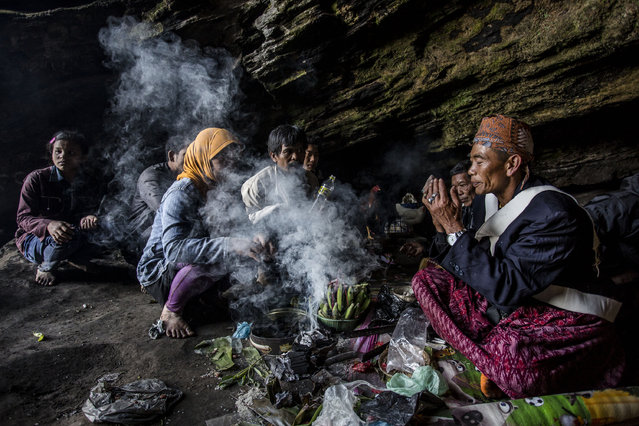
A Tenggerese shaman praying for worshippers at Widodaren cave during the Tenggerese Hindu Yadnya Kasada festival on July 31, 2015 in Probolinggo, East Java, Indonesia. The festival is the main festival of the Tenggerese people and lasts about a month. On the fourteenth day, the Tenggerese make the journey to Mount Bromo to make offerings of rice, fruits, vegetables, flowers and livestock to the mountain gods by throwing them into the volcano's caldera. (Photo by Ulet Ifansasti/Getty Images)

A Tenggerese shaman praying for worshippers at Widodaren cave during the Tenggerese Hindu Yadnya Kasada festival on July 31, 2015 in Probolinggo, East Java, Indonesia. The festival is the main festival of the Tenggerese people and lasts about a month. On the fourteenth day, the Tenggerese make the journey to Mount Bromo to make offerings of rice, fruits, vegetables, flowers and livestock to the mountain gods by throwing them into the volcano's caldera. The origin of the festival lies in the 15th century when a princess named Roro Anteng started the principality of Tengger with her husband Joko Seger, and the childless couple asked the mountain Gods for help in bearing children. The legend says the Gods granted them 24 children but on the provision that the 25th must be tossed into the volcano in sacrifice. The 25th child, Kesuma, was finally sacrificed in this way after initial refusal, and the tradition of throwing sacrifices into the caldera to appease the mountain Gods continues today. (Photo by Ulet Ifansasti/Getty Images)
Details
01 Aug 2015 12:07:00
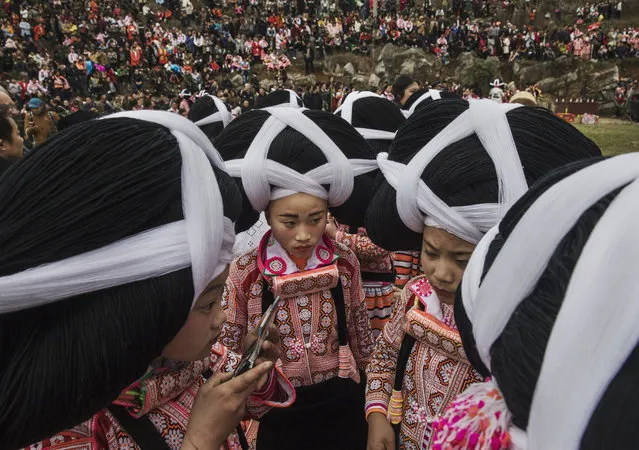
Girls of the Long Horn Miao ethnic minority group wear headdresses as they prepare gather for Tiaohua or Flower Festival as part of the Lunar New Year on February 6, 2017 in Longga village, Guizhou province, southern China. The Long Horn Miao are recognized for their declining practice of wrapping a blend of linen, wool, and the hair of their ancestors around animal horns or a wooden clip to make headdresses. Many young women say they now wear the headdresses only for special occasions and festivals, as the ornaments, which are attached by the horns to their real hair, have proved impractical for modern daily life in a fast changing world. China officially recognizes 56 different ethnic minorities, and statistics show over 7 million Chinese identifying themselves as Miao. But the small Long Horn Miao community counts only around 5000 people living in 12 villages, whose age-old traditions, language, and culture are fading. It is increasingly difficult in a modernizing China, as young people are drawn from remote rural villages to opportunities in bigger cities amongst wide-scale urbanization. Farming and labour remain the mainstays of life for the Long Horn Miao, leaving the area relatively poor in comparison with many parts of China. The government has invested significant amounts into local infrastructure and the tourism industry to try to bolster the local economy. (Photo by Kevin Frayer/Getty Images)

Girls of the Long Horn Miao ethnic minority group wear headdresses as they prepare gather for Tiaohua or Flower Festival as part of the Lunar New Year on February 6, 2017 in Longga village, Guizhou province, southern China. (Photo by Kevin Frayer/Getty Images)
Details
13 Feb 2017 00:01:00
Eryn, owned by Tom Chudleigh in Canada. New global research has revealed that ‘shed-scapism’ is sweeping the world with more people than ever ditching their tools and transforming their sheds into zen dens. The research comes as the Cuprinol Shed of the Year competition joins forces with aspirational shed fan site, Cabin p*rn, to launch the first ever global category. We have a stunning suite of imagery of 9 sheds from across the world - from Norway to Slovenia, British Colombia to Colorado who have all submitted their sheds in the hopes of being crowned the first ever Global Shed of the Year. (Photo by Cuprinol/Rex Features/Shutterstock)

Eryn, owned by Tom Chudleigh in Canada. New global research has revealed that ‘shed-scapism’ is sweeping the world with more people than ever ditching their tools and transforming their sheds into zen dens. The research comes as the Cuprinol Shed of the Year competition joins forces with aspirational shed fan site, Cabin p*rn, to launch the first ever global category. We have a stunning suite of imagery of 9 sheds from across the world - from Norway to Slovenia, British Colombia to Colorado who have all submitted their sheds in the hopes of being crowned the first ever Global Shed of the Year. (Photo by Cuprinol/Rex Features/Shutterstock)
Details
15 Mar 2017 00:02:00
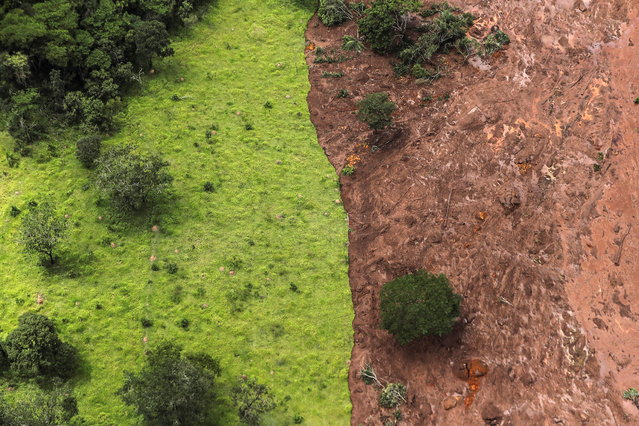
Aerial view over mud and waste from the disaster caused by dam spill in Brumadinho, Minas Gerais, Brazil, 26 January 2019. At least nine people have died and 300 are missing after a tailings dam burst at the Feijao mine in southeastern Brazil owned by Vale, the world's largest iron-ore producer, the Minas Gerais state government said. The dam in Brumadinho near Belo Horizonte broke on 25 January at around mid-day, unleashing a river of sludge that destroyed some nearby houses. (Photo by Antonio Lacerda/EPA/EFE)

Aerial view over mud and waste from the disaster caused by dam spill in Brumadinho, Minas Gerais, Brazil, 26 January 2019. At least nine people have died and 300 are missing after a tailings dam burst at the Feijao mine in southeastern Brazil owned by Vale, the world's largest iron-ore producer, the Minas Gerais state government said. The dam in Brumadinho near Belo Horizonte broke on 25 January at around mid-day, unleashing a river of sludge that destroyed some nearby houses. (Photo by Antonio Lacerda/EPA/EFE)
Details
29 Jan 2019 00:03:00
This photo taken on November 6, 2023 shows people posing for photos next to the statue of “Hachiko” in front of Shibuya station in central Tokyo, ahead of the 100th anniversary of the legendary dog's birth this month. A century since its birth, the tale of the loyal companion who had waited at the Shibuya train station for its master to come home – not knowing he had already died – continues to inspire the public, who have made the statue a singular landmark at a glitzy hub of Tokyo's street culture. (Photo by Richard A. Brooks/AFP Photo)

This photo taken on November 6, 2023 shows people posing for photos next to the statue of “Hachiko” in front of Shibuya station in central Tokyo, ahead of the 100th anniversary of the legendary dog's birth this month. A century since its birth, the tale of the loyal companion who had waited at the Shibuya train station for its master to come home – not knowing he had already died – continues to inspire the public, who have made the statue a singular landmark at a glitzy hub of Tokyo's street culture. (Photo by Richard A. Brooks/AFP Photo)
Details
27 Nov 2023 00:06:00