Loading...
Done
Palestinian barber Ramadan Odwan styles and straightens the hair of a customer with fire at his salon in Rafah, in the southern Gaza Strip February 2, 2017. In Ramadan Odwan's barbershop in Gaza, hair isn't just blow-dried, it's blowtorch-dried. “People have gone crazy about it, many people are curious to go through the experience and they are not afraid”, he told Reuters. “People here love adventures”. Odwan, 37, is not the first stylist in the world to use flame to straighten hair, but his craft is unique in the Gaza Strip. In his salon in the southern Gaza town of Rafah, Odwan applied what he described as a protective liquid coating to a customer's hair – he declined to disclose its contents – before aiming for the head and pressing the button on a small blowtorch. “I control how long I apply fire, I keep it on and off for 10 seconds or 15 seconds. It is completely safe and I have not encountered any accident since I started it two months ago”, Odwan added. Odwan charges 20 shekels ($5.20) for a haircut and fire-straightening. A barber for the past 18 years, he said part of the reason he uses the technique is to show that Palestinian barbers are as “professional as those out there around the world”. (Photo by Ibraheem Abu Mustafa/Reuters)

Palestinian barber Ramadan Odwan styles and straightens the hair of a customer with fire at his salon in Rafah, in the southern Gaza Strip February 2, 2017. In Ramadan Odwan's barbershop in Gaza, hair isn't just blow-dried, it's blowtorch-dried. “People have gone crazy about it, many people are curious to go through the experience and they are not afraid”, he told Reuters. “People here love adventures”. (Photo by Ibraheem Abu Mustafa/Reuters)
Details
11 Feb 2017 00:05:00
Girls of the Long Horn Miao ethnic minority group wear headdresses as they prepare gather for Tiaohua or Flower Festival as part of the Lunar New Year on February 6, 2017 in Longga village, Guizhou province, southern China. The Long Horn Miao are recognized for their declining practice of wrapping a blend of linen, wool, and the hair of their ancestors around animal horns or a wooden clip to make headdresses. Many young women say they now wear the headdresses only for special occasions and festivals, as the ornaments, which are attached by the horns to their real hair, have proved impractical for modern daily life in a fast changing world. China officially recognizes 56 different ethnic minorities, and statistics show over 7 million Chinese identifying themselves as Miao. But the small Long Horn Miao community counts only around 5000 people living in 12 villages, whose age-old traditions, language, and culture are fading. It is increasingly difficult in a modernizing China, as young people are drawn from remote rural villages to opportunities in bigger cities amongst wide-scale urbanization. Farming and labour remain the mainstays of life for the Long Horn Miao, leaving the area relatively poor in comparison with many parts of China. The government has invested significant amounts into local infrastructure and the tourism industry to try to bolster the local economy. (Photo by Kevin Frayer/Getty Images)

Girls of the Long Horn Miao ethnic minority group wear headdresses as they prepare gather for Tiaohua or Flower Festival as part of the Lunar New Year on February 6, 2017 in Longga village, Guizhou province, southern China. (Photo by Kevin Frayer/Getty Images)
Details
13 Feb 2017 00:01:00
Suffering from a broken nose and bruised ribs Natasha Dzhuley, 16, relaxes after inhaling glue for the first time – something she swore she would never do, 2002. She was beaten by her pimps men in what Ruslana believes was a warning to other prostitutes to stay in line. Though another child believes her pimp had her beaten because she was pregnant. Less than a week after this picture of Natasha was taken she was dragged away by six men. She has not been heard or seen since. (Photo by Kurt Vinion /Getty Images)

Suffering from a broken nose and bruised ribs Natasha Dzhuley, 16, relaxes after inhaling glue for the first time – something she swore she would never do, 2002. She was beaten by her pimps men in what Ruslana believes was a warning to other prostitutes to stay in line. Though another child believes her pimp had her beaten because she was pregnant. Less than a week after this picture of Natasha was taken she was dragged away by six men. She has not been heard or seen since. (Photo by Kurt Vinion /Getty Images)
Details
18 Feb 2017 00:05:00
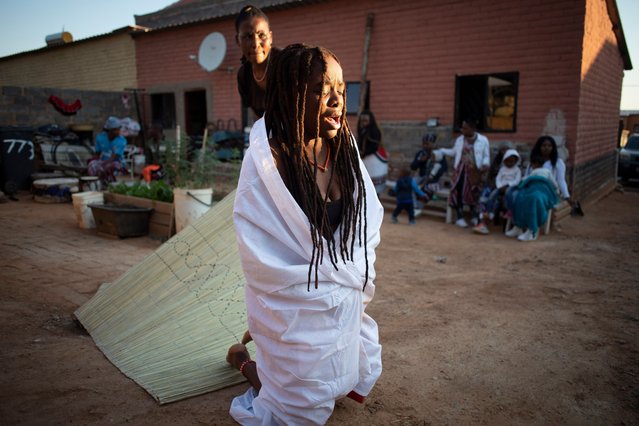
“Sangoma” initiate Dipuo Banda (C) is led out of her teachers shack while she remains in a trance like state prior to dancing during her 3 day initiation ceremony with her teacher, family, friends and students in the Alexandra Township in Johannesburg, South Africa, 14 May 2021. Sangomas, the Zulu term for Medicine Women or traditional healers, fulfill different social and political roles in the community, including divination, physical healing, emotional and spiritual illnesses, directing birth or death rituals and finding lost cattle. (Photo by Kim Ludbrook/EPA/EFE)

“Sangoma” initiate Dipuo Banda (C) is led out of her teachers shack while she remains in a trance like state prior to dancing during her 3 day initiation ceremony with her teacher, family, friends and students in the Alexandra Township in Johannesburg, South Africa, 14 May 2021. Sangomas, the Zulu term for Medicine Women or traditional healers, fulfill different social and political roles in the community, including divination, physical healing, emotional and spiritual illnesses, directing birth or death rituals and finding lost cattle. (Photo by Kim Ludbrook/EPA/EFE)
Details
28 May 2021 08:13:00
A disabled child is buried up to his neck in sand during the partial solar eclipse in belief its rays can heal, in Karachi, Pakistan, 25 October 202. A partial solar eclipse occurs when a portion of the Earth is engulfed by the shadow (penumbra) cast by the Moon as it passes between our planet and the Sun in imperfect alignment. During this eclipse - the first of the decade – the Moon appears to cover the Sun, leaving the Sun's halo as a visible rim forming an annulus, popularly known as the 'ring of fire. (Photo by Shahzaib Akber/EPA/EFE/Rex Features/Shutterstock)

A disabled child is buried up to his neck in sand during the partial solar eclipse in belief its rays can heal, in Karachi, Pakistan, 25 October 202. A partial solar eclipse occurs when a portion of the Earth is engulfed by the shadow (penumbra) cast by the Moon as it passes between our planet and the Sun in imperfect alignment. During this eclipse - the first of the decade – the Moon appears to cover the Sun, leaving the Sun's halo as a visible rim forming an annulus, popularly known as the 'ring of fire. (Photo by Shahzaib Akber/EPA/EFE/Rex Features/Shutterstock)
Details
09 Nov 2022 05:24:00
Performers Aidee Arely Ramirez Arellano (left) and Viridiana Mayte Arica Rico from Banda Monumental De Mexico who are part of this year's Royal Edinburgh Military Tattoo cast, display their Monarch butterfly costumes in Princes Street Gardens, Edinburgh on Thursday, August 25, 2022, ahead of the final weekend of this year's show, Voices. The butterfly costumes are a tribute to the Duke of Edinburgh and the Queen's Platinum Jubilee, inspired by an image of the Duke of Edinburgh watching the butterflies migration during a trip he attended to support conservation of the species. (Photo by Jane Barlow/PA Wire)

Performers Aidee Arely Ramirez Arellano (left) and Viridiana Mayte Arica Rico from Banda Monumental De Mexico who are part of this year's Royal Edinburgh Military Tattoo cast, display their Monarch butterfly costumes in Princes Street Gardens, Edinburgh on Thursday, August 25, 2022, ahead of the final weekend of this year's show, Voices. The butterfly costumes are a tribute to the Duke of Edinburgh and the Queen's Platinum Jubilee, inspired by an image of the Duke of Edinburgh watching the butterflies migration during a trip he attended to support conservation of the species. (Photo by Jane Barlow/PA Wire)
Details
25 Nov 2023 03:23:00
Balinese Hindu people take part in a cleansing ceremony called 'Melasti', in Denpasar, Bali, Indonesia, 25 March 2025. Melasti is a purification ritual where Balinese Hindus cleanse themselves and their sacred objects in the ocean to purify and renew spiritually, symbolizing the washing away of impurities and starting anew. It typically precedes Nyepi, the Day of Silence, marking the Balinese New Year. Balinese will celebrate Nyepi Day on 29 March 2025, during which Hindus on the island of Bali are not allowed to travel, work, light lamps, cook, or do any other activities. (Photo by Made Nagi/EPA)

Balinese Hindu people take part in a cleansing ceremony called “Melasti”, in Denpasar, Bali, Indonesia, 25 March 2025. Melasti is a purification ritual where Balinese Hindus cleanse themselves and their sacred objects in the ocean to purify and renew spiritually, symbolizing the washing away of impurities and starting anew. It typically precedes Nyepi, the Day of Silence, marking the Balinese New Year. Balinese will celebrate Nyepi Day on 29 March 2025, during which Hindus on the island of Bali are not allowed to travel, work, light lamps, cook, or do any other activities. (Photo by Made Nagi/EPA)
Details
07 Apr 2025 02:47:00
People use large water guns to spray each other as they celebrate the annual Songkran festival in Bangkok, Thailand on April 14, 2025. Thailand celebrated the Thai traditional New Year, called Songkran in Thai and also known as ëthe water festivalí, on 13 April, with festivities going on on throughout the weekend. During Songkran, people celebrate the New Year by splashing water to each other as a sign of washing away sins and bad luck from the previous year. People across Thailand celebrate the New Year with parties and water related activities throughout the weekend. (Photo by Diego Azubel/Matrix Images)

People use large water guns to spray each other as they celebrate the annual Songkran festival in Bangkok, Thailand on April 14, 2025. Thailand celebrated the Thai traditional New Year, called Songkran in Thai and also known as ëthe water festivalí, on 13 April, with festivities going on on throughout the weekend. During Songkran, people celebrate the New Year by splashing water to each other as a sign of washing away sins and bad luck from the previous year. People across Thailand celebrate the New Year with parties and water related activities throughout the weekend. (Photo by Diego Azubel/Matrix Images)
Details
19 Jul 2025 02:24:00