Loading...
Done
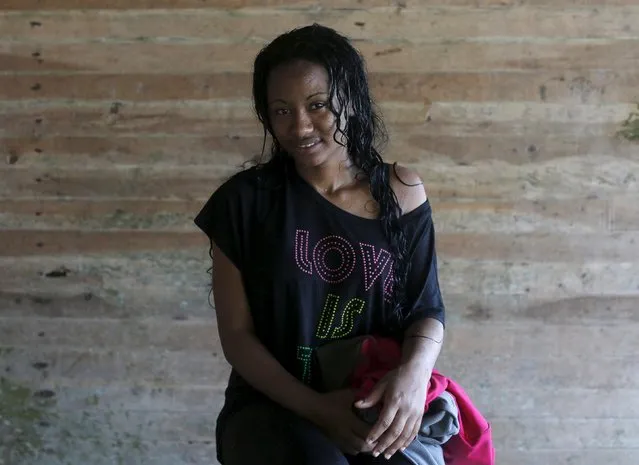
Cuban Daymara A., 20, poses for a photograph after she crossed the border from Colombia through the jungle into La Miel, in the province of Guna Yala, Panama December 2, 2015.  According to local authorities in La Miel, some 100 to 150 Cubans have been entering Panama from Colombia every day for the last three months. Scores of Cubans have come to Panama as they seek overland passage towards the United States fearing a recent detente between Washington and Havana could end their preferential treatment. (Photo by Carlos Jasso/Reuters)

Cuban Daymara A., 20, poses for a photograph after she crossed the border from Colombia through the jungle into La Miel, in the province of Guna Yala, Panama December 2, 2015. According to local authorities in La Miel, some 100 to 150 Cubans have been entering Panama from Colombia every day for the last three months. Scores of Cubans have come to Panama as they seek overland passage towards the United States fearing a recent detente between Washington and Havana could end their preferential treatment. (Photo by Carlos Jasso/Reuters)
Details
05 Dec 2015 08:00:00
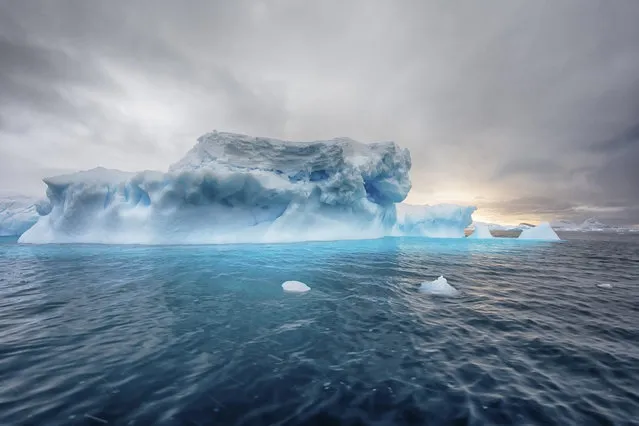
A serene turquoise glow glimmers from underneath these powerful icebergs. Stood in the middle of Antarctica, the giant icebergs appear to be from an unearthly world. These stunning photographs were captured by American photographer Michael Leggero. “My images show pure nature, as that is how I describe Antarctica, simply pure nature”, says the 43 year old, of Carthage, New York. “It is the only place on our planet that humans have not left a presence behind”. (Photo by Michael Leggero/Hotspotmedia/Visual Press Agency)

A serene turquoise glow glimmers from underneath these powerful icebergs. Stood in the middle of Antarctica, the giant icebergs appear to be from an unearthly world. These stunning photographs were captured by American photographer Michael Leggero. “My images show pure nature, as that is how I describe Antarctica, simply pure nature”, says the 43 year old, of Carthage, New York. “It is the only place on our planet that humans have not left a presence behind”. (Photo by Michael Leggero/Hotspotmedia/Visual Press Agency)
Details
07 Aug 2014 10:32:00
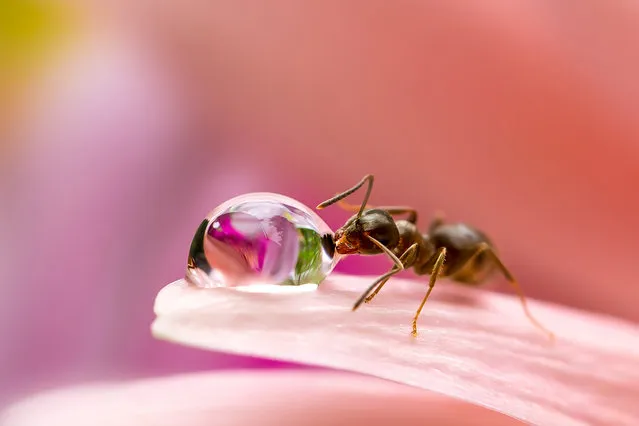
A macro view of an ant taking a sip from a water droplet on the edge of a flower in Obihiro, Japan. Animal-Lover Miki Asai has gone a step beyond feeding bread to the ducks – by syringe-feeding water to tiny ants. The office worker from Obihiro City, Japan, squirts droplets near the tiny insects and then uses a macro lens to capture quenching their thirst. The amateur photographer started capturing these images near her house in July 2013 after spotting an ant struggling in the rain. (Photo by Miki Asai/Barcroft Media)

A macro view of an ant taking a sip from a water droplet on the edge of a flower in Obihiro, Japan. Animal-Lover Miki Asai has gone a step beyond feeding bread to the ducks – by syringe-feeding water to tiny ants. The office worker from Obihiro City, Japan, squirts droplets near the tiny insects and then uses a macro lens to capture quenching their thirst. The amateur photographer started capturing these images near her house in July 2013 after spotting an ant struggling in the rain. (Photo by Miki Asai/Barcroft Media)
Details
09 Sep 2014 08:34:00
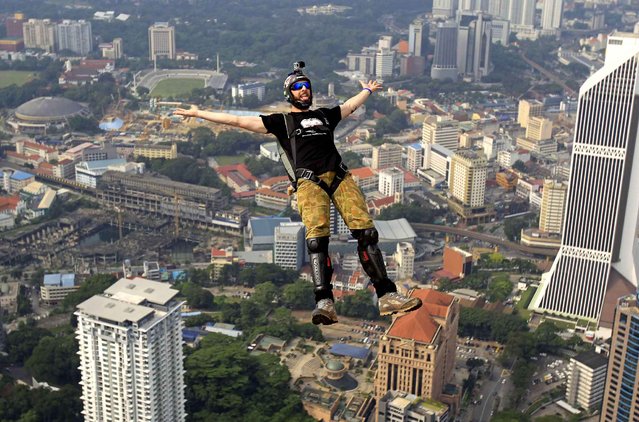
BASE jumper Luke Denniss of Australia gestures as he dives in the air from the Kuala Lumpur Tower during the KL Tower International Jump in Kuala Lumpur, Malaysia, Saturday, September 27, 2014. BASE stands for the places such jumpers usually jump from: buildings, antennas, spans (bridges) and earth (cliffs). (Photo by Lai Seng Sin/AP Photo)

BASE jumper Luke Denniss of Australia gestures as he dives in the air from the Kuala Lumpur Tower during the KL Tower International Jump in Kuala Lumpur, Malaysia, Saturday, September 27, 2014. BASE stands for the places such jumpers usually jump from: buildings, antennas, spans (bridges) and earth (cliffs). (Photo by Lai Seng Sin/AP Photo)
Details
27 Sep 2014 12:12:00
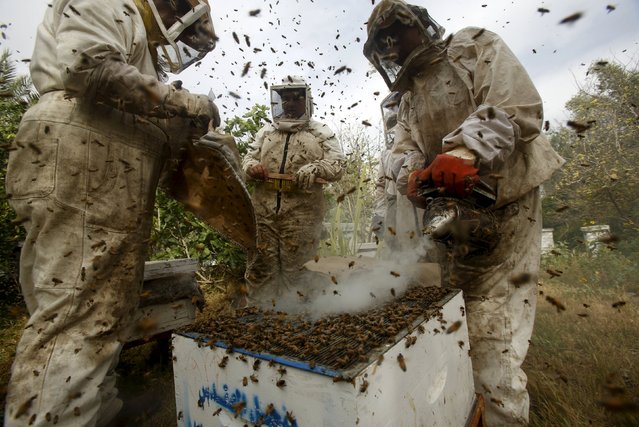
A Palestinian beekeeper uses smoke to calm bees in the process of collecting honey at a farm in Rafah, in the southern Gaza Strip April 11, 2016. (Photo by Suhaib Salem/Reuters)

A Palestinian beekeeper uses smoke to calm bees in the process of collecting honey at a farm in Rafah, in the southern Gaza Strip April 11, 2016. Rateb Samour sees 250 patients a day, whose complaints range from hair loss to cerebral palsy and cancer. He is not a doctor and has never worked in a hospital. Samour inherited the skill of bee-sting therapy from his father. From 2003 the agricultural engineer dedicated all his time to study and develop the alternative-medicine treatment of apitherapy, which uses bee-related products from honey, propolis – or bee glue used to build hives – to venom. (Photo by Suhaib Salem/Reuters)
Details
13 Apr 2016 09:14:00
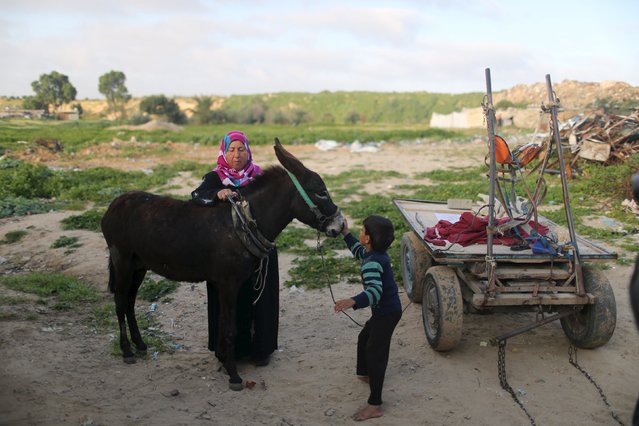
Palestinian woman Jihan Abu Muhsen prepares her donkey with her son Kareem before going work collecting bricks for sale from sites of demolished buildings, at her dwelling in Khan Younis in the southern Gaza Strip March 8, 2016. Abu Muhsen gathers bricks from the sites of demolished buildings and sells them to recycling factories. She earns around 20 shekels ($5) a day and her 10-year-old son Mohammad helps her when he is not at school. (Photo by Ibraheem Abu Mustafa/Reuters)

Palestinian woman Jihan Abu Muhsen prepares her donkey with her son Kareem before going work collecting bricks for sale from sites of demolished buildings, at her dwelling in Khan Younis in the southern Gaza Strip March 8, 2016. Abu Muhsen gathers bricks from the sites of demolished buildings and sells them to recycling factories. She earns around 20 shekels ($5) a day and her 10-year-old son Mohammad helps her when he is not at school. (Photo by Ibraheem Abu Mustafa/Reuters)
Details
19 Apr 2016 13:32:00
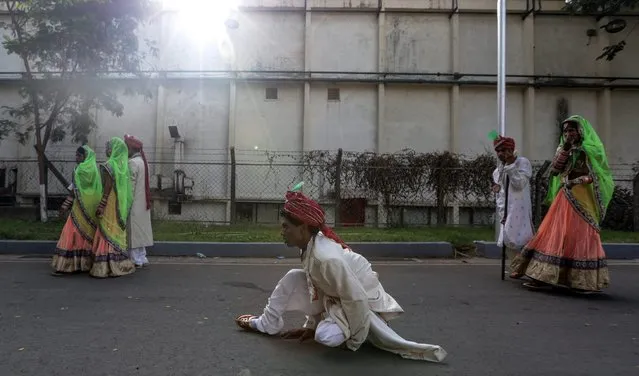
Indian underprivileged and specially abled grooms and brides in traditional marriage attire arrives to take part in a mass marriage ceremony in Mumbai, India, 29 May 2016. Around 51 couples got married during the ceremony which was organized by Narayan Seva Sansthan, for the underprivileged and specially abled people. From this 51 couples, both the partners are physically disabled in 22 couples, one partner is physically disabled in seven couples and 22 couples are from underprivileged circumstances. (Photo by Divyakant Solanki/EPA)

Indian underprivileged and specially abled grooms and brides in traditional marriage attire arrives to take part in a mass marriage ceremony in Mumbai, India, 29 May 2016. Around 51 couples got married during the ceremony which was organized by Narayan Seva Sansthan, for the underprivileged and specially abled people. From this 51 couples, both the partners are physically disabled in 22 couples, one partner is physically disabled in seven couples and 22 couples are from underprivileged circumstances. (Photo by Divyakant Solanki/EPA)
Details
31 May 2016 11:48:00
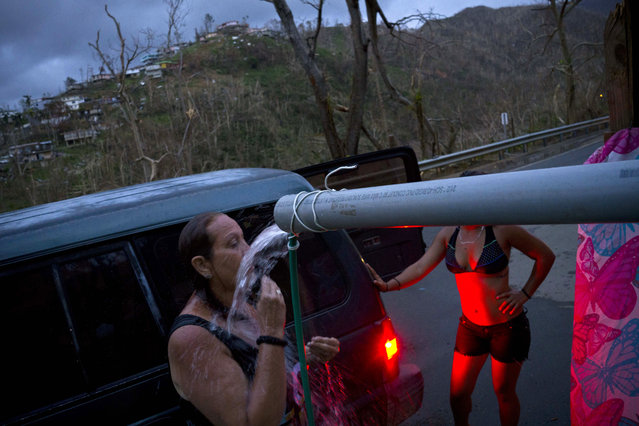
People affected by Hurricane Maria bathe in water piped from a creek in the mountains, in Naranjito, Puerto Rico, Thursday, September 28, 2017. Residents of the area drive to the pipes to bathe because they were left without water supplies by the damage caused by Hurricane Maria. The pipe was set up by a neighbor who ran it from a creek in his property to the side of the road in order to help those left without water. (Photo by Ramon Espinosa/AP Photo)

People affected by Hurricane Maria bathe in water piped from a creek in the mountains, in Naranjito, Puerto Rico, Thursday, September 28, 2017. Residents of the area drive to the pipes to bathe because they were left without water supplies by the damage caused by Hurricane Maria. The pipe was set up by a neighbor who ran it from a creek in his property to the side of the road in order to help those left without water. (Photo by Ramon Espinosa/AP Photo)
Details
29 Sep 2017 07:45:00