Loading...
Done
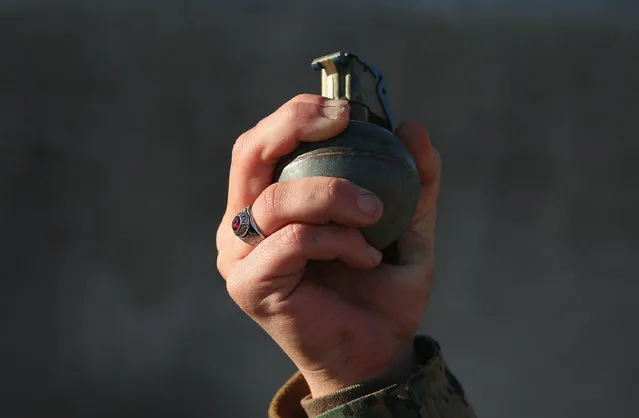
A female Marine prepares to throw a practice grenade during Marine Combat Training (MCT) on February 21, 2013 at Camp Lejeune, North Carolina.  Since 1988 all non-infantry enlisted male Marines have been required to complete 29 days of basic combat skills training at MCT after graduating from boot camp. MCT has been required for all enlisted female Marines since 1997. About six percent of enlisted Marines are female.  (Photo by Scott Olson)

A female Marine prepares to throw a practice grenade during Marine Combat Training (MCT) on February 21, 2013 at Camp Lejeune, North Carolina. Since 1988 all non-infantry enlisted male Marines have been required to complete 29 days of basic combat skills training at MCT after graduating from boot camp. MCT has been required for all enlisted female Marines since 1997. About six percent of enlisted Marines are female. (Photo by Scott Olson)
Details
22 Feb 2013 11:34:00
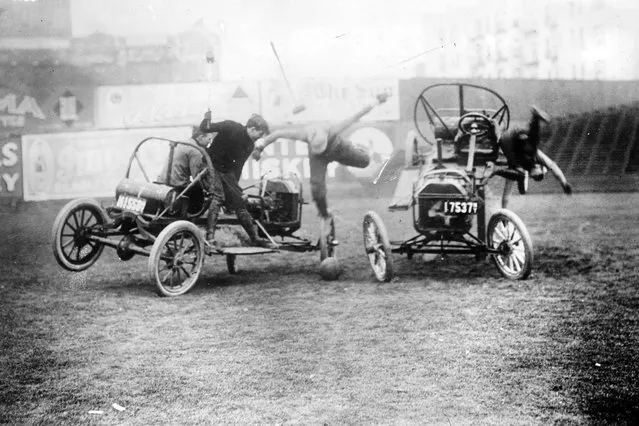
Auto polo, Coney Isl. Between ca. 1910 and ca. 1915. (Photo by George Grantham Bain Collection)

“Automobile polo or Auto polo was a motorsport invented in the United States with rules and equipment similar to equestrian polo but using automobiles instead of horses. The sport was popular at fairs, exhibitions and sports venues across the United States and several areas in Europe from 1911 until the late 1920s; but it was dangerous and carried the risk of injury and death to the participants and spectators”. – Wikipedia. Photo: Auto polo, Coney Isl., between ca. 1910 and ca. 1915. (Photo by George Grantham Bain Collection)

P.S. All pictures are presented in high resolution. To see Hi-Res images – just TWICE click on any picture. In other words, click small picture – opens the BIG picture. Click BIG picture – opens VERY BIG picture (if available; this principle works anywhere on the site AvaxNews).
Details
01 Mar 2013 13:23:00
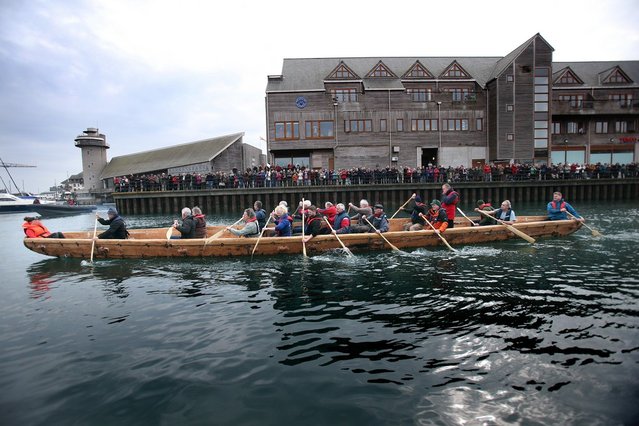
Crew in Britain's first ever full-size reconstructed sea-going Bronze Age boat, paddle out to sea near to the National Maritime Museum as it makes its maiden voyage on March 6, 2013 in Falmouth, England. With a crew of of 18, equipped with Bronze-Age-style wooden paddles, the 15 metre long experimental vessel – a replica of the sort of craft used for long-distance trade between Britain and the continent 4000 years ago – will be used to test prehistoric seafaring methods in a project in collaboration with the University of Exeter and the Falmouth-based National Maritime Museum Cornwall. (Photo by Matt Cardy)

Crew in Britain's first ever full-size reconstructed sea-going Bronze Age boat, paddle out to sea near to the National Maritime Museum as it makes its maiden voyage on March 6, 2013 in Falmouth, England. (Photo by Matt Cardy)
Details
07 Mar 2013 08:48:00
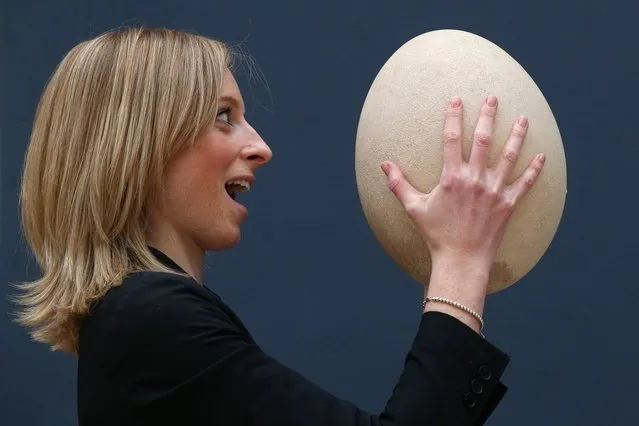
An employee at Christie's auction house examines a complete sub-fossilised elephant bird egg on March 27, 2013 in London, England. The elephant bird egg is expected to fetch 30,000 GBP when it features in Christie's “Travel, Science and Natural History” sale, which is to be held on April 24, 2013 in London.  (Photo by Oli Scarff)

An employee at Christie's auction house examines a complete sub-fossilised elephant bird egg on March 27, 2013 in London, England. The elephant bird egg is expected to fetch 30,000 GBP when it features in Christie's “Travel, Science and Natural History” sale, which is to be held on April 24, 2013 in London. (Photo by Oli Scarff)
Details
28 Mar 2013 12:16:00
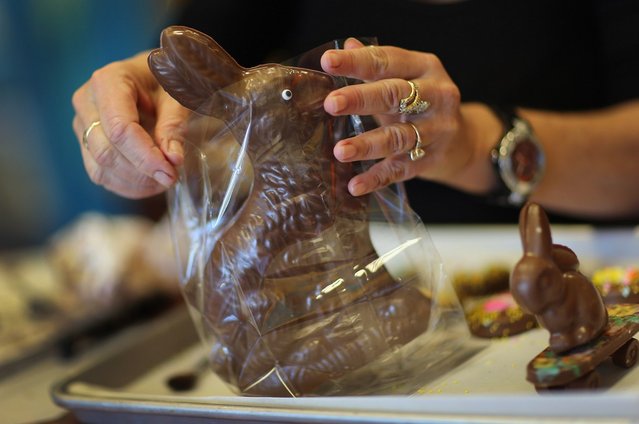
Darlene Eddy packages up a chocolate Easter bunny that she made in her store Amazing Chocolates on March 28, 2013 in Hollywood, Florida. As Easter Sunday approaches chocolatiers are busy manufacturing many different types of delights for the holiday when Americans spend roughly $1.9 billion on Easter candy, second only to Halloween in candy consumption. Around ninety million chocolate Easter bunnies are produced each year, from white to dark chocolate, and with an unlimited varieties of styles. (Photo by Joe Raedle)

Darlene Eddy packages up a chocolate Easter bunny that she made in her store Amazing Chocolates on March 28, 2013 in Hollywood, Florida. As Easter Sunday approaches chocolatiers are busy manufacturing many different types of delights for the holiday when Americans spend roughly $1.9 billion on Easter candy, second only to Halloween in candy consumption. Around ninety million chocolate Easter bunnies are produced each year, from white to dark chocolate, and with an unlimited varieties of styles. (Photo by Joe Raedle)
Details
29 Mar 2013 12:39:00
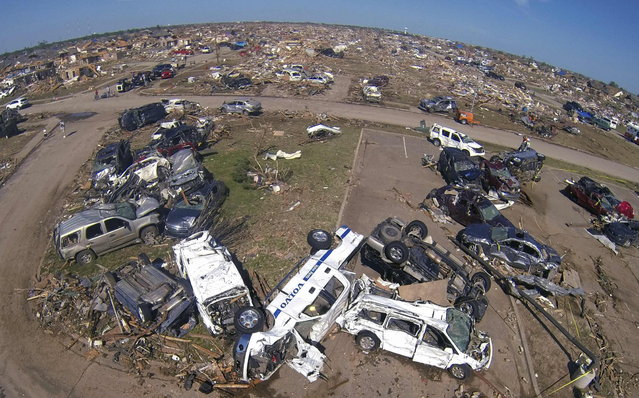
A pile of destroyed cars of teachers sits outside Briarwood elementary school in Oklahoma City, Oklahoma May 22, 2013.  Rescue workers with sniffer dogs picked through the ruins on Wednesday to ensure no survivors remained buried after a deadly tornado left thousands homeless and trying to salvage what was left of their belongings. Curvature of horizon in the photo is due to an ultra-wide angle lens. (Photo by Rick Wilking/Reuters)

A pile of destroyed cars of teachers sits outside Briarwood elementary school in Oklahoma City, Oklahoma May 22, 2013. Rescue workers with sniffer dogs picked through the ruins on Wednesday to ensure no survivors remained buried after a deadly tornado left thousands homeless and trying to salvage what was left of their belongings. Curvature of horizon in the photo is due to an ultra-wide angle lens. (Photo by Rick Wilking/Reuters)
Details
24 May 2013 06:58:00
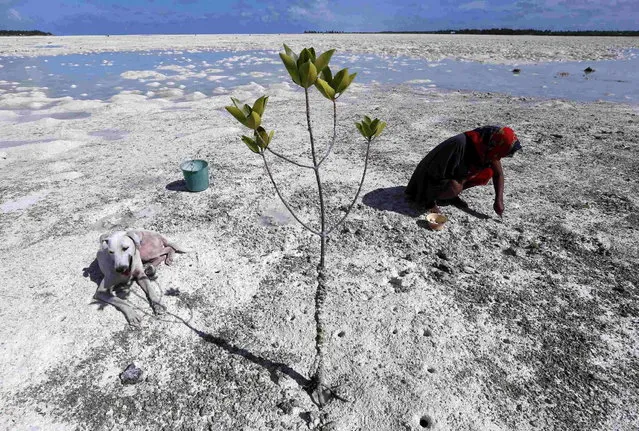
A dog sits in the shade of a mangrove tree as a woman uses a fork to dig for shellfish on the reef-mud flats of a lagoon located at South Tarawa in the central Pacific island nation of Kiribati May 23, 2013. (Photo by David Gray/Reuters)

A dog sits in the shade of a mangrove tree as a woman uses a fork to dig for shellfish on the reef-mud flats of a lagoon located at South Tarawa in the central Pacific island nation of Kiribati May 23, 2013. Kiribati consists of a chain of 33 atolls and islands that stand just metres above sea level, spread over a huge expanse of otherwise empty ocean. With surrounding sea levels rising, Kiribati President Anote Tong has predicted his country will likely become uninhabitable in 30-60 years because of inundation and contamination of its freshwater supplies. (Photo by David Gray/Reuters)
Details
13 Jun 2013 09:23:00
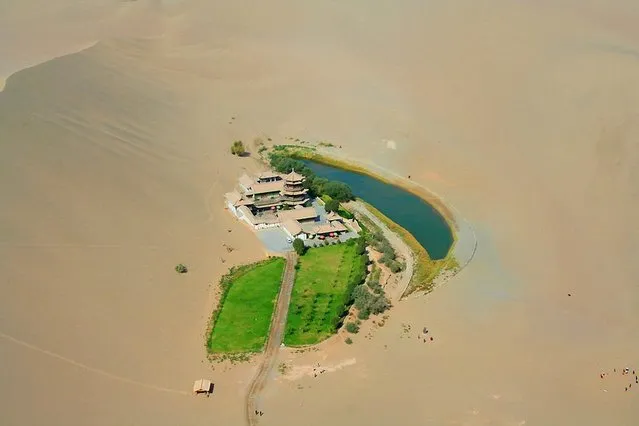
Crescent Lake In China

Yueyaquan is a crescent-shaped lake in an oasis, 6 km south of the city of Dunhuang in Gansu Province, China. It was named Yueyaquan in the Qing Dynasty. According to measurements made in 1960, the average depth of the lake was 4 to 5 meters, with a maximum depth of 7.5 metres In the following 40 years, the depth of the lake continually declined. In the early 1990s, its area had shrunk to only 5,500 m2 with an average depth of 0.9 meter (maximum 1.3 meter). In 2006, the local government with help of the central government started to fill the lake and restore its depth; its depth and size have been growing yearly since then. The lake and the surrounding deserts are very popular with tourists, who are offered camel and 4x4 rides.
Details
25 Jun 2013 10:29:00