Loading...
Done


“Kumbh Mela is a mass Hindu pilgrimage in which Hindus gather at the Ganges river. The normal Kumbh Mela is celebrated every 3 years, the Ardh (half) Kumbh Mela is celebrated every six years at Haridwar and Prayag, the Purna (complete) Kumbh takes place every twelve years, at four places (Prayag (Allahabad), Haridwar, Ujjain, and Nashik). The Maha (great) Kumbh Mela which comes after 12 “Purna Kumbh Melas”, or 144 years, is held at Allahabad.

The last Ardh Kumbh Mela was held over a period of 45 days beginning in January 2007, more than 70 million Hindu pilgrims took part in the Ardh Kumbh Mela at Prayag, and on January 15, the most auspicious day of the festival of Makar Sankranti, more than 5 million participated. The previous Maha Kumbh Mela, held in 2001, was attended by around 60 million people, making it at the time the largest gathering anywhere in the world in recorded history”. – Wikipedia

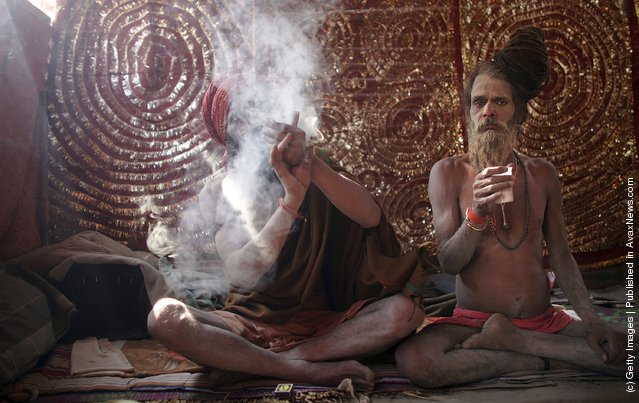
Photo: Sadhus (holy men) smoke at their camp near the ritual site at Sangam, the confluence of the Ganges, Yamuna and mythical Saraswati rivers during the Ardh Kumbh Mela festival (Half Pitcher festival) January 18, 2007 in Allahabad, India. Millions of Hindu pilgrims have flocked to the largest religious gathering in the world which lasts for 45 days in northern India. The festival commemorates the mythical conflict between gods and demons over a pitcher filled with the “nectar of immortality”. Devotees believe that taking a holy dip in the Ganges at this time washes away their sins and paves the path to salvation. (Photo by Mario Tama/Getty Images)
Details
30 Jun 2011 10:27:00

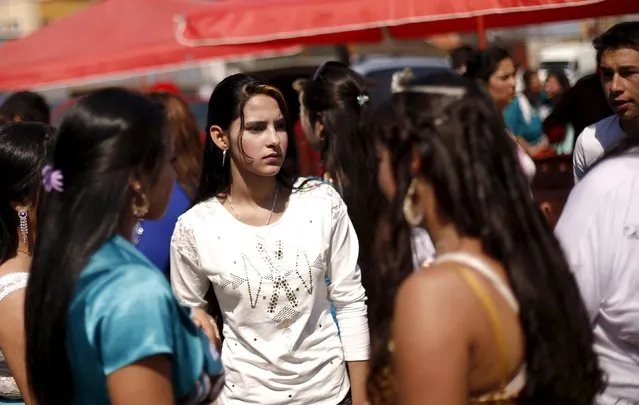
Bulgarian Roma women from the close-knit Kalaidjii clan attend a so-called “bride fair” in a suburb of the city of Plovdiv April 13, 2015. (Photo by Stoyan Nenov/Reuters)

Bulgarian Roma women from the close-knit Kalaidjii clan attend a so-called “bride fair” in a suburb of the city of Plovdiv April 13, 2015. Each year Roma families from the close-knit Kalaidjii clan gather during what they call a “bride fair”, an event offering parents a chance to meet and to arrange marriages for their children. (Photo by Stoyan Nenov/Reuters)
Details
14 Apr 2015 10:59:00
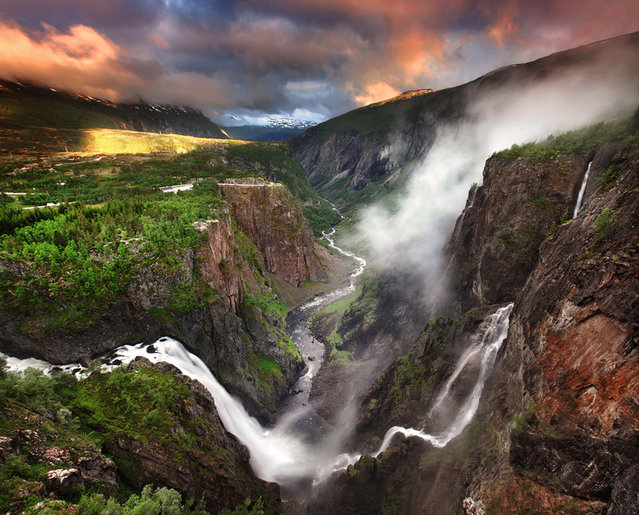
Voringfossen Waterfall In Norway

Vøringfossen is the 83rd highest waterfall in Norway on the basis of total fall. It lies at the top of Måbødalen in the municipality of Eidfjord, in Hordaland, not far from Highway 7, which connects Oslo with Bergen. It has a total drop of 182 meters, and a major drop of 163 meters. It is perhaps the most famous in the country and a major tourist attraction on the way down from Hardangervidda to Hardangerfjord. The name Vøringfossen (Old Norse Vyrðingr) is derived from the verb vyrða (English: esteem, revere). The last element fossen, the finite form of foss (waterfall), is a later addition.
Details
02 Dec 2013 10:58:00
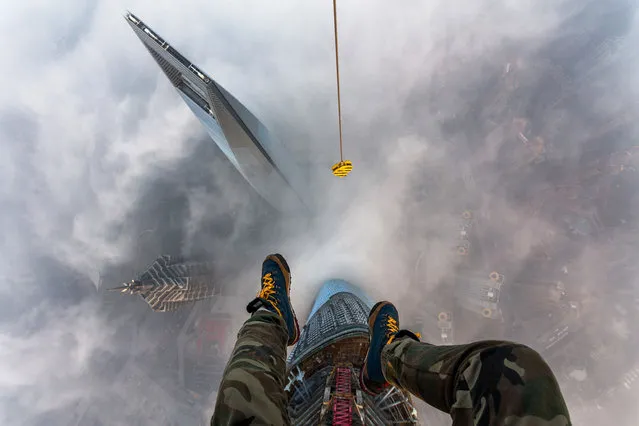
Vitaly Raskalov's feet dangle from the top of the Shanghai Tower, high above the Shanghai World Financial Centre. (Photo by Vitaly Raskalov/Caters News Agency)

China’s new tallest building has received unexpected publicity thanks to Russian free climbers Vadim Makhorov and Vitaly Raskalov. The pair took two hours to climb 650 metres up the unfinished Shanghai Tower. They did not use safety equipment on their ascent to the top of a crane attached to the tower, from where they took these extraordinary pictures of Shanghai. Photo: Vitaly Raskalov's feet dangle from the top of the Shanghai Tower, high above the Shanghai World Financial Centre. (Photo by Vitaly Raskalov/Caters News Agency)
Details
18 Feb 2014 14:47:00
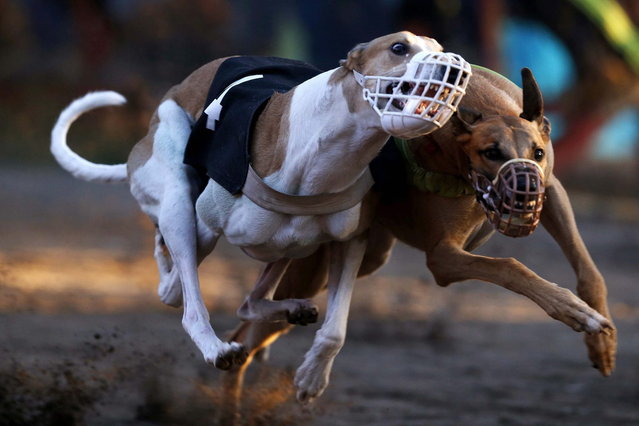
Greyhounds compete during a race at Santiago city, March 8, 2014. (Photo by Ivan Alvarado/Reuters)

Greyhounds compete during a race at Santiago city, March 8, 2014. With over 100 years of history, greyhound racing attracts people mainly from rural areas of Santiago every weekend. Some dogs come from Argentina, the United States and Ireland and can develop a speed of up to 80 kilometers per hour on a straight running track of about 200 meters, according to organisers. Bets range from $2 to $1,000 per race, offering a livelihood for breeders and gamblers. (Photo by Ivan Alvarado/Reuters)
Details
02 Apr 2014 09:02:00
Kinetic Masterpieces By Anthony Howe (Video)

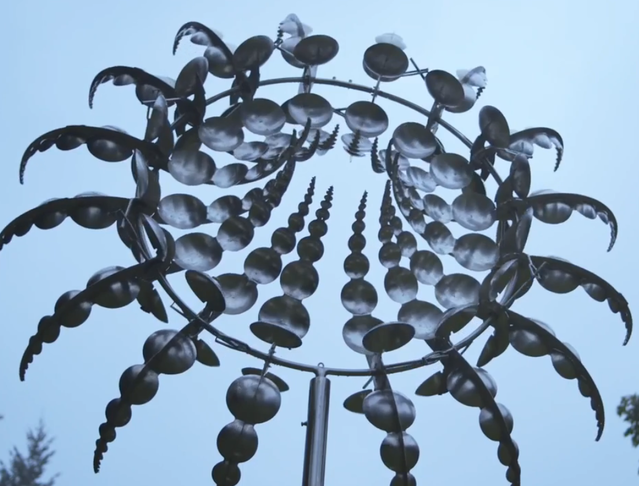
The kinetic sculptures created by Anthony Howe are nothing short of a miracle. You simply cannot wrap your mind around the fact that these creations are real. The magic comes from the fact that all the creations of Anthony Howe were first digitally modeled and only then wrought from metal. The resulting pieces of art are mystifying, entrancing, and sometimes even terrifying. For example, one of the earlier creations of Howe is an installation called “About Face”. It is a human face, pieces of which move from side to side, even if there is just a gentle breeze. However, most of his creations are mesmerizing, capturing your mind, as you marvel at their intricacy.
Details
28 Nov 2014 12:04:00
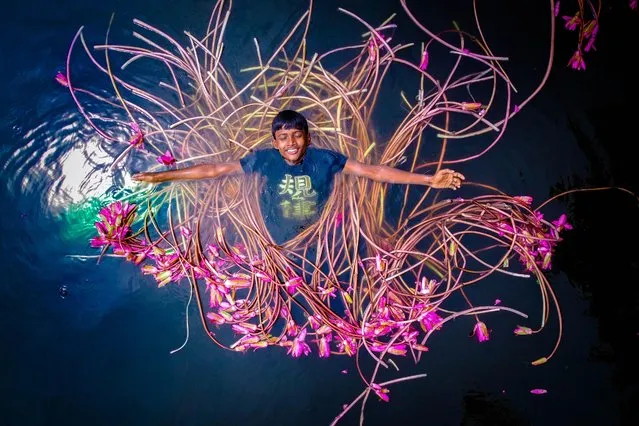
A village boy from Satla Village, Barishal swimmimg with water lilies in a canal near Barishal, Bangladesh on August 17, 2021. (Photo by Mustasinur Rahman Alvi/Eyepix Group/Pacific Press/Rex Features/Shutterstock)

A village boy from Satla Village, Barishal swimmimg with water lilies in a canal near Barishal, Bangladesh on August 17, 2021. Every bright pink blooms is hand-picked and collected carefully by farmers to distribute in the local markets during a annual period. The flowers bloom during of the seasonal flood starting from August to November. (Photo by Mustasinur Rahman Alvi/Eyepix Group/Pacific Press/Rex Features/Shutterstock)
Details
17 Sep 2021 08:57:00
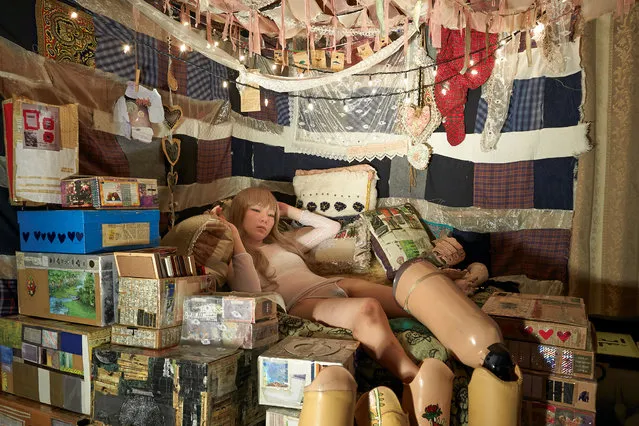
Ophelia (2013). From a series of photos of imagined women exhibited at the 2013 Aichi Triennale. Here, Katayama invokes Hamlet’s tragic heroine, after the painting by British pre-Raphaelite John Everett Millais. (Photo by Mari Katayama/The Guardian)

Born with a rare condition, the artist has chronicled her life in portraits – capturing everything from her tattooed prosthetics to the tentacled creature she stitched together on the shores of Naoshima. Here: Ophelia (2013). From a series of photos of imagined women exhibited at the 2013 Aichi Triennale. Here, Katayama invokes Hamlet’s tragic heroine, after the painting by British pre-Raphaelite John Everett Millais. (Photo by Mari Katayama/The Guardian)
Details
07 Mar 2017 00:04:00