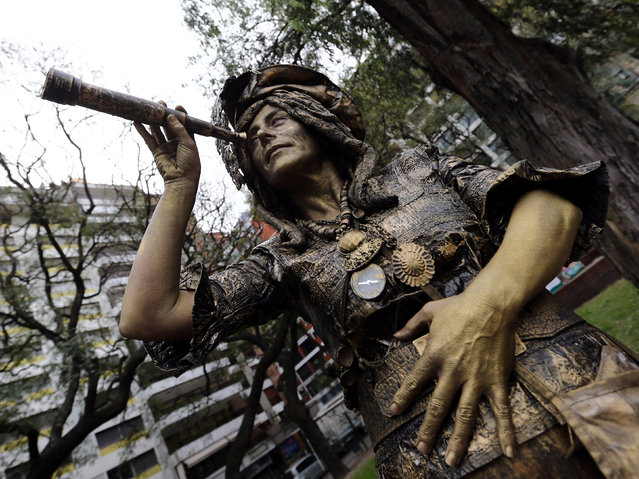
Maria Ines Banegas portraying “La Pirata” (The Pirate) takes part in a human living statues contest in Buenos Aires, Argentina, September 24, 2016. (Photo by Enrique Marcarian/Reuters)
A light installation is seen on the facade on the banks of the Saone river to pay tribute to the victims of the Paris attacks in Lyon, France, December 8, 2015. (Photo by Robert Pratta/Reuters)
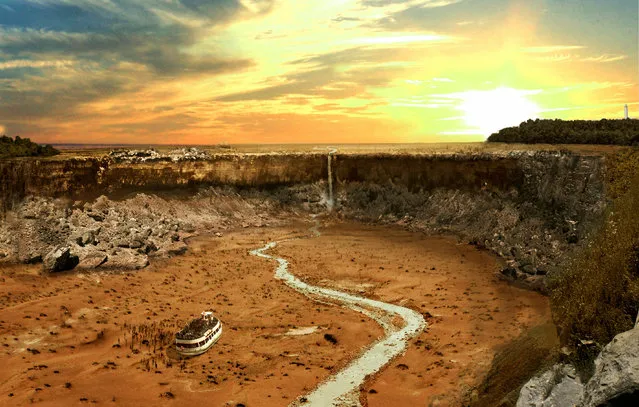
A graphic designer has produced a haunting look at what the world’s most famous landmarks would look like if they were hit by a severe drought. Joel Krebs has intricately dried up hot spots such as the Tower Bridge in London, the Capitol in Washington, D.C., Niagara Falls and Machu Picchu. Here: Niagara Falls, Canada, after severe drought. (Photo by Joel Krebs/Caters News)
“The Atlas moth (Attacus atlas) is a large saturniid moth found in the tropical and subtropical forests of Southeast Asia, and common across the Malay archipelago. Atlas moths are considered the largest moths in the world in terms of total wing surface area [upwards of c. 400 cm2 (62 sq in)]. Their wingspans are also amongst the largest, reaching over 25 cm (10 in). Females are appreciably larger and heavier”. – Wikipedia. Photo: Atlas Moth. (Photo by Terri Oda)
US Vogue’s top fashion editor works with photographers to inject style with sci-fi and fantasy. A new book, “Stoppers: Photographs from My Life at Vogue” by Phyllis Posnick and Vogue’s chief editor, Anna Wintour, highlights the results. Here: Surburban Woman #10, Mountainville, New York, August 2006. (Photo by Steven Klein)
Soldiers of the French Air and Space Force who took part in the Skyros Operation get ready prior to the annual Bastille Day military parade on the Champs-Elysees avenue in Paris on July 14, 2021. (Photo by Ludovic Marin/AFP Photo)
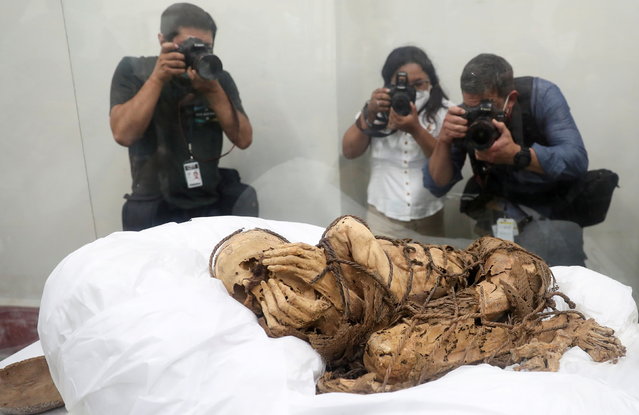
Members of the media take pictures of the pre-Inca “Mummy of Cajamarquilla”, which is presumed to be between 800 and 1200 years old, in Lima, Peru December 7, 2021. The “Mummy of Cajamarquilla” found by archaeologists from San Marcos inside a burial chamber of about three meters long and a depth of 1.40 meters in the Cajamarquilla archaeological site, east of Lima. (Photo by Sebastian Castaneda/Reuters)