Loading...
Done
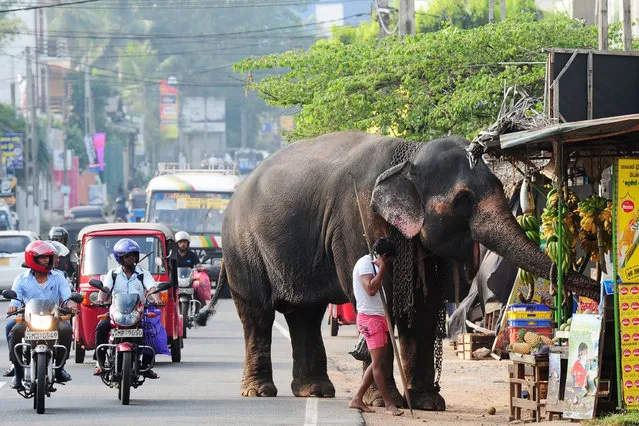
A Sri Lankan elephant, accompanied by his mahout, browse through a roadside fruit stall in Colombo on January 19, 2015. The Sri Lankan elephant is listed as endangered by the International Union for Conservation of Nature (IUCN) as the population has declined by at least 50 percent over the last three generations, with the species threatened by habitat loss, degradation and fragmentation. (Photo by Lakruwan Wanniarachchi/AFP Photo)

A Sri Lankan elephant, accompanied by his mahout, browse through a roadside fruit stall in Colombo on January 19, 2015. The Sri Lankan elephant is listed as endangered by the International Union for Conservation of Nature (IUCN) as the population has declined by at least 50 percent over the last three generations, with the species threatened by habitat loss, degradation and fragmentation. (Photo by Lakruwan Wanniarachchi/AFP Photo)
Details
23 Jan 2015 13:21:00
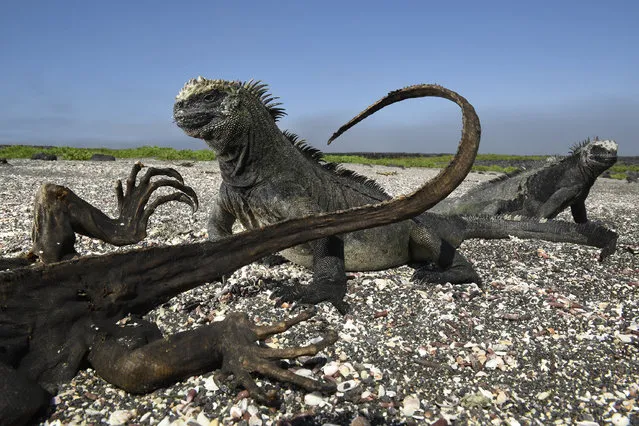
Galapagos – Rocking the Cradle: Four major ocean currents converge along the Galapagos archipelago, creating the conditions for an extraordinary diversity of animal life, April 25, 2016. The islands are home to at least 7,000 flora and fauna species, of which 97 percent of the reptiles, 80 percent of the land birds, 50 percent of the insects and 30 percent of the plants are endemic. The local ecosystem is highly sensitive to the changes in temperature, rainfall and ocean currents that characterize the climatic events known as El Niño and La Niña. These changes cause marked fluctuations in weather and food availability. Many scientists expect the frequency of El Niño and La Niña to increase as a result of climate change, making the Galapagos a possible early-warning location for its effects. (Photo by Thomas P. Peschak for National Geographic/World Press Photo)

Galapagos – Rocking the Cradle: Four major ocean currents converge along the Galapagos archipelago, creating the conditions for an extraordinary diversity of animal life, April 25, 2016. The islands are home to at least 7,000 flora and fauna species, of which 97 percent of the reptiles, 80 percent of the land birds, 50 percent of the insects and 30 percent of the plants are endemic. (Photo by Thomas P. Peschak for National Geographic/World Press Photo)
Details
16 Apr 2018 00:01:00
Pedra da Gavea highline, 850 meters above the city, 100 meters direct exposure, March 24, 2013. Brian Mosbaugh on the line. Carefully tiptoeing almost 3000 metres above Rio de Janeiro on a thin wire got a bit too much for this adrenaline junkie – so he decided to have a LIE DOWN. Fearless Brian Mosbaugh is so used to the perilous heights he decided he deserved a short break and proceeded to kick back and relax over the famous Brazilian city. (Photo by Scott Rogers/Caters)

Pedra da Gavea highline, 850 meters above the city, 100 meters direct exposure, March 24, 2013. Brian Mosbaugh on the line. Carefully tiptoeing almost 3000 metres above Rio de Janeiro on a thin wire got a bit too much for this adrenaline junkie – so he decided to have a LIE DOWN. Fearless Brian Mosbaugh is so used to the perilous heights he decided he deserved a short break and proceeded to kick back and relax over the famous Brazilian city. (Photo by Scott Rogers/Caters)

P.S. All pictures are presented in high resolution. To see Hi-Res images – just TWICE click on any picture. In other words, click small picture – opens the BIG picture. Click BIG picture – opens VERY BIG picture (if available; this principle works anywhere on the site AvaxNews).
Details
30 Mar 2013 12:00:00
Two Chinese farmers got more than they bargained for when they pulled up the root of a fleece flower – and came face-to-face with the doppelganger of Homer Simpson, on May 17, 2013. The large root appears to have two bulging eyes and a prominent nose – giving it an uncanny resemblance to the famous cartoon character. With two offshoot roots shaped like arms, it even looks like it is pondering or confused – just what you would expect from the real Homer. (Photo by ImagineChina)

Two Chinese farmers got more than they bargained for when they pulled up the root of a fleece flower – and came face-to-face with the doppelganger of Homer Simpson, on May 17, 2013. The large root appears to have two bulging eyes and a prominent nose – giving it an uncanny resemblance to the famous cartoon character. With two offshoot roots shaped like arms, it even looks like it is pondering or confused – just what you would expect from the real Homer. (Photo by ImagineChina)
Details
18 May 2013 11:52:00
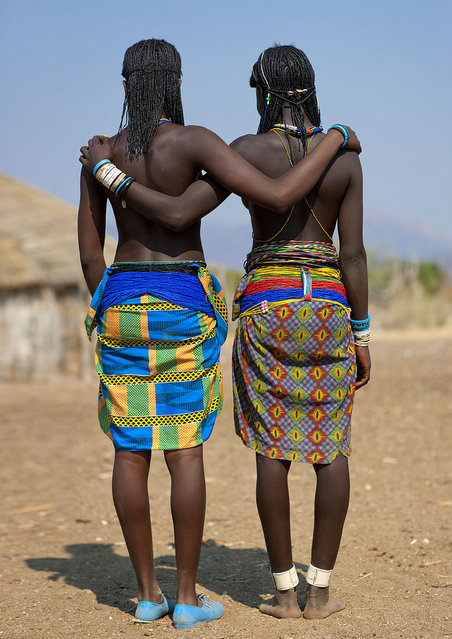
“Show us our butts! Mucawana tribe – Angola. In Soba village, the Muhacaona (Mucawana) tribe, perhaps the best place i have visited. They use cow dung and fat to make this so nice haircut, and love the beads. They asked me to make pictures of their backs... and butts to see on the camera screen if everything was perfect!”. (Eric Lafforgue)

“Show us our butts! Mucawana tribe – Angola. In Soba village, the Muhacaona (Mucawana) tribe, perhaps the best place i have visited. They use cow dung and fat to make this so nice haircut, and love the beads. They asked me to make pictures of their backs... and butts to see on the camera screen if everything was perfect!”. (Photo and comments by Eric Lafforgue)
Details
09 Nov 2012 15:04:00
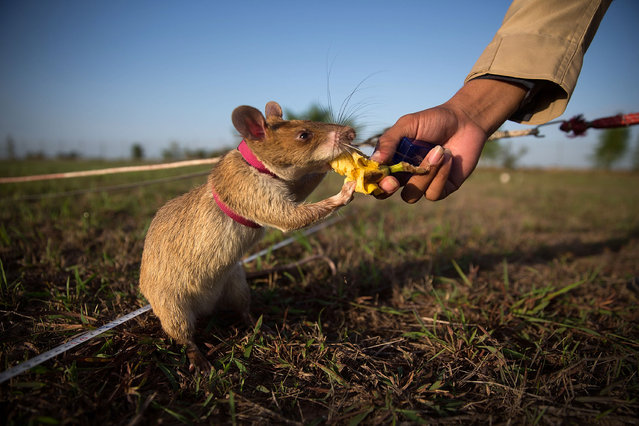
A mine detection rat is given banana as a reward after successfully identifying an inactive mine on July 2, 2015 in Siem Reap, Cambodia. (Photo by Taylor Weidman/Getty Images)

A mine detection rat is given banana as a reward after successfully identifying an inactive mine on July 2, 2015 in Siem Reap, Cambodia. The Cambodian Mine Action Center (CMAC) working with the Belgian NGO APOPO has recently begun testing the feasability of using large mine detection rats from Tanzania to help clear fields of mines and unexploded ordnance in one of the most bombed and mined countries in the world. (Photo by Taylor Weidman/Getty Images)
Details
03 Jul 2015 13:31:00
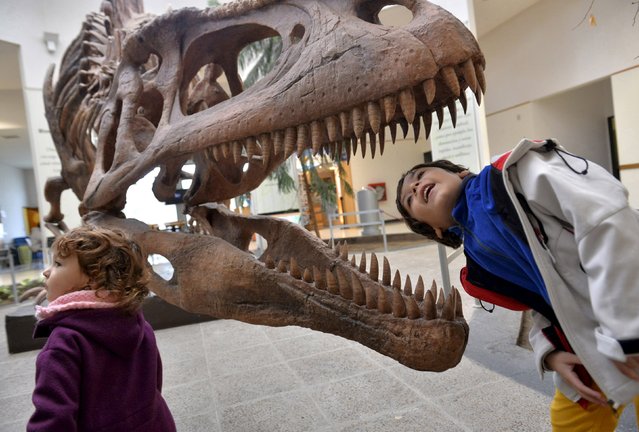
A boy looks inside the skull of a Tyrannosaurus Rex replica at the Egidio Feruglio Museum in Trelew, Argentina, in this May 18, 2014 file photograph. Scientists on July 28, 2015 unveiled a comprehensive analysis of the teeth of the group of carnivorous dinosaurs called theropods, which include the Tyrannosaurus Rex, detailing a unique serrated structure that let them chomp efficiently through the flesh and bones of large prey. (Photo by Maxi Jonas/Reuters)

A boy looks inside the skull of a Tyrannosaurus Rex replica at the Egidio Feruglio Museum in Trelew, Argentina, in this May 18, 2014 file photograph. Scientists on July 28, 2015 unveiled a comprehensive analysis of the teeth of the group of carnivorous dinosaurs called theropods, which include the Tyrannosaurus Rex, detailing a unique serrated structure that let them chomp efficiently through the flesh and bones of large prey. (Photo by Maxi Jonas/Reuters)
Details
29 Jul 2015 11:55:00
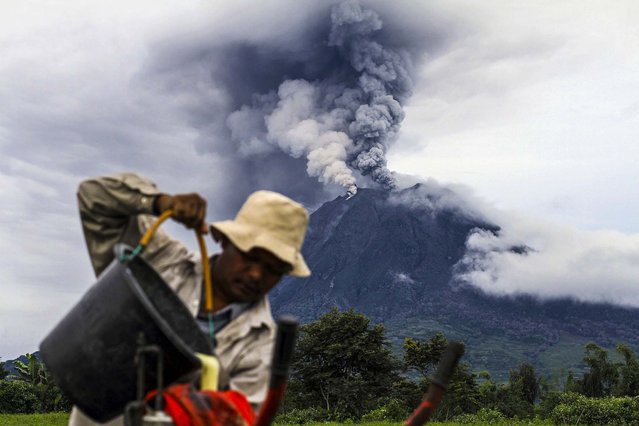
A villager pours pesticide from a bucket as Mount Sinabung spews ash at Kebayaken village in Karo district, Indonesia's North Sumatra province, on December 4, 2013. The country has ordered the evacuation of 15,000 residents near the active volcano. (Photo by Roni Bintang/Reuters)

A villager pours pesticide from a bucket as Mount Sinabung spews ash at Kebayaken village in Karo district, Indonesia's North Sumatra province, on December 4, 2013. The country has ordered the evacuation of 15,000 residents near the active volcano. (Photo by Roni Bintang/Reuters)
Details
07 Dec 2013 11:48:00