Loading...
Done
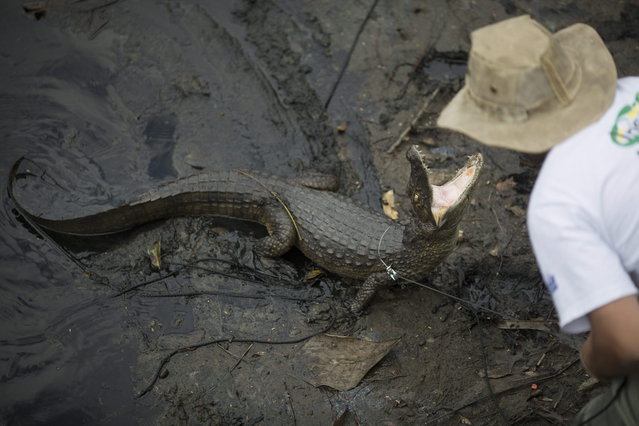
In this October 14, 2013 photo, ecology professor Ricardo Freitas catches a broad-snouted caiman to examine, then release back into the water channel in the affluent Recreio dos Bandeirantes suburb of Rio de Janeiro, Brazil. (Photo by Felipe Dana/AP Photo)

In this October 14, 2013 photo, ecology professor Ricardo Freitas catches a broad-snouted caiman to examine, then release back into the water channel in the affluent Recreio dos Bandeirantes suburb of Rio de Janeiro, Brazil. Caimans are like tanks, a very old species with a remarkable capacity for renovation that allows them to survive under extreme conditions where others couldn't, said Freitas, who runs the Instituto Jacare, or the Caiman Institute, which aims to protect the reptiles. (Photo by Felipe Dana/AP Photo)
Details
18 Oct 2013 09:05:00
A tour guide shows a thumbs up as he sits on top of a crocodile on the Tarcoles river in Tarcoles, Costa Rica. (Photo and caption by Barcroft Media)

To most of us, hand-feeding crocodiles might sound like a one-way ticket to a watery grave. But for Jose Eduardo Chaves Salas, 32, coming within inches of the fearsome creatures’ razor-sharp teeth is all in a day’s work. He runs Jose's Crocodile River Tour on the Tarcoles River in Costa Rica, where tourists can watch him feed crocs up to 17 feet long. Photo: A tour guide shows a thumbs up as he sits on top of a crocodile on the Tarcoles river in Tarcoles, Costa Rica. (Photo and caption by Barcroft Media)
Details
20 Oct 2013 09:06:00
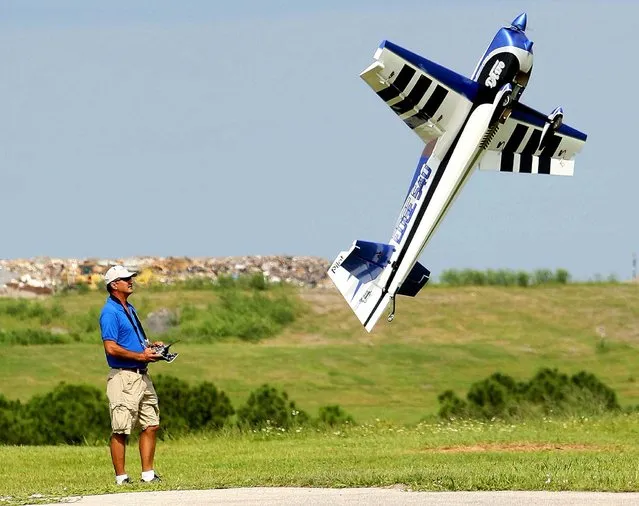
Professional pilot and remote control plane enthusiast Bob Rembert prepares to start the propeller of a 1/4 scale Edge 540 remote control, gas powered plane. “I wanted to fly since I was 10 years old. I love it so much. And I can do stuff with the model airplanes I can't do with the real planes”, said Rembert. (Photo by Bill Ingram/The Palm Beach Post)

The R.C. Bush Pilots club was started in 1981, for those who enjoy flying radio control (RC) model planes. It’s one of the largest clubs in Florida, and calls Phil Wherry Field in West Palm Beach home. Photo: Professional pilot and remote control plane enthusiast Bob Rembert prepares to start the propeller of a 1/4 scale Edge 540 remote control, gas powered plane. (Photo by Bill Ingram/The Palm Beach Post)
Details
01 Jun 2015 14:38:00
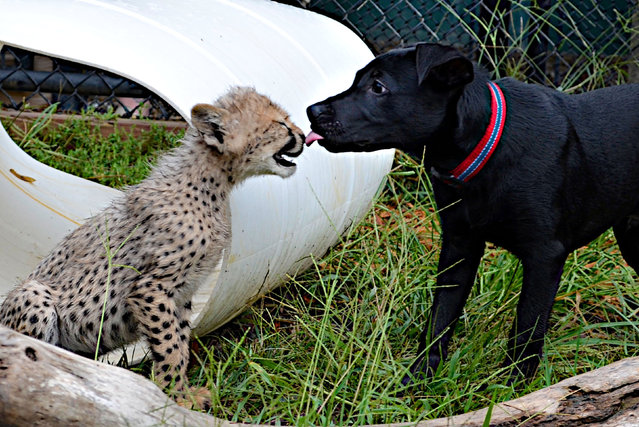
These stunning images could be mistaken for a cheetah ravenously chasing down a dog, but in fact, the pair are best of friends. Savanah, the one-and-a-half-year-old cheetah and Max, who is just a few weeks younger, were put together when Savanah was just 10-weeks-old. (Photo by Caters News Agency)

These stunning images could be mistaken for a cheetah ravenously chasing down a dog, but in fact, the pair are best of friends. Savanah, the one-and-a-half-year-old cheetah and Max, who is just a few weeks younger, were put together when Savanah was just 10-weeks-old. Ever since, their friendship has amazed visitors at Cincinatti Zoo, who are delighted but confused as to why the spotted beast hasnt eaten the dashing hound. So, when it snowed, Savanah and Max just like young children were very excitable and wasted no time playing in the snow. (Photo by Caters News Agency)
Details
21 Dec 2013 13:56:00
Military vehicles surround a wreckage of a trolleybus, in Volgograd, Russia, Monday, December 30, 2013. A bomb blast tore through a trolleybus in the city of Volgograd on Monday morning, killing at least 10 people a day after a suicide bombing that killed at least 17 at the city's main railway station. Volgograd is about 650 kilometers (400 miles) northeast of Sochi, where the Olympics are to be held. (Photo by Denis Tyrin/AP Photo)

Military vehicles surround a wreckage of a trolleybus, in Volgograd, Russia, Monday, December 30, 2013. A bomb blast tore through a trolleybus in the city of Volgograd on Monday morning, killing at least 10 people a day after a suicide bombing that killed at least 17 at the city's main railway station. Volgograd is about 650 kilometers (400 miles) northeast of Sochi, where the Olympics are to be held. (Photo by Denis Tyrin/AP Photo)
Details
30 Dec 2013 10:50:00
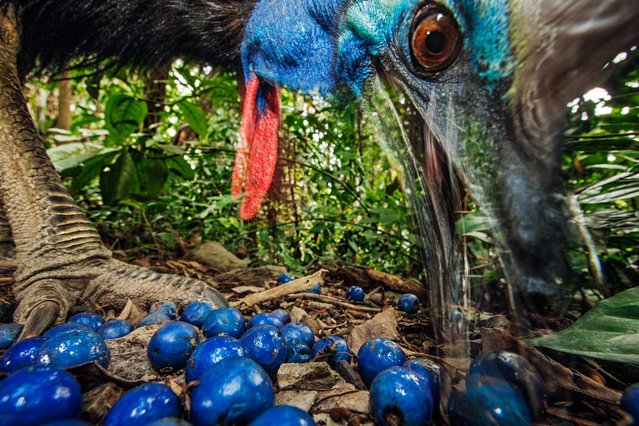
“Cassowaries are large, flightless birds related to emus and (more distantly) to ostriches, rheas, and kiwis”, writes Olivia Judson in the September issue of National Geographic magazine. (Photo by Christian Ziegler/National Geographic)

“Cassowaries are large, flightless birds related to emus and (more distantly) to ostriches, rheas, and kiwis”, writes Olivia Judson in the September issue of National Geographic magazine. How large? People-size: Adult males stand well over five foot five and top 110 pounds. Females are even taller, and can weigh more than 160 pounds. Dangerous when roused, they’re shy and peaceable when left alone. But even birds this big and tough are prey to habitat loss. The dense New Guinea and Australia rain forests where they live have dwindled. Today cassowaries might number 1,500 to 2,000. And because they help shape those same forests – by moving seeds from one place to another – “if they vanish”, Judson writes, “the structure of the forest would gradually change” too. (Photo by Christian Ziegler/National Geographic)
Details
06 Jan 2014 12:21:00
A prisoner from the Pedrinhas prison is carried to receive medical help after he was injured during a fight between rival gangs inside the jail, in Sao Luiz, capital of Maranhao state, January 8, 2014. (Photo by Douglas Cunha/Reuters/O Estado do Maranhão)

A prisoner from the Pedrinhas prison is carried to receive medical help after he was injured during a fight between rival gangs inside the jail, in Sao Luiz, capital of Maranhao state, January 8, 2014. The recent posting on a major Brazilian news website of a video filmed last December 17 by Pedrinhas prisoners of the decapitated and tortured bodies of rival inmates inside the jail has highlighted some of the problems present in the country's prison system which houses nearly twice as many prisoners as its capacity, according to official statistics. (Photo by Douglas Cunha/Reuters/O Estado do Maranhão)
Details
11 Jan 2014 13:03:00
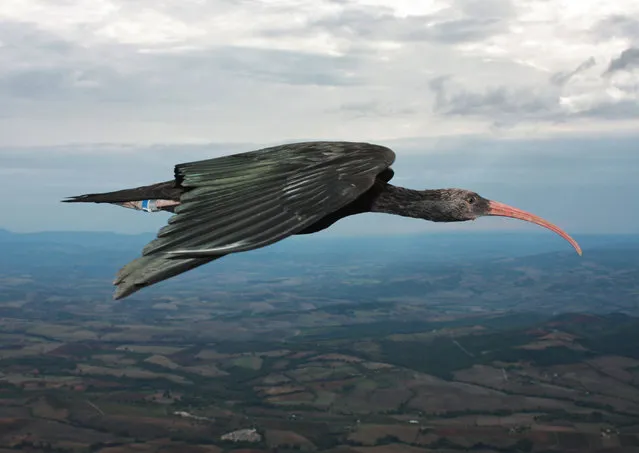
In this undated photo made available by journal Nature on January 15, 2014, a northern bald ibis (Geronticus eremita) flies in Tuscany, Italy. A new study released Wednesday, January 15, 2014 says the birds choreograph the flapping of their wings, getting a boost from an updraft of air in the wake of the flapping wings by flying behind the first bird and off to the side. When a flock of birds take advantage of these aerodynamics, they form a V. (Photo by Markus Unsöld/AP Photo)

In this undated photo made available by journal Nature on January 15, 2014, a northern bald ibis (Geronticus eremita) flies in Tuscany, Italy. A new study released Wednesday, January 15, 2014 says the birds choreograph the flapping of their wings, getting a boost from an updraft of air in the wake of the flapping wings by flying behind the first bird and off to the side. When a flock of birds take advantage of these aerodynamics, they form a V. (Photo by Markus Unsöld/AP Photo)
Details
18 Jan 2014 13:54:00