Loading...
Done
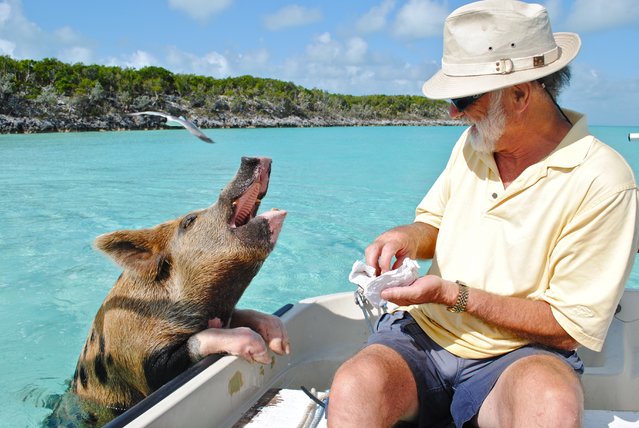
“So you're on a boat in Bahamas and then this pig swims by begging for food”. (Photo and caption by Lisa Larsen/Public Domain)

The Bahamas, the Commonwealth nation of hundreds of islands roughly the size of Connecticut and with population of just a bit over Anaheim, is known for its crystal waters and pristine beaches. This is possibly one of the world’s most beautiful havens of nature, yet people are coming here to see pigs. It is unclear when the pigs first appeared on Exuma Island or where they come from. There’s talk about a daring escape from a shipwreck, or sailors releasing the swine on purpose. In all probability, there were no pigs on this tropical paradise before European settlers came, so their mere presence is the work of human. The intriguing feat of nature, however, is that this population of pigs developed a fine aptitude for swimming. Here: “So you're on a boat in Bahamas and then this pig swims by begging for food”. (Photo and caption by Lisa Larsen/Public Domain)
Details
03 Sep 2015 11:53:00
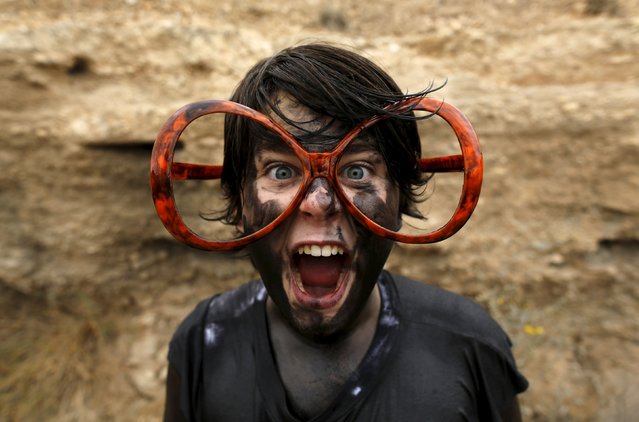
Jose, a reveller covered in grease, poses for a photo as he takes part in the annual Cascamorras festival in Baza, southern Spain September 6, 2015. The festival was inspired by a dispute between the town of Baza and Guadix over the possession of an icon of the Virgin of Piedad. The Cascamorras refers to representatives from Guadix, who were sent to Baza to recover the statue. As the Cascamorras had to stay perfectly clean to gain possession of the statue, Baza residents attempt to make them as “dirty” as possible. (Photo by Marcelo del Pozo/Reuters)

Jose, a reveller covered in grease, poses for a photo as he takes part in the annual Cascamorras festival in Baza, southern Spain September 6, 2015. The festival was inspired by a dispute between the town of Baza and Guadix over the possession of an icon of the Virgin of Piedad. The Cascamorras refers to representatives from Guadix, who were sent to Baza to recover the statue. As the Cascamorras had to stay perfectly clean to gain possession of the statue, Baza residents attempt to make them as “dirty” as possible. (Photo by Marcelo del Pozo/Reuters)
Details
07 Sep 2015 14:11:00
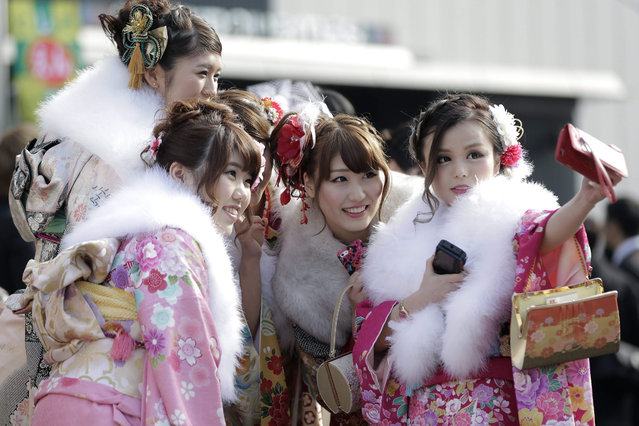
Young Japanese women dressed in colourful Kimonos take a photo of themselves as they gather for a ceremony marking the 'Coming of Age Day' at the Toshimaen Amusement Park in Tokyo, Japan, 11 January 2016. The Coming of Age Day is the day to celebrate young people who turn 20 years old while the age of 20 is considered the beginning of adulthood and is the minimum legal age for voting, drinking and smoking in Japan. (Photo by Kiyoshi Ota/EPA)

Young Japanese women dressed in colourful Kimonos take a photo of themselves as they gather for a ceremony marking the “Coming of Age Day” at the Toshimaen Amusement Park in Tokyo, Japan, 11 January 2016. The Coming of Age Day is the day to celebrate young people who turn 20 years old while the age of 20 is considered the beginning of adulthood and is the minimum legal age for voting, drinking and smoking in Japan. (Photo by Kiyoshi Ota/EPA)
Details
13 Jan 2016 08:02:00
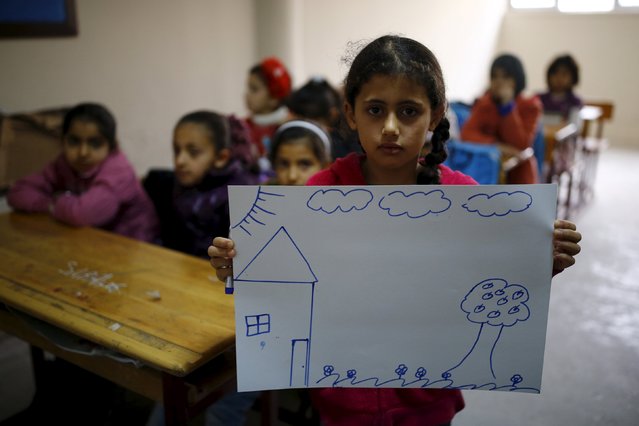
Syrian refugee girl Nur El-Huda, 9, shows a drawing of her home in Syria, in her classroom in Yayladagi refugee camp in Hatay province near the Turkish-Syrian border, Turkey, December 16, 2015. (Photo by Umit Bektas/Reuters)

Syrian refugee girl Nur El-Huda, 9, shows a drawing of her home in Syria, in her classroom in Yayladagi refugee camp in Hatay province near the Turkish-Syrian border, Turkey, December 16, 2015. Syria's conflict has left hundreds of thousands dead, pushed millions more into exile, and had a profound effect on children who lost their homes or got caught up in the bloodletting. The drawings of young refugees living in Turkey show their memories of home and hopes for its future. The pictures also point to the mental scars borne by 2.3 million Syrian refugees living in Turkey, more than half of them children. (Photo by Umit Bektas/Reuters)
Details
16 Jan 2016 08:05:00
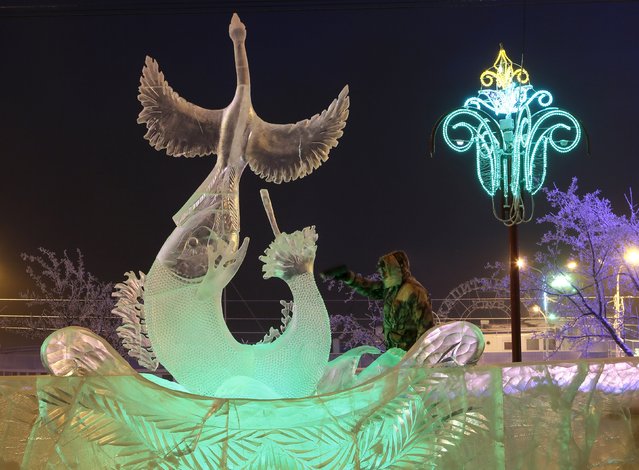
Mikhail Vasilenko, a participant from the Siberian town of Nizhny Tagil, works on an ice sculpture called “The Predator”, on the last day of the annual international festival of snow and ice sculptures “The Magical Ice of Siberia”, with the air temperature at about minus 28 degrees Celsius (minus 18.4 degrees Fahrenheit), in Krasnoyarsk, Russia, January 17, 2016. (Photo by Ilya Naymushin/Reuters)

Mikhail Vasilenko, a participant from the Siberian town of Nizhny Tagil, works on an ice sculpture called “The Predator”, on the last day of the annual international festival of snow and ice sculptures “The Magical Ice of Siberia”, with the air temperature at about minus 28 degrees Celsius (minus 18.4 degrees Fahrenheit), in Krasnoyarsk, Russia, January 17, 2016. (Photo by Ilya Naymushin/Reuters)
Details
19 Jan 2016 08:00:00
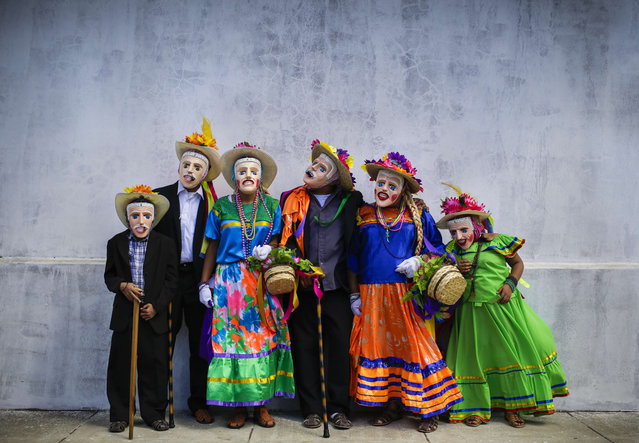
Dancers pose after performing “El Macho Raton”, “El Toro Huaco” and “El Gueguense” traditional dances during San Sebastian festivity in Diriamba, province of Carazo, some 50 km south of Managua on January 19, 2016. Devotees of Saint Sebastian dance in traditional costumes between the cities of Diriamba and Dolores, which are some three kilometers away. (Photo by Inti Ocon/AFP Photo)

Dancers pose after performing “El Macho Raton”, “El Toro Huaco” and “El Gueguense” traditional dances during San Sebastian festivity in Diriamba, province of Carazo, some 50 km south of Managua on January 19, 2016. Devotees of Saint Sebastian dance in traditional costumes between the cities of Diriamba and Dolores, which are some three kilometers away. (Photo by Inti Ocon/AFP Photo)
Details
21 Jan 2016 12:08:00
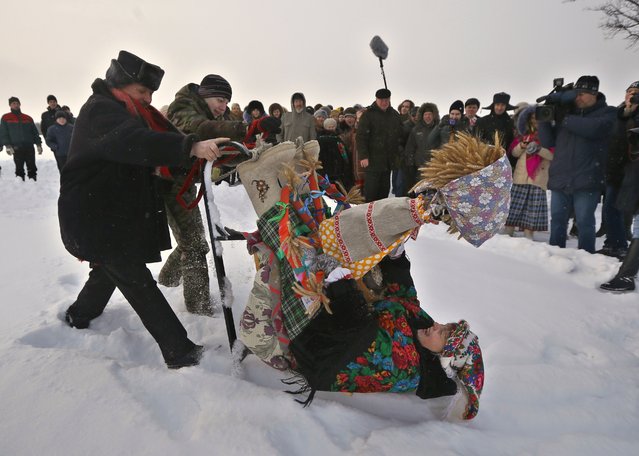
Belarusians wearing national costumes celebrate a Pull the Kolyada Up the Oak rite in the village of Martsiyanauka, some 77 km (48 miles) east of capital Minsk, Belarus, Thursday, January 21, 2016. (Photo by Sergei Grits/AP Photo)

Belarusians wearing national costumes celebrate a Pull the Kolyada Up the Oak rite in the village of Martsiyanauka, some 77 km (48 miles) east of capital Minsk, Belarus, Thursday, January 21, 2016. The merry ancient rite Pull the Kolyada Up the Oak marks the end of Orthodox Christmas celebrations in Belarus. On Jan. 21 a wheel, the so-called Kolyada, would be pulled up an oak or any old tree. The Belarusians believed that the ritual heralds a good harvest, luck and happiness for the entire year. (Photo by Sergei Grits/AP Photo)
Details
22 Jan 2016 10:13:00
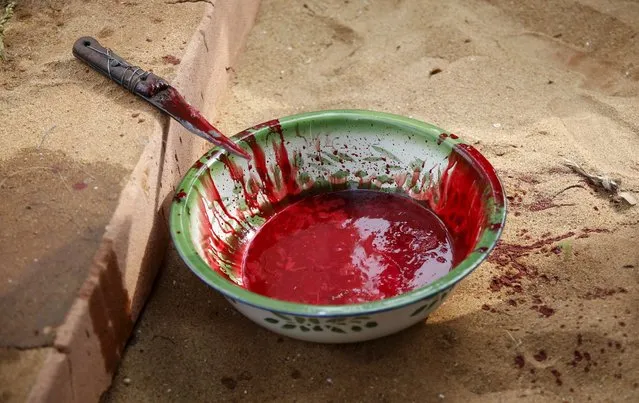
A knife is seen beside a bowl containing blood after a ram was killed as a sacrifice in front of a shrine at the annual voodoo festival in Ouidah, Benin, January 10, 2016. (Photo by Akintunde Akinleye/Reuters)

A knife is seen beside a bowl containing blood after a ram was killed as a sacrifice in front of a shrine at the annual voodoo festival in Ouidah, Benin, January 10, 2016. In Ouidah, a small town and former slave port in the West African country of Benin, the annual voodoo festival gathers visitors from far and wide. It's a week that brings together priests and dignitaries, rich and poor, locals and visitors from as far afield as the Caribbean and France. The festival commemorates the estimated 60 million people who lost their homelands and their freedom during the African slave trade. (Photo by Akintunde Akinleye/Reuters)
Details
23 Jan 2016 12:55:00