Loading...
Done
NASA's New Space Launch System

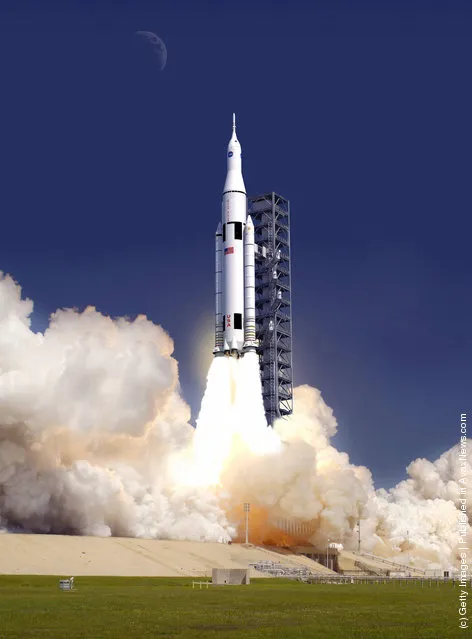
“The Space Launch System, or SLS, is a Shuttle-Derived heavy launch vehicle being designed by NASA, following the cancellation of the Constellation Program, to replace the Space Shuttle after its retirement. The NASA Authorization Act of 2010 envisions the transformation of the Ares I and Ares V vehicle designs into a single launch vehicle usable for both crew and cargo. It is to be upgraded over time with more powerful versions. The proposed SLS is visually similar to the legacy Saturn V booster and in particular the proposed, two-stage, Saturn INT-20”. – Wikipedia

Photo: In this illustration provided by NASA, the design for a new space rocket system, the Space Launch System, is seen. NASA's new rocket design will reportedly cost about $35 billion and be ready to for test launch in 2017. According to NASA, the rocket will be used to carry Orion Multi-Purpose Crew Vehicle as well as cargo and science experiments to earth's orbit, as a backup for the space station and possibly destinations beyond that. (Illustration by NASA via Getty Images)
Details
15 Sep 2011 10:50:00
Urban explorer Vad Him of Rudex team jumps whilst on a rooftop in Moscow, Russia, August 14, 2017. (Photo by Maxim Shemetov/Reuters)

To an outsider, their passion is at times illegal and often on the verge of life and death. But climbing rooftops of high-rise buildings and exploring abandoned facilities is in the blood of these young Muscovites. The small group calls itself “Rudex”, which stands for “roof and decay exploration”, and is akin a Western youth craze known as urbex or “urban exploration” of man-made structures. Here: Urban explorer Vad Him of Rudex team jumps whilst on a rooftop in Moscow, Russia, August 14, 2017. (Photo by Maxim Shemetov/Reuters)
Details
25 Sep 2017 06:36:00
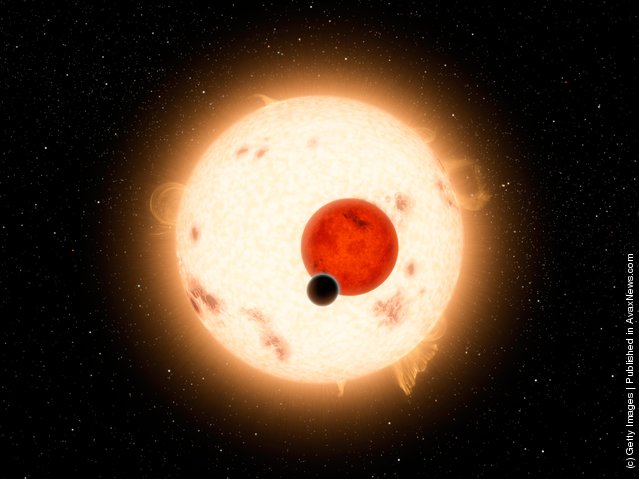
The newly-discovered gaseous planet Kepler-16b orbits it's two stars

The newly-discovered gaseous planet Kepler-16b orbits it's two stars. NASA's Kepler Mission discoverd the world orbiting two Stars, the larger a K dwarf and the smaller a red dwarf. (Photo by NASA/JPL-Caltech/T. Pyle via Getty Images)
Details
07 Dec 2011 12:28:00
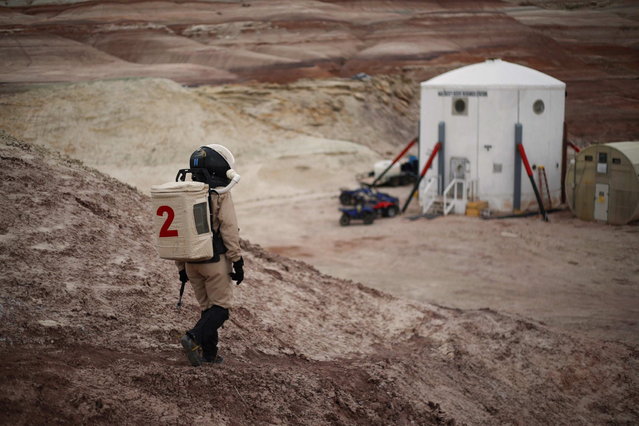
Csilla Orgel, a geologist of Crew 125 EuroMoonMars B mission, makes her way back to the Mars Desert Research Station (MDRS) in the Utah desert March 3, 2013. (Photo by Jim Urquhart/Reuters)

NASA says it could be another 20 years before humans touch down on Mars, but in a sense, the Mars Society has been exploring the red planet for more than a decade – in Utah. Photo: Csilla Orgel, a geologist of Crew 125 EuroMoonMars B mission, makes her way back to the Mars Desert Research Station (MDRS) in the Utah desert March 3, 2013. The MDRS aims to investigate the feasibility of a human exploration of Mars and uses the Utah desert's Mars-like terrain to simulate working conditions on the red planet. Scientists, students and enthusiasts work together developing field tactics and studying the terrain. All outdoor exploration is done wearing simulated spacesuits and carrying air supply packs and crews live together in a small communication base with limited amounts of electricity, food, oxygen and water. Everything needed to survive must be produced, fixed and replaced on site. (Photo by Jim Urquhart/Reuters)
Details
14 Mar 2013 12:11:00
A NASA Engineer Builds A Better Halloween Costume

Two years ago, Mark Rober was an engineer at NASA’s Jet Propulsion Laboratory in Pasadena, California, part of a team that worked on the Curiosity rover. For Halloween, he strapped an iPad to his chest and another to his back. Then he turned them on and used the devices’ cameras and screens to make it appear as if he had a gaping hole in the middle of his torso. (Photo By Mark Rober)
Details
15 Oct 2014 17:16:00


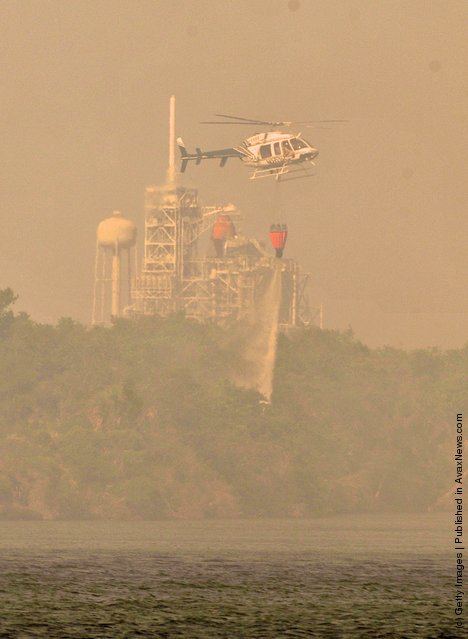
A helicopter pours water over a wildfire with the Space Shuttle Endeavour seen through heavy smoke in the background April 27, 2011 in Cape Canaveral, Florida. (Photo by Roberto Gonzalez/Getty Images)
Details
29 Apr 2011 08:56:00
NASA

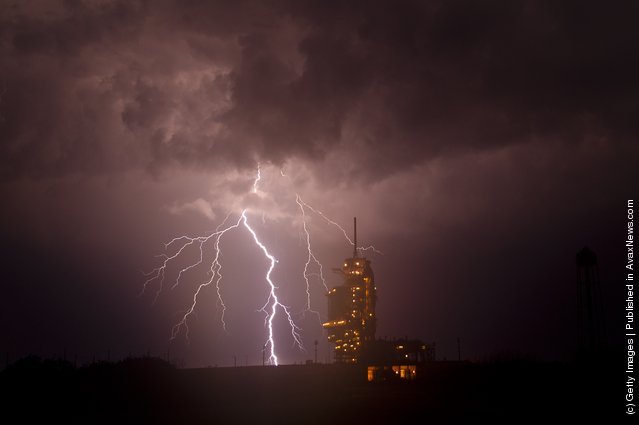
In this handout image provided by NASA, the space shuttle Endeavour is seen on launch pad 39a as a storm passes by prior to the rollback of the Rotating Service Structure (RSS) April 28, 2011, at Kennedy Space Center in Cape Canaveral, Florida. During the 14-day mission, Endeavour and the STS-134 crew will deliver the Alpha Magnetic Spectrometer (AMS) and spare parts, including two S-band communications antennas, a high-pressure gas tank and additional spare parts for Dextre. Launch is targeted for April 29 at 3:47 p.m. EDT.
Details
30 Apr 2011 08:18:00


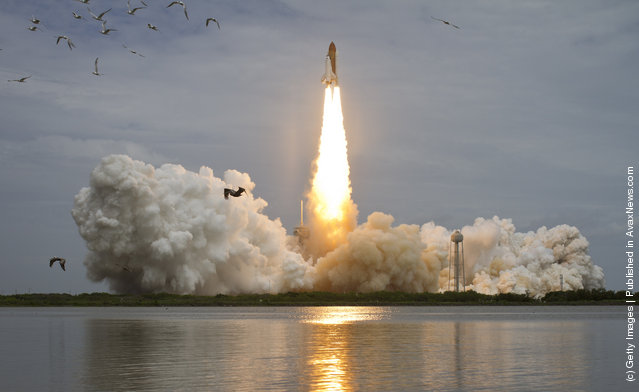
Space shuttle Atlantis launches from pad 39A on July 8, 2011 at the NASA Kennedy Space Center in Cape Canaveral, Florida. The launch of Atlantis, STS-135, is the final flight of the shuttle program, a 12-day mission to the International Space Station. (Photo by Bill Ingalls/NASA via Getty Images)
Details
09 Jul 2011 12:06:00