Loading...
Done
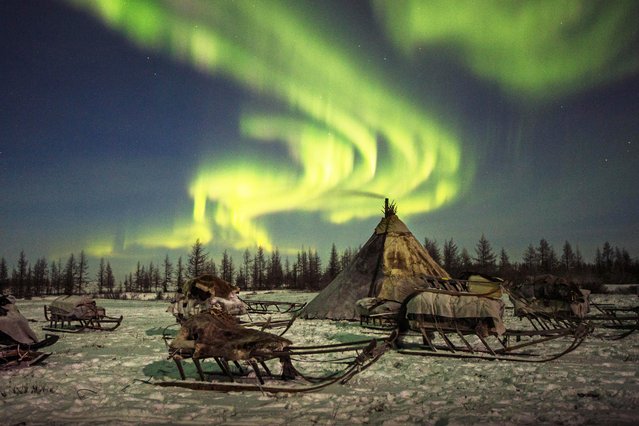
An empty camp is shown beneath a colourful sky in Siberia, December 2016. (Photo by Timothy Allen/Barcroft Productions)

A British photographer has captured life at the “edge of the world”. Timothy Allen, best known for his work on BBC's Human Planet, trekked through the freezing Siberian wilderness for 16 days as he joined part of an 800km migration of reindeer in the Yamal-Nenets region – a name that roughly translates to “edge of the world”. The stunning pictures feature the nomadic Nenets tribe, who drink blood to survive in -45°C temperatures. Timothy's epic journey, which will be revealed in an eight-minute documentary on Animal Planet USA, saw him travel across the bleak terrain of the frozen Ob River with the Nenets people in December last year. Here: An empty camp is shown beneath a colourful sky in Siberia, December 2016. (Photo by Timothy Allen/Barcroft Productions)
Details
19 Sep 2017 07:48:00
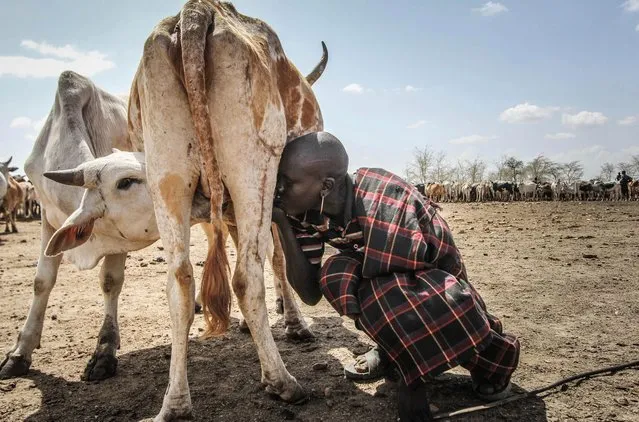
Cattle are the most important way of livelihood for the Karamojong: they provide milk, meat, blood and money when sold, Karamoja, Uganda, February 2017. (Photo by Sumy Sadurni/Barcroft Images)

Cattle are the most important way of livelihood for the Karamojong: they provide milk, meat, blood and money when sold, Karamoja, Uganda, February 2017. (Photo by Sumy Sadurni/Barcroft Images)
Details
17 Feb 2017 00:02:00
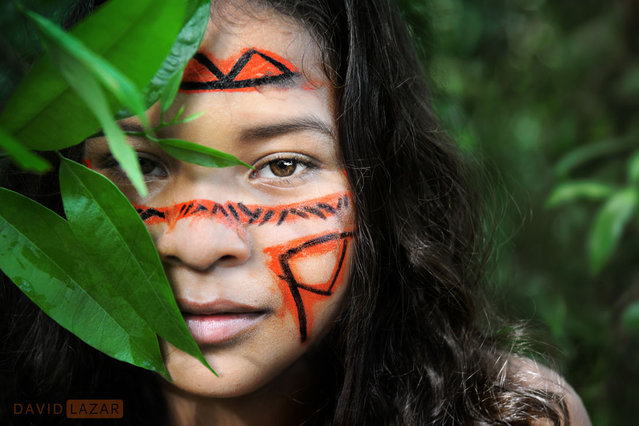
Amazon Tribe By David Lazar (Video)

Photographer David Lazar captured photos of native Dessana tribe, nearly 3,000 miles away from Brazil's capital. Tribe is only accessible by boat from city of Manaus. Surrounded by trees, waterfalls and tropical wildlife, this Amazon tribe is a world away from the beaches of Rio.
Details
27 Oct 2016 21:46:00
Artist Pyotr Pavlensky sits on the wall enclosing the Serbsky State Scientific Center for Social and Forensic Psychiatry after he cut off a part of his earlobe during his protest action titled “Segregation” in Moscow October 19, 2014. (Photo by Maxim Zmeyev/Reuters)

Artist Pyotr Pavlensky sits on the wall enclosing the Serbsky State Scientific Center for Social and Forensic Psychiatry after he cut off a part of his earlobe during his protest action titled “Segregation” in Moscow October 19, 2014. Pavlensky protested against the usage of forensic psychiatry for politically motivated purposes. He cut off his earlobe to demonstrate how authorities could “cut off” an unwanted individual from society by using psychiatric and medical diagnosis to forcefully send a person to a penitentiary hospital, according to Pavlensky. (Photo by Maxim Zmeyev/Reuters)
Details
21 Oct 2014 12:10:00
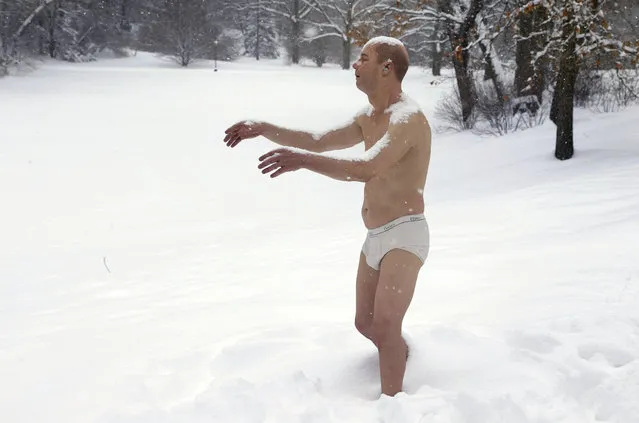
A statue of a man sleepwalking in his underpants is surrounded by snow on the campus of Wellesley College, in Wellesley, Mass., Wednesday, Feb. 5, 2014. The sculpture entitled "Sleepwalker" is part of an exhibit by sculptor Tony Matelli at the college's Davis Museum. (AP Photo/Steven Senne)

A statue of a man sleepwalking in his underpants is surrounded by snow on the campus of Wellesley College, in Wellesley, Mass., Wednesday, February 5, 2014. The sculpture entitled “Sleepwalker” is part of an exhibit by sculptor Tony Matelli at the college's Davis Museum. (Photo by Steven Senne/AP Photo)
Details
07 Feb 2014 07:09:00
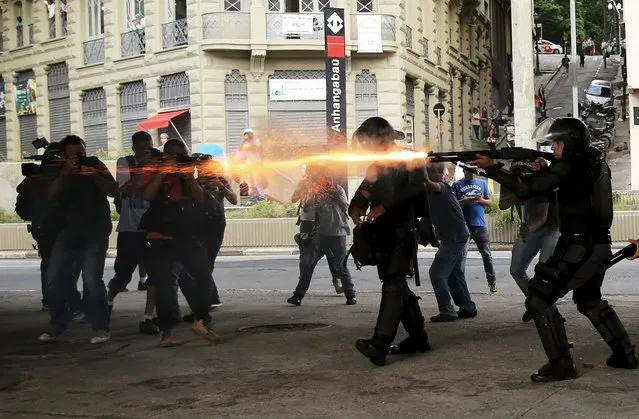
Riot police fire tear gas at demonstrators during a protest against fare hikes for city buses in Sao Paulo, Brazil, January 8, 2016. (Photo by Nacho Doce/Reuters)

Riot police fire tear gas at demonstrators during a protest against fare hikes for city buses in Sao Paulo, Brazil, January 8, 2016. Brazilian riot police on Friday fired tear gas and stun grenades to disperse a violent protest against a rise in public transport fares in the country's largest city, Sao Paulo. (Photo by Nacho Doce/Reuters)
Details
10 Jan 2016 12:04:00
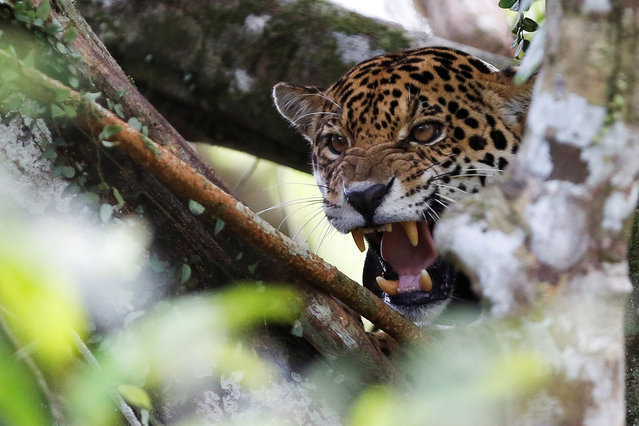
A female adult jaguar, which has a cub, growls at the Mamiraua Sustainable Development Reserve in Uarini, Amazonas state, Brazil, June 5, 2017. (Photo by Bruno Kelly/Reuters)

Brazilian jaguars, imperilled by hunters, ranchers and destruction of their habitat, have learned to survive at least one menace – flooding in the Amazon. They take to the trees. Although they can be six feet long and 200 pounds, the largest South American cats nimbly navigate treetops where they stay from April to July when the rainforest floor is under meters-deep water. Here: A female adult jaguar, which has a cub, growls at the Mamiraua Sustainable Development Reserve in Uarini, Amazonas state, Brazil, June 5, 2017. (Photo by Bruno Kelly/Reuters)
Details
07 Apr 2018 00:03:00
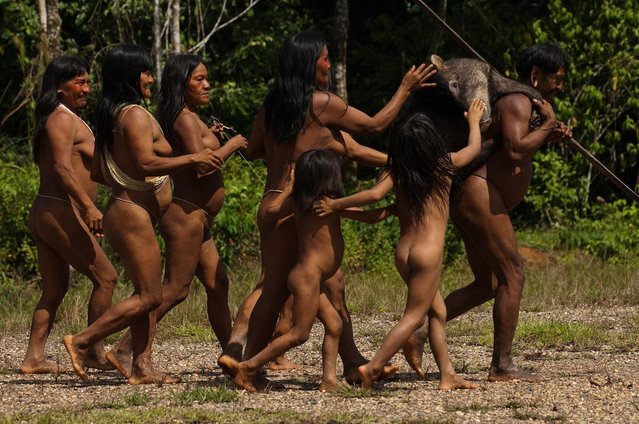
Spectacular images offering insight into the lives of the Huaorani people in the Ecuadorian Amazon have been revealed showing how they use traditional methods to hunt monkeys for food. The stunning pictures were taken by conservation photographer Pete Oxford from Torquay, Devon in the Ecuadorian Amazon. “The Huaorani Indians are a forest people highly in tune with their environment. Many are now totally acculturated since the 1950s by missionaries”, said Pete. “Today they face radical change to their culture to the proximity of oil exploration within their territory and the Yasuni National Park and Biosphere Reserve, they are vastly changed. Some still live very traditionally and for this shoot, through my Huaorani friend, a direct relative of those photographed he wanted to depict them as close to their original culture as possible. They still largely hunt with blow pipes and spears eating a lot of monkeys and peccaries”. The Huaorani are also known as the Waorani, Waodani or the Waos and are native Amerindians. Their lands are located between the Curaray and Napo rivers and speak the Huaorani language. Pete says that during his visit he was welcomed into the group and hopes that ancient cultures can be saved. Here: The tribe were seen celebrating after a hunter returned to camp with a wild pig. (Photo by Pete Oxford/Mediadrumworld.com)

Spectacular images offering insight into the lives of the Huaorani people in the Ecuadorian Amazon have been revealed showing how they use traditional methods to hunt monkeys for food. The stunning pictures were taken by conservation photographer Pete Oxford from Torquay, Devon in the Ecuadorian Amazon. Here: The tribe were seen celebrating after a hunter returned to camp with a wild pig. (Photo by Pete Oxford/Mediadrumworld.com)
Details
20 Jan 2017 07:58:00