Loading...
Done
Children Cooling Off at Dhiari Homeland. Local children get wet and cool in Arnhem Land. (Photo by Matthew Abbott/Australian Life Prize 2015)

From the rocks of Arnhem Land to the backyards of the Sydney suburbs, from stretching by the pool to waiting for evening prayer, snapshots for the 2015 Australian Life prize demonstrated a nation in colour and motion. Here: Children Cooling Off at Dhiari Homeland. Local children get wet and cool in Arnhem Land. (Photo by Matthew Abbott/Australian Life Prize 2015)
Details
23 Nov 2015 08:03:00
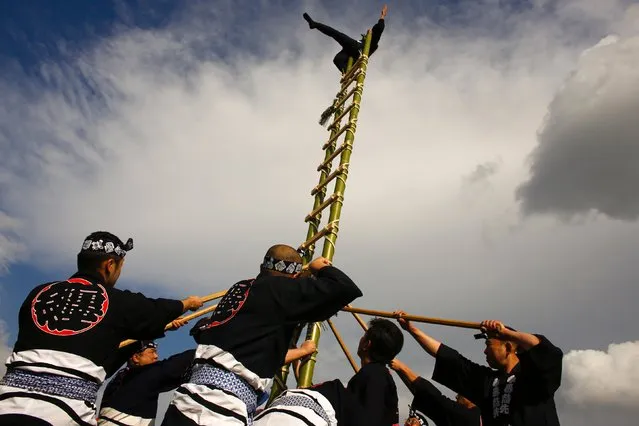
A member of the Edo Firemanship Preservation Association displays his balancing skills atop bamboo ladder during a New Year presentation by the fire brigade in Tokyo January 6, 2015. (Photo by Thomas Peter/Reuters)

A member of the Edo Firemanship Preservation Association displays his balancing skills atop bamboo ladder during a New Year presentation by the fire brigade in Tokyo January 6, 2015. (Photo by Thomas Peter/Reuters)
Details
07 Jan 2015 14:16:00
Paramedics care for a woman who is ill after the Geelong Cup on Geelong Cup day at Geelong Racecourse in Melbourne, Australia, 19 October 2016. The Geelong Racing Club was founded in March 1865 at a public meeting at the British Hotel. The first Geelong Cup was held in 1872 over a distance of two miles. (Photo by Tracey Nearmy/EPA)

Paramedics care for a woman who is ill after the Geelong Cup on Geelong Cup day at Geelong Racecourse in Melbourne, Australia, 19 October 2016. The Geelong Racing Club was founded in March 1865 at a public meeting at the British Hotel. The first Geelong Cup was held in 1872 over a distance of two miles. (Photo by Tracey Nearmy/EPA)
Details
20 Oct 2016 10:49:00
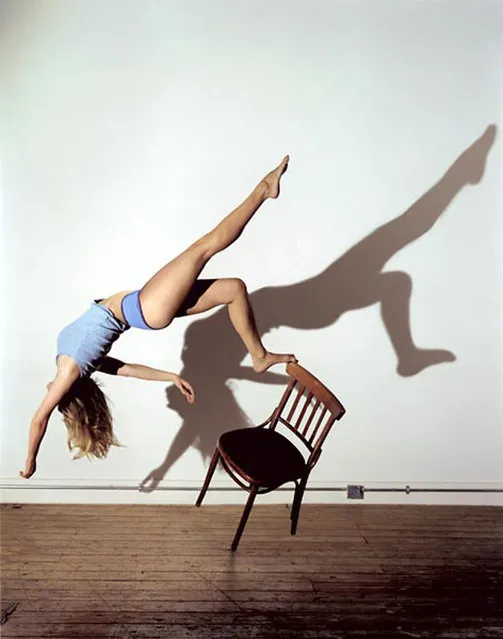
Sam Taylor-Wood, Bram Stoker's Chair Series

The last series of Sam Taylor-Wood's that I have looked into is called Bram Stoker's Chair. This series links with her Suspended series in that they both show the artist seemingly poised in mid-air. These photos have the added element of the chair being there for her to balance on, giving her more of a physical connection with her surroundings.

Details
16 Dec 2012 12:28:00
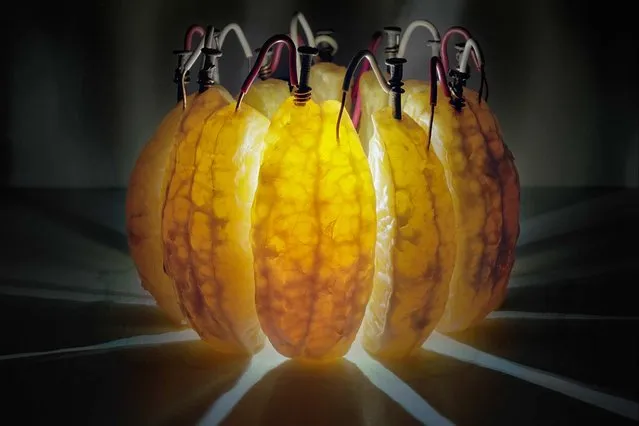
Wedges of an orange generate enough current and electrical juice – 3.5 volts – to power an LED. The fruit’s citric acid helps electrons flow from galvanized nails to copper wire in this 14-hour exposure. This image was published in September’s Visions of Earth, a trio of photos that appear in each issue of National Geographic. (Photo by Caleb Charland/National Geographic)

Wedges of an orange generate enough current and electrical juice – 3.5 volts – to power an LED. The fruit’s citric acid helps electrons flow from galvanized nails to copper wire in this 14-hour exposure. This image was published in September’s Visions of Earth, a trio of photos that appear in each issue of National Geographic. (Photo by Caleb Charland/National Geographic)
Details
06 Jan 2014 12:09:00
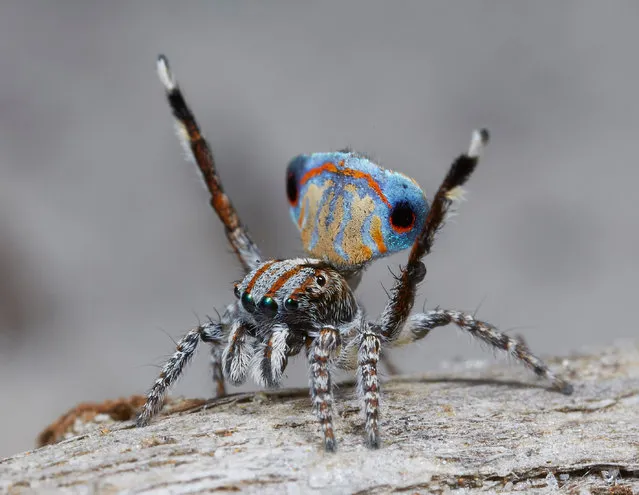
Several new species of peacock spider – just a few millimetres long and featuring extraordinary colours – have been discovered in Western Australia and South Australia. Jürgen Otto, a biologist from Sydney, has been researching the arachnids since 2005, and has gained a significant following online with his footage. He believes there are now 48 confirmed species of peacock spider within the Maratus genus, found across Australia but particularly in Western Australia – and many more awaiting confirmation. Here: Maratus Tasmanicus, one of seven new species of peacock spiders studied by the Sydney biologist Jürgen Otto. (Photo by Jürgen Otto)


Several new species of peacock spider – just a few millimetres long and featuring extraordinary colours – have been discovered in Western Australia and South Australia. Jürgen Otto, a biologist from Sydney, has been researching the arachnids since 2005, and has gained a significant following online with his footage. He believes there are now 48 confirmed species of peacock spider within the Maratus genus, found across Australia but particularly in Western Australia – and many more awaiting confirmation. Here: Maratus Tasmanicus, one of seven new species of peacock spiders studied by the Sydney biologist Jürgen Otto. (Photo by Jürgen Otto)
Details
30 May 2016 08:40:00
Members of the audience sit in the centre of the catwalk as the watch models for the C/MEO Collective walk by at Fashion Week Australia in Sydney on May 17, 2017. (Photo by Jason Reed/Reuters)

Members of the audience sit in the centre of the catwalk as the watch models for the C/MEO Collective walk by at Fashion Week Australia in Sydney on May 17, 2017. (Photo by Jason Reed/Reuters)
Details
19 May 2017 08:39:00
“Cassowaries are large, flightless birds related to emus and (more distantly) to ostriches, rheas, and kiwis”, writes Olivia Judson in the September issue of National Geographic magazine. (Photo by Christian Ziegler/National Geographic)

“Cassowaries are large, flightless birds related to emus and (more distantly) to ostriches, rheas, and kiwis”, writes Olivia Judson in the September issue of National Geographic magazine. How large? People-size: Adult males stand well over five foot five and top 110 pounds. Females are even taller, and can weigh more than 160 pounds. Dangerous when roused, they’re shy and peaceable when left alone. But even birds this big and tough are prey to habitat loss. The dense New Guinea and Australia rain forests where they live have dwindled. Today cassowaries might number 1,500 to 2,000. And because they help shape those same forests – by moving seeds from one place to another – “if they vanish”, Judson writes, “the structure of the forest would gradually change” too. (Photo by Christian Ziegler/National Geographic)
Details
06 Jan 2014 12:21:00