Loading...
Done
Two Girls who managed to evade the police walk away as police on foot and horseback push back to te curd at Park Row, In New York on April 26, 1960, A milling throng of more than 1,000 High students who storned city hall in a Demonstration supporting teachers wage demands. (Photo by AP Photo)

Two Girls who managed to evade the police walk away as police on foot and horseback push back to te curd at Park Row, In New York on April 26, 1960, A milling throng of more than 1,000 High students who storned city hall in a Demonstration supporting teachers wage demands. (Photo by AP Photo)
Details
25 Jun 2018 00:05:00
A view motorists have grown accustomed seeing, a military truck made by Oshkosh Corp. is taken for a test drive Thursday, April 11, 2013 in Oshkosh, Wis. Faced with deep cuts in U.S. military spending, and the end of the wars in Iraq and Afghanistan, Oshkosh Corp. is laying off 900 employees in its defense division based in Oshkosh. Approximately 700 hourly workers at the state's largest manufacturer will lose their jobs in mid-June, followed by approximately 200 salaried employees through July. (Photo by Mark Hoffman via The Journal Sentinel)

A view motorists have grown accustomed seeing, a military truck made by Oshkosh Corp. is taken for a test drive Thursday, April 11, 2013 in Oshkosh, Wis. Faced with deep cuts in U.S. military spending, and the end of the wars in Iraq and Afghanistan, Oshkosh Corp. is laying off 900 employees in its defense division based in Oshkosh. Approximately 700 hourly workers at the state's largest manufacturer will lose their jobs in mid-June, followed by approximately 200 salaried employees through July. (Photo by Mark Hoffman via The Journal Sentinel)
Details
14 Apr 2013 11:15:00
View of the visitor walkway at the Iguazu Falls, which was destroyed by the strong current of the river on the triple border between Brazil, Argentina and Paraguay, on October 30, 2023. The Falls are flowing at over 24 million liters of water per second, according to hydrological monitoring by Companhia Paranaense de Energia (Copel). This is the second highest flow since 1997, when monitoring became automatic and was measured hourly. (Photo by Christian Rizzi/AFP Photo)

View of the visitor walkway at the Iguazu Falls, which was destroyed by the strong current of the river on the triple border between Brazil, Argentina and Paraguay, on October 30, 2023. The Falls are flowing at over 24 million liters of water per second, according to hydrological monitoring by Companhia Paranaense de Energia (Copel). This is the second highest flow since 1997, when monitoring became automatic and was measured hourly. (Photo by Christian Rizzi/AFP Photo)
Details
21 Dec 2024 03:30:00
Volunteers skin western diamondback rattlesnakes during the 2021 Rattlesnake Roundup at the Nolan County Coliseum in Sweetwater, Texas on March 13, 2021. The town of Sweetwater holds the largest rattlesnake roundup in the world, launched in 1958 with the sole purpose of getting rid of rattlesnakes, killing an average of 5,000 pounds of snake each year. (Photo by Paul Ratje/AFP Photo)

Volunteers skin western diamondback rattlesnakes during the 2021 Rattlesnake Roundup at the Nolan County Coliseum in Sweetwater, Texas on March 13, 2021. The town of Sweetwater holds the largest rattlesnake roundup in the world, launched in 1958 with the sole purpose of getting rid of rattlesnakes, killing an average of 5,000 pounds of snake each year. (Photo by Paul Ratje/AFP Photo)
Details
22 Mar 2021 09:07:00
In this March 30, 2020, photo, Zandile Mlotshwa, 21, cashier at Spar supermarket in the Norwood suburb of Johannesburg, counts her cash at the end of her shift. From South Africa to Italy to the U.S., grocery workers – many in low-wage jobs – are manning the front lines amid worldwide lockdowns, their work deemed essential to keep food and critical goods flowing. (Photo by Jerome Delay/AP Photo)

In this March 30, 2020, photo, Zandile Mlotshwa, 21, cashier at Spar supermarket in the Norwood suburb of Johannesburg, counts her cash at the end of her shift. From South Africa to Italy to the U.S., grocery workers – many in low-wage jobs – are manning the front lines amid worldwide lockdowns, their work deemed essential to keep food and critical goods flowing. (Photo by Jerome Delay/AP Photo)
Details
25 Apr 2020 00:03:00
Jimmy Bryan of Phoenix, Ariz., gets the checkered victory flag at the Indiana State Fairgrounds September 17, 1955 as he wins the “Hoosier Hundred” for the second consecutive year. Bryan averaged 83.98 miles an hour for the 100-lap, 100-mile AAA big car race. (Photo by AP Photo)

Jimmy Bryan of Phoenix, Ariz., gets the checkered victory flag at the Indiana State Fairgrounds September 17, 1955 as he wins the “Hoosier Hundred” for the second consecutive year. Bryan averaged 83.98 miles an hour for the 100-lap, 100-mile AAA big car race. (Photo by AP Photo)
Details
18 Sep 2015 15:12:00
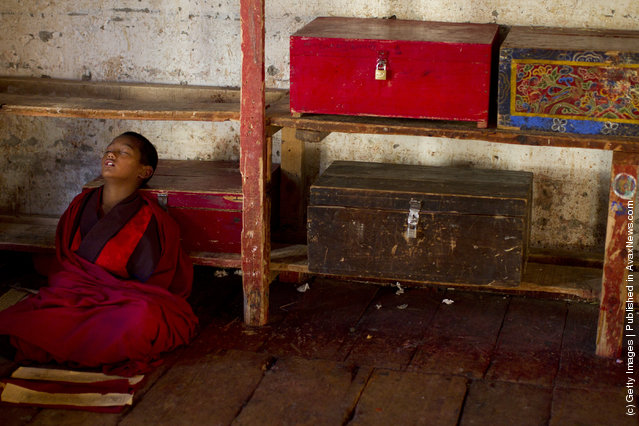
Monastic Life in Thimhu

A novice Bhutanese monk sleeps after hours of prayer waiting for class to be over at the Dechen Phodrang monastery October 18, 2011 in Thimphu, Bhutan. The monks average about 10 hours of study a day waking up at 5:00am. (Photo by Paula Bronstein/Getty Images)
Details
19 Oct 2011 10:31:00
A dhobi, or a washerman washes cloths on the banks of the River Gomti in Lucknow, India, Saturday, September 12, 2020. Dhobis are traditional laundry workers who wash clothes by hand and dry them in the sun, an occupation which has been in existence for generations. Most cities in India have a Dhobi Ghat, or washermen's area, where the city's pile of clothes is laundered. This practice is still popular in India, despite of modern technology. Around 1,000 families work in Lucknow's Dhobi Ghat. However, in light of the novel coronavirus, their wages have decreased drastically. With each family earning around US$100-200 per month. (Photo by Rajesh Kumar Singh/AP Photo)

A dhobi, or a washerman washes cloths on the banks of the River Gomti in Lucknow, India, Saturday, September 12, 2020. Dhobis are traditional laundry workers who wash clothes by hand and dry them in the sun, an occupation which has been in existence for generations. Most cities in India have a Dhobi Ghat, or washermen's area, where the city's pile of clothes is laundered. This practice is still popular in India, despite of modern technology. Around 1,000 families work in Lucknow's Dhobi Ghat. However, in light of the novel coronavirus, their wages have decreased drastically. With each family earning around US$100-200 per month. (Photo by Rajesh Kumar Singh/AP Photo)
Details
25 Sep 2020 00:03:00