Loading...
Done
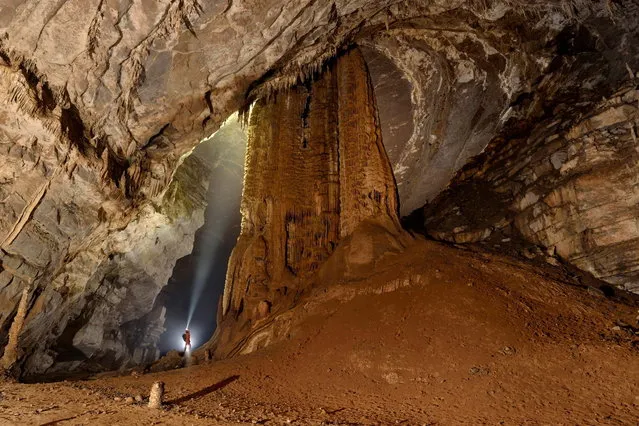
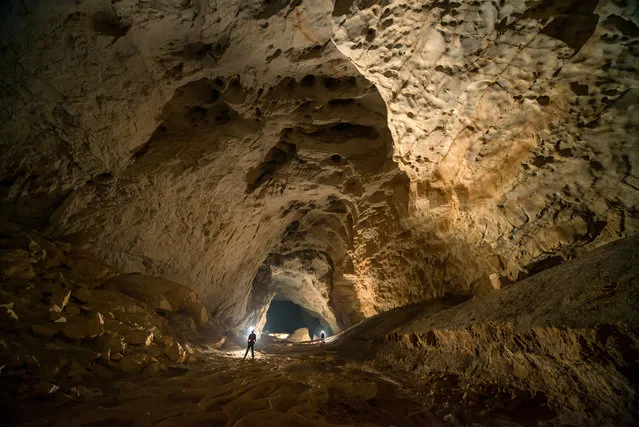
Perfectly situated in the middle of the passage this giant calcite stal boss makes a huge statement. Dwarfed by it's sheer size, Hong Meigui team member; Matt Ryan can only look up in amazement. This is one of many gigantic formations in San Wang Dong. (Photo by Robbie Shone/Caters News/ImagineChina)

“A team of expert cavers and photographers had been exploring caves in the Chongquing province of China – when they were amazed to discover the entrance to a hidden cave that was previously undiscovered. And they were stunned when they managed to enter the ginormous cave – and found that it was so large there was even a cloud inside it – a cave so large it has its own weather system. Photographer and caver Robbie Shone, from Manchester, was part of a team of 15 explorers on a month-long expedition who stumbled across the natural wonder”. – Caters News
Details
23 Mar 2014 00:03:00
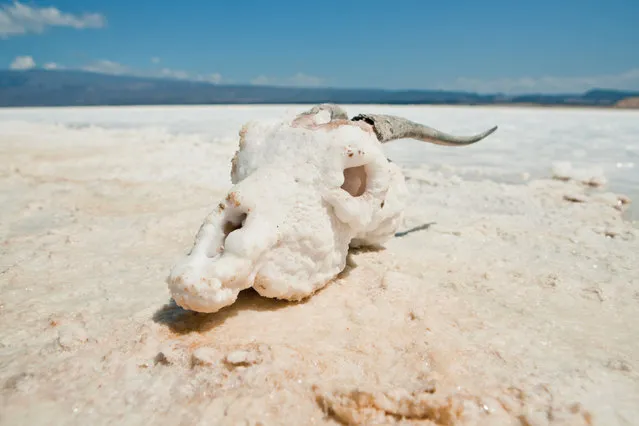
Lake Assal Crater Lake In The Central Djibouti

Lake Assal is a crater lake in central-western Djibouti. It is located at the western end of Gulf of Tadjoura in the Tadjoura Region, touching Dikhil Region, at the top of the Great Rift Valley, some 120 km (75 mi) west of Djibouti city. Lake Assal is a saline lake which lies 155 m (509 ft) below sea level in the Afar Triangle, making it the lowest point on land in Africa and the third-lowest land depression on Earth after the Dead Sea and Sea of Galilee.
Details
15 Jul 2015 10:19:00
 Marble Caves, Patagonia, Chile

The Marble Caves of Patagonia, Chile, are beautiful vibrant blue caverns, partially submerged in the equally stunning turquoise waters of Carrera Lake. The lake itself is on the border of Argentina and Chile, with the caves located on the Chilean side. The caves are comprised of three main caverns: the Chapel (La Capilla), the Cathedral (El Catedral), and the Cave (La Cueva). Visitors to the caves can explore them in a small boat or kayak, but only when Carrera Lake’s waters are calm and gentle. A rare and invaluable natural wonder, the existence of these caves is currently threatened by plans to build five large dams in the area. If you visit these caves, please treat them with the utmost respect and care.
Details
15 Aug 2012 11:25:00
Caving expedition in Fengshan, China, Guangxi province. (Photo by Francois-Xavier De Ruydts/Caters News)

“Adventurers have gone deep underground to discover previously unexplored caves in these pictures. The awe-inspiring snaps show the cavers dwarfed by the huge series natural rock chambers in the Leye – Fengshan Geopark, China. Belgian photographer Francois-Xavier De Ruydts, 33, captured the team of explorers as they trekked through the deep wonderground in January 2014”. – Caters News. Here: Caving expedition in Fengshan, China, Guangxi province. (Photo by Francois-Xavier De Ruydts/Caters News)
Details
29 Oct 2014 12:08:00
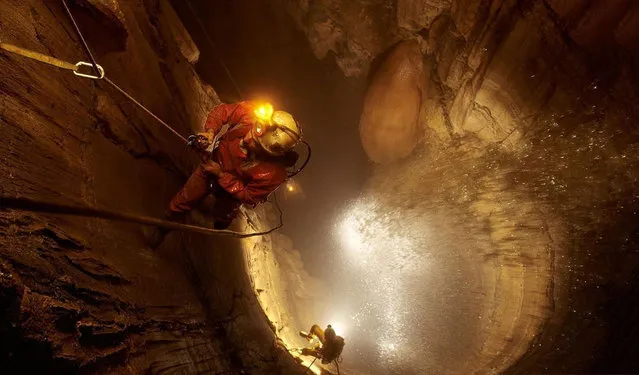
Krubera Cave Gerogia

Krubera Cave is the deepest known cave on Earth. It is located in the Arabika Massif of the Gagrinsky Range of the Western Caucasus, in the Gagra district of Abkhazia, a breakaway region of Georgia.
Details
06 Jul 2014 20:33:00
[Lake Natron in Tanzania

Lake Natron is a salt lake located in northern Tanzania, close to the Kenyan border, in the eastern branch of the East African Rift. The lake is fed by the Southern Ewaso Ng'iro River and also by mineral-rich hot springs. It is quite shallow, less than three meters (10 feet) deep, and varies in width depending on its water level, which changes due to high levels of evaporation, leaving concentrations of salt and other minerals, notably sodium carbonate (natron).
Details
05 Jun 2013 10:29:00
Crescent Lake In China

Yueyaquan is a crescent-shaped lake in an oasis, 6 km south of the city of Dunhuang in Gansu Province, China. It was named Yueyaquan in the Qing Dynasty. According to measurements made in 1960, the average depth of the lake was 4 to 5 meters, with a maximum depth of 7.5 metres In the following 40 years, the depth of the lake continually declined. In the early 1990s, its area had shrunk to only 5,500 m2 with an average depth of 0.9 meter (maximum 1.3 meter). In 2006, the local government with help of the central government started to fill the lake and restore its depth; its depth and size have been growing yearly since then. The lake and the surrounding deserts are very popular with tourists, who are offered camel and 4x4 rides.
Details
25 Jun 2013 10:29:00
Kashmiri vegetable vendors assemble at a floating market in the interiors of the Dal Lake in Srinagar April 17, 2012. (Photo by Danish Ismail/Reuters)

Kashmiri vegetable vendors assemble at a floating market in the interiors of the Dal Lake in Srinagar April 17, 2012. (Photo by Danish Ismail/Reuters)
Details
03 Jul 2015 13:11:00