Loading...
Done


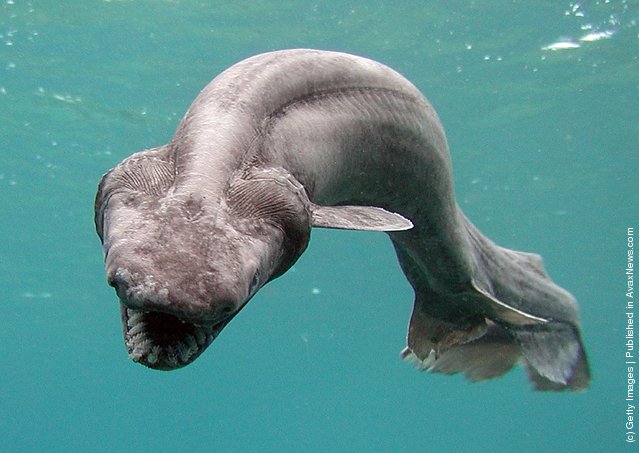
“The frilled shark (Chlamydoselachus anguineus) is one of two extant species of shark in the family Chlamydoselachidae, with a wide but patchy distribution in the Atlantic and Pacific Oceans. This uncommon species is found over the outer continental shelf and upper continental slope, generally near the bottom though there is evidence of substantial upward movements. It has been caught as deep as 1,570 m (5,150 ft), whereas in Suruga Bay, Japan it is most common at depths of 50–200 m (160–660 ft). Exhibiting several “primitive” features, the frilled shark has often been termed a «living fossil»”. – Wikipedia

Photo: A 1.6 meter long Frill shark swims in a tank after being found by a fisherman at a bay in Numazu, on January 21, 2007 in Numazu, Japan. The frill shark, also known as a Frilled shark usually lives in waters of a depth of 600 meters and so it is very rare that this shark is found alive at sea-level. It's body shape and the number of gill are similar to fossils of sharks which lived 350,000,000 years ago. (Photo by Awashima Marine Park/Getty Images)
Details
05 May 2011 10:01:00
The Wood Art Of Mark Doolittle

Mantle Or Desk Clock “Ancient Sea Form”

A large Mantle or Desk Clock featuring a fossil ammonite at its center, carved from the South American wood Keolbra with radiating Walnut spines. The clock hangs on a round, Plexiglass back supported by a wood base (Bubinga). The clockworks is a quartz, high-torque movement that runs on a single AA battery.
Details
21 Nov 2013 11:49:00
A model presents the Flesby, a one-seater mobility concept car, during a media preview of the 45th Tokyo Motor Show in Tokyo, Japan on October 25, 2017. (Photo by Kim Kyung-Hoon/Reuters)

A model presents the Flesby, a one-seater mobility concept car, during a media preview of the 45th Tokyo Motor Show in Tokyo, Japan on October 25, 2017. Japan's flagship automakers present their futuristic visions for the post-fossil fuel era at the Tokyo Motor Show that kicks off Wednesday. (Photo by Kim Kyung-Hoon/Reuters)
Details
26 Oct 2017 08:18:00
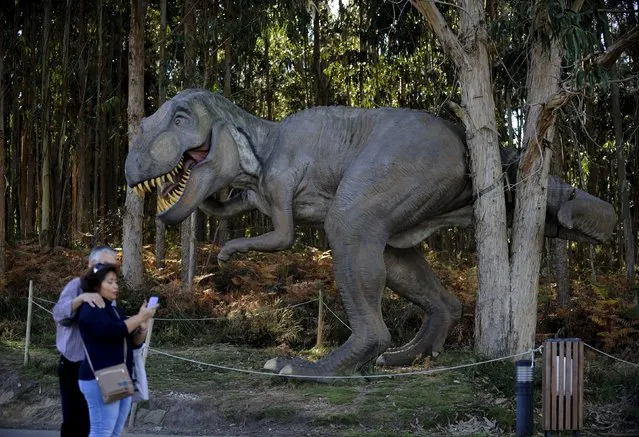
A couple takes a photo outside the MUJA (Jurassic Museum of Asturias) in Colunga, northern Spain, November 6, 2015. (Photo by Eloy Alonso/Reuters)

A couple takes a photo outside the MUJA (Jurassic Museum of Asturias) in Colunga, northern Spain, November 6, 2015. The scientific team of the Jurassic Museum of Asturias (MUJA) presents their latest studies on the fossil of a Ichthyosaur, which acccording to them is the most complete found in the Iberian Peninsula and one of the few in the world. (Photo by Eloy Alonso/Reuters)
Details
09 Nov 2015 08:00:00
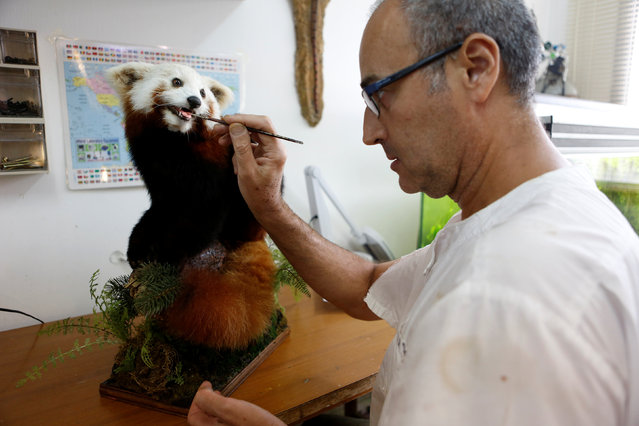
Igor Gavrilov, the main taxidermist of the Zoological centre at Tel Aviv University, works on a taxidermied animal, part of a collection which will be housed at the Steinhardt Museum of Natural History, a new Israeli natural history museum set to open next year in Tel Aviv, Israel June 8, 2016. Legions of insects, sea creatures and ancient fossils are lining up in a new museum shaped liked a giant Noah's Ark, telling the story of a crucial evolutionary byway across Israel. Experts say all humans and other animals had to pass through Israel on their first journey out of Africa into Europe and Asia. (Photo by Nir Elias/Reuters)

Igor Gavrilov, the main taxidermist of the Zoological centre at Tel Aviv University, works on a taxidermied animal, part of a collection which will be housed at the Steinhardt Museum of Natural History, a new Israeli natural history museum set to open next year in Tel Aviv, Israel June 8, 2016. Legions of insects, sea creatures and ancient fossils are lining up in a new museum shaped liked a giant Noah's Ark, telling the story of a crucial evolutionary byway across Israel. (Photo by Nir Elias/Reuters)
Details
25 Aug 2016 09:42:00
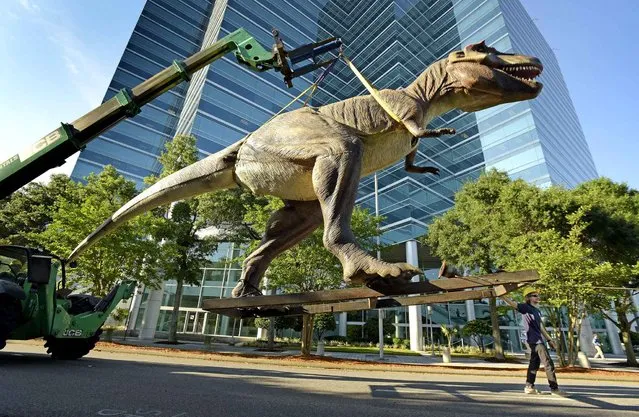
Crews move a 39 foot long, 16 foot tall, 2400 lbs. replica of a Tyrannosaurus Rex from behind the Museum Of Science And History in Jacksonville, Fla., to its new location in front of the entrance of the museum Wednesday morning, May 20, 2015, to kickoff the upcoming Dinosaurs Unearthed exhibit. (Photo by Bob Self/The Florida Times-Union via AP Photo)

Crews move a 39 foot long, 16 foot tall, 2400 lbs. replica of a Tyrannosaurus Rex from behind the Museum Of Science And History in Jacksonville, Fla., to its new location in front of the entrance of the museum Wednesday morning, May 20, 2015, to kickoff the upcoming Dinosaurs Unearthed exhibit. The exhibiti, which opens this week, includes animatronic dinosaurs as well as prehistoric fossils and runs through September 7. (Photo by Bob Self/The Florida Times-Union via AP Photo)
Details
23 May 2015 11:22:00
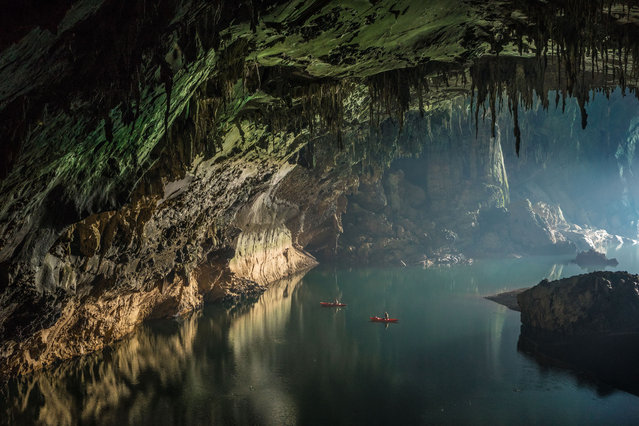
Floating on clear deep water and reflections near the cave entrance. Visitors can either bring their own kayaks or rent boats from the local community to paddle deep inside the cave and marvel at its wonders on March 2015 at Tham Khoun Ex, Laos. Tham Khoun Xe, commonly known as the Xe Bang Fai River Cave, in Laos, has over 15km of passages filled with awe-inspiring views and wide expanses of water. (Photo by John Spies/Barcroft Media/ABACAPress)

Floating on clear deep water and reflections near the cave entrance. Visitors can either bring their own kayaks or rent boats from the local community to paddle deep inside the cave and marvel at its wonders on March 2015 at Tham Khoun Ex, Laos. Tham Khoun Xe, commonly known as the Xe Bang Fai River Cave, in Laos, has over 15km of passages filled with awe-inspiring views and wide expanses of water. Photographer, John Spies, 59, captured scenes from the entrances of the huge underground river passages, intricate cave formations and views from a passage high above the water. The cave is formed by the Xe Bang Fai river, a major tributary of the Mekong and in the dry season can be traversed using inflatable kayaks. (Photo by John Spies/Barcroft Media/ABACAPress)
Details
11 Apr 2015 09:56:00
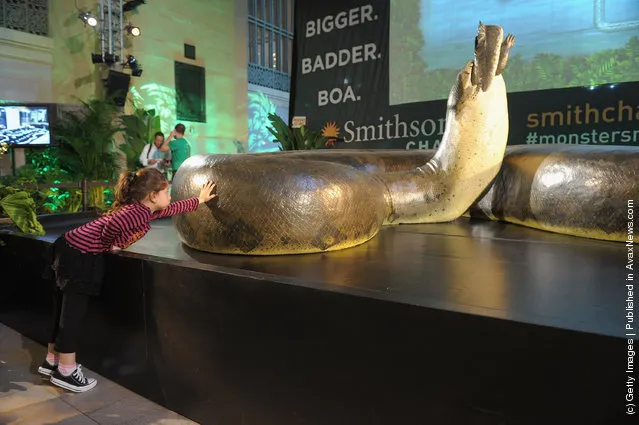
Attendees view a replica of the prehistoric Titanoboa, the largest snake to ever live, on display at Grand Central Terminal in New York City

“Titanoboa is a genus of snake that lived approximately 58–60 million years ago, during the Paleocene epoch, a 10-million-year period immediately following the dinosaur extinction event. The only known species is the Titanoboa cerrejonensis, the largest snake ever discovered, which supplanted the previous record holder, Gigantophis”. – Wikipedia

Photo: Leah Del Rio views a replica of the prehistoric Titanoboa, the largest snake to ever live, on display at Grand Central Terminal on March 23, 2012 in New York City. (Photo by Michael Loccisano/Getty Images)
Details
24 Mar 2012 10:14:00