Loading...
Done
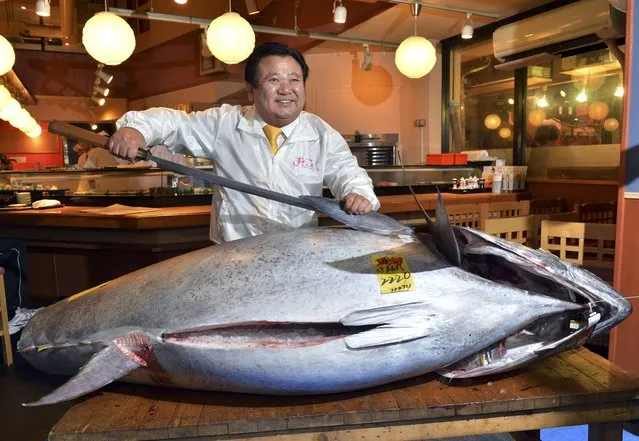
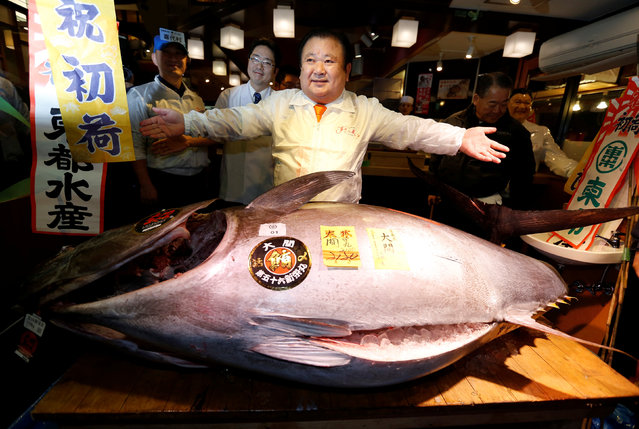
Kiyomura Co's President Kiyoshi Kimura (C), who runs a chain of sushi restaurants Sushi Zanmai, poses with a 212 kg (467 lbs) bluefin tuna at his sushi restaurant outside Tsukiji fish market in Tokyo, Japan, January 5, 2017. Kimura won the bid for the tuna caught off Oma, Aomori prefecture, northern Japan, with a 74 million yen (633,000 USD) at the fish market's first tuna auction this year. (Photo by Issei Kato/Reuters)

Kiyomura Co's President Kiyoshi Kimura (C), who runs a chain of sushi restaurants Sushi Zanmai, poses with a 212 kg (467 lbs) bluefin tuna at his sushi restaurant outside Tsukiji fish market in Tokyo, Japan, January 5, 2017. Kimura won the bid for the tuna caught off Oma, Aomori prefecture, northern Japan, with a 74 million yen (633,000 USD) at the fish market's first tuna auction this year. (Photo by Issei Kato/Reuters)
Details
06 Jan 2017 13:49:00
President of sushi restaurant chain Sushi-Zanmai, Kiyoshi Kimura, displays a 222kg bluefin tuna at his main restaurant near Tokyo's Tsukiji fish market on January 5, 2013. The bluefin tuna was traded at 155.4 million yen (1.77 million USD) at the wholesale market, smashing a previous record. (Photo by Yoshikazu Tsuno/AFP Photo)

Japanese businessman Kiyoshi Kimura has paid 1.38 million euros ($1.76 million, or 155.4 million yen) for a blue fin tuna – more than three times the previous high – which he also set one year ago. The 222-kilogram fish will be served to Kimura’s customers. Blue fin tuna is annually sold in a traditional New Year’s auction. Japan consumes 80 percent blue fin tuna caught worldwide.

Photo: President of sushi restaurant chain Sushi-Zanmai, Kiyoshi Kimura, displays a 222kg bluefin tuna at his main restaurant near Tokyo's Tsukiji fish market on January 5, 2013. The bluefin tuna was traded at 155.4 million yen (1.77 million USD) at the wholesale market, smashing a previous record. (Photo by Yoshikazu Tsuno/AFP Photo)
Details
06 Jan 2013 13:26:00
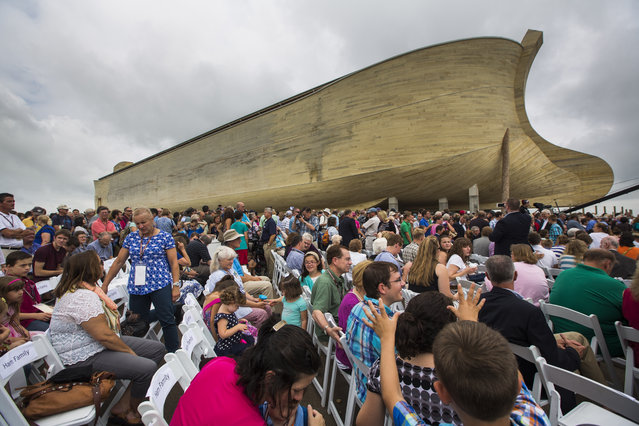
Visitors gather outside Ark Encounter, a 100 million USD, 510-foot-long re-creation of Noah's Ark in Williamstown Kentucky, USA, 05 July 2016. Ark Encounter is the brainchild of Australian-born creationist Ken Ham; it was built with the help of state tax incentives and the sale of 62 million USD in junk bonds. (Photo by Jim Lo Scalzo/EPA)

Visitors gather outside Ark Encounter, a 100 million USD, 510-foot-long re-creation of Noah's Ark in Williamstown Kentucky, USA, 05 July 2016. Ark Encounter is the brainchild of Australian-born creationist Ken Ham; it was built with the help of state tax incentives and the sale of 62 million USD in junk bonds. (Photo by Jim Lo Scalzo/EPA)
Details
07 Jul 2016 11:40:00


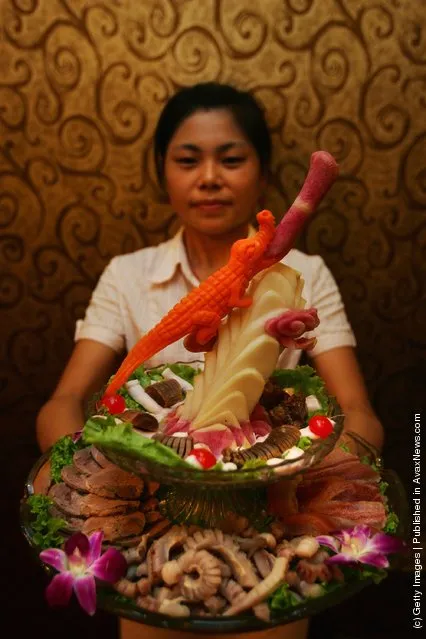
A waitress displays a plate of animal penises and testis at the Guolizhuang pen*s Restaurant on September 7, 2007 in Beijing, China. The restaurant offers more than 30 types of animal-pen*s dishes which can cost from 500 yuan (76.99 USD) up to 90,000 yuan (13,857.67 USD). It is believed that eating an animal's pen*s can strengthen a man's sexual ability. (Photo by Feng Li/Getty Images)
Details
06 May 2011 12:20:00
#6. Vietnam, Total GDP: USD 202.6 billion (2016). Contribution of Travel and Tourism to GDP: 9.1% . Here: A boat in the Thu Bon River, Hoi An, Vietnam. (Photo by Domingo Leiva/Getty Images)

South Asian countries in terms of total contribution of travel and tourism to GDP. #6. Vietnam, Total GDP: USD 202.6 billion (2016). Contribution of Travel and Tourism to GDP: 9.1% . Here: A boat in the Thu Bon River, Hoi An, Vietnam. (Photo by Domingo Leiva/Getty Images)
Details
06 Dec 2017 07:03:00


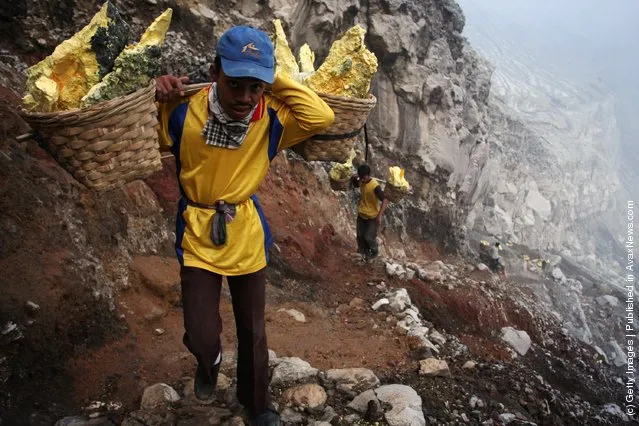
Traditional miners carry sulphur on the Ijen volcano complex on May 25, 2009 outside Banyuwangi, East Java, Indonesia. Miners carry the solidified yellow sulphur blocks from the crater floor to the rim for as many hours a day as they can tolerate, paid by the kilogram of sulphur they extract. The average wage is USD $.05 per kilogram of sulphur and a worker, depending on his strength and stamina, carry on average 3 baskets of 70-80kg per day, earning him around USD $11. (Photo by Ulet Ifansasti/Getty Images)
Details
08 Jul 2011 10:53:00
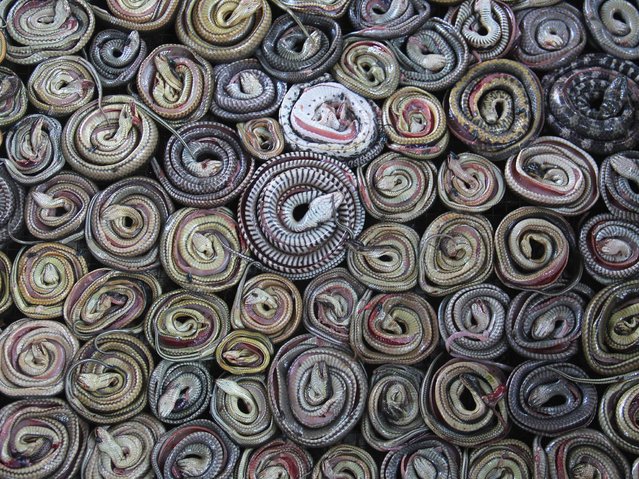
Snakes are collected and rolled before putting into the oven on March 2, 2014 in the village of Kertasura, Cirebon, Indonesia. (Photo by Nurcholis Anhari Lubis/Getty Images)

Snakes are collected and rolled before putting into the oven on March 2, 2014 in the village of Kertasura, Cirebon, Indonesia. At slaughter house snake skins measuring in the hundreds of metres, are sold to bag factories in the West and Central Java provinces on a monthly basis. From snake skin was manufactured into bags, shoes, wallets and belts. The price of a bag made from snake skin costs between 150,000 rupiah ($15 USD) and 300,000 rupiah ($30 USD), depending on its size. When snake skins reach Western fashion houses their price can increase dramatically and sell for up to $4,000 USD. (Photo by Nurcholis Anhari Lubis/Getty Images)
Details
05 Mar 2014 07:31:00
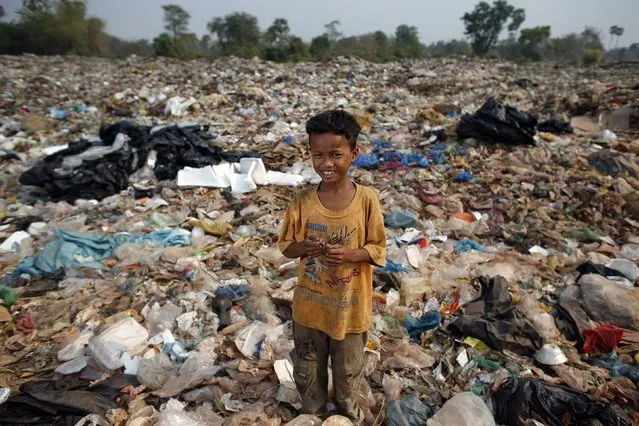
Ty, a 15-year-old boy, poses for a picture while collecting usable items at a landfill dumpsite outside Siem Reap March 19, 2015. Ty, who finished  six-grade primary school, said he makes 5 USD per month working at the dumpsite. (Photo by Athit Perawongmetha/Reuters)

Ty, a 15-year-old boy, poses for a picture while collecting usable items at a landfill dumpsite outside Siem Reap March 19, 2015. Ty, who finished six-grade primary school, said he makes 5 USD per month working at the dumpsite. (Photo by Athit Perawongmetha/Reuters)
Details
22 Mar 2015 11:13:00