Loading...
Done
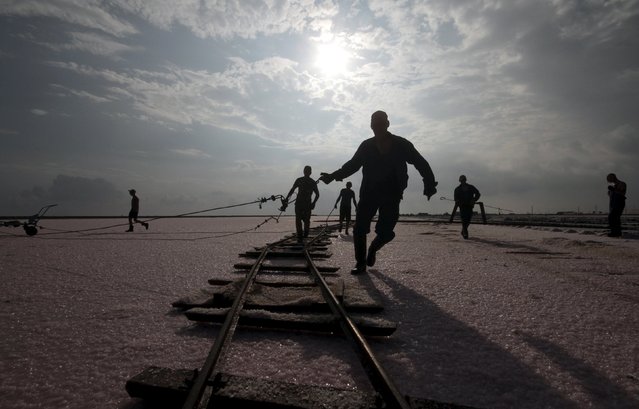
Workers adjust rails at the bed of a drained area of a lake used for the production of salt at the Sasyk-Sivash lake near the city of Yevpatoria, Crimea, September 25, 2015. The area has a long tradition of salt production, prepared from salt flats flooded with water from the Black Sea. (Photo by Pavel Rebrov/Reuters)

Workers adjust rails at the bed of a drained area of a lake used for the production of salt at the Sasyk-Sivash lake near the city of Yevpatoria, Crimea, September 25, 2015. The area has a long tradition of salt production, prepared from salt flats flooded with water from the Black Sea. (Photo by Pavel Rebrov/Reuters)
Details
28 Sep 2015 08:01:00
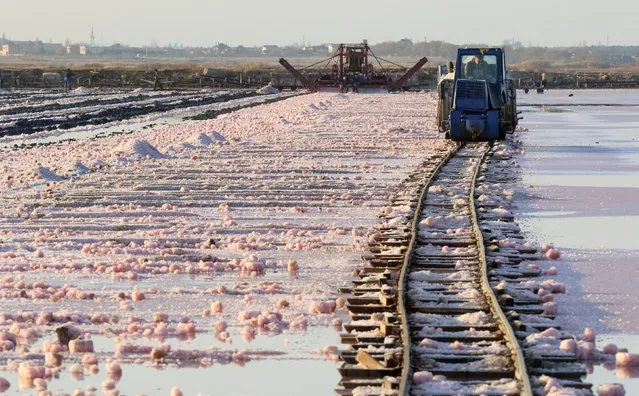
A train drives along a field at a salt production site at the Sasyk-Sivash lake near the city of Yevpatoria, Crimea, November 14, 2017. (Photo by Pavel Rebrov/Reuters)

A train drives along a field at a salt production site at the Sasyk-Sivash lake near the city of Yevpatoria, Crimea, November 14, 2017. A saltwater lagoon known as Lake Sasyk-Sivash on Ukraine's Crimea peninsula is the source of a rare resource: pink salt. The mineral is tinted by tiny algae that produce the pigment beta-carotene. Each autumn, seasonal workers collect thousands of tons of pink salt for processing and export. (Photo by Pavel Rebrov/Reuters)
Details
16 Nov 2017 08:18:00
Salt

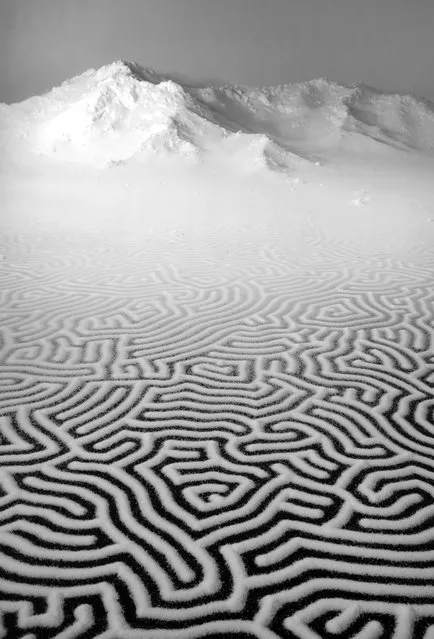
Motoi Yamamoto is an incredibly patient man. His intricate salt labyrinths can take weeks to create and require a slow, steady hand, not to mention a tremendous amount of salt. The result is a beautifully detailed, if impermanent, exhibition.
Details
13 Jul 2012 10:21:00
Villagers cry for their relatives who were killed in an earthquake during a funeral in Longmen village, in Lushan county in southwest China's Sichuan province, on April 21, 2013. Rescuers and relief teams struggled to rush supplies into the rural hills of the area after an earthquake left at least 180 people dead and more than 11,000 injured. (Photo by Associated Press)

Villagers cry for their relatives who were killed in an earthquake during a funeral in Longmen village, in Lushan county in southwest China's Sichuan province, on April 21, 2013. Rescuers and relief teams struggled to rush supplies into the rural hills of the area after an earthquake left at least 180 people dead and more than 11,000 injured. (Photo by Associated Press)
Details
21 Apr 2013 10:59:00
Split Apple Rock

Split Apple Rock is a geological rock formation in The Tasman Bay off the northern coast of the South Island of New Zealand. Made of granite, it is in the shape of an apple which has been cut in half. It is a popular tourist attraction in the waters of the Tasman Sea approximately 50 metres off the coast between Kaiteriteri and Marahau. The rock sits in shallow water at low tide and is accessible by wading. It is also a point of interest for the many tourist boats and pleasure craft which operate along the shores of the Abel Tasman National Park. The cleft to produce two sides of the 'apple' was a natural occurrence. It is unknown when this happened and therefore the cleaving of the rock has attracted mythological explanations.
Details
19 Oct 2013 10:58:00
Rock Fishing In Sydney

A fisherman is seen standing on a cliff edge at Cape Bank in La Perouse on February 20, 2011 in Sydney, Australia. The practice of fishing from rock platforms, cliffs and rocky outcrops is notoriously dangerous with many anglers per year being washed into the ocean by dangerous surf or unexpected large waves. Angling is often reported as the sport having the highest mortality rate on average due to fishermen drowning with rocking fishing contributing to a high number of these deaths. (Photo by Mark Kolbe/Getty Images)
Details
16 Aug 2011 11:34:00
Wave Rock, Arizona

Wave Rock is a natural rock formation that is shaped like a tall breaking ocean wave. The "wave" is about 14 m (46 ft) high and around 110 m (360 ft) long. It forms the north side of a solitary hill, which is known as “Hyden Rock”. This hill, which is a granite inselberg, lies about 3 km (2 mi) east of the small town of Hyden and 296 km (184 mi) east-southeast of Perth, Western Australia. Wave Rock and Hyden Rock are part of a 160 ha (395-acre) nature reserve, Hyden Wildlife Park.
Details
12 Aug 2014 10:21:00
Salt ponds in San Francisco Bay

Salt evaporation ponds, also called salterns or salt pans, are shallow artificial ponds designed to produce salts from sea water or other brines. The seawater or brine is fed into large ponds and water is drawn out through natural evaporation which allows the salt to be subsequently harvested. The ponds also provide a productive resting and feeding ground for many species of waterbirds, which may include endangered species. The ponds are commonly separated by levees.
Details
11 Oct 2012 12:49:00