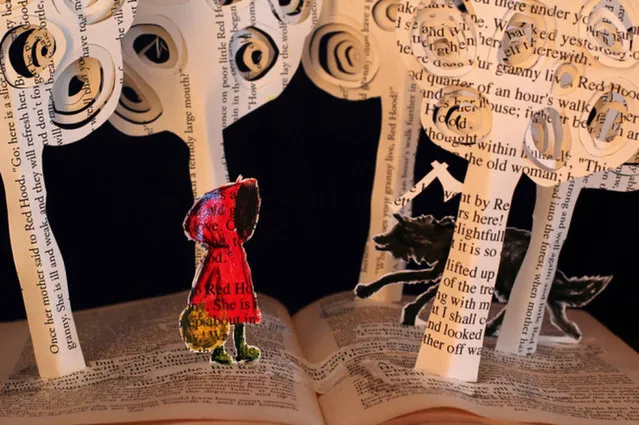
Justin Rowe creates these magical sculptures from hand cut books and found images with the help of just a touch of gum arabic and 24 carat gold or palladium leaf. Some are very much in the realms of fairy stories like the one above, but my favourites are the stories below where Justin’s skill brings the book’s own illustrations to life.
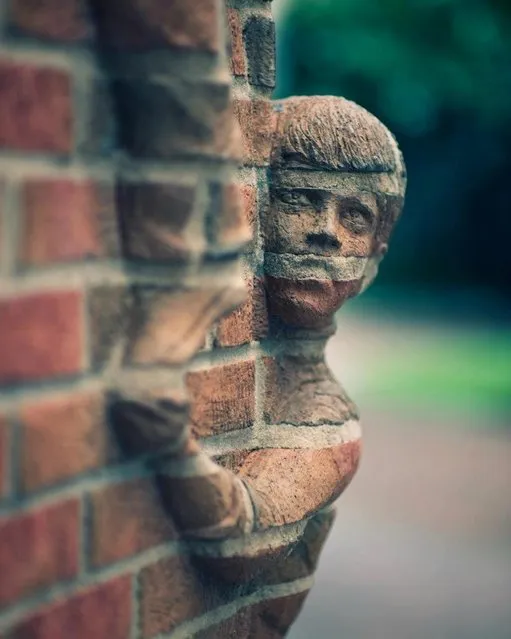
Brad Says “Brick sculpture can be dated back to ancient Babylon but remains a fresh and interesting enhancement to any building, wall or environment. The brick medium has all the same characteristics of durability and low maintenance as a brick building, blends well in settings where other brick construction is present, looks good with landscaping and has a familiarity which is comforting to people. Brick sculpture adds intrigue and interest to a commonly understood material as viewers try to figure out the techniques by which it was created.”
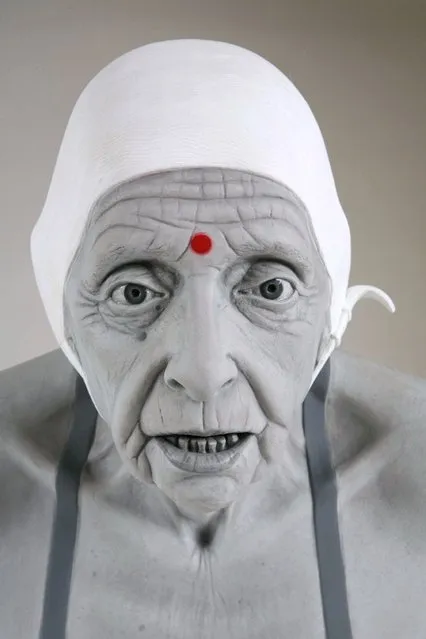
Tip Toland is a sculptor and instructor living in the Seattle, Washington area. Her current focus is figurative ceramic sculpture. Tip is represented by the Nancy Margolis Gallery in New York City.
Photo: “Letter to God”, 2011. Stoneware, paint, chalk pastel, hair. (Photo by Tip Toland/Marie-Andrée Côté)
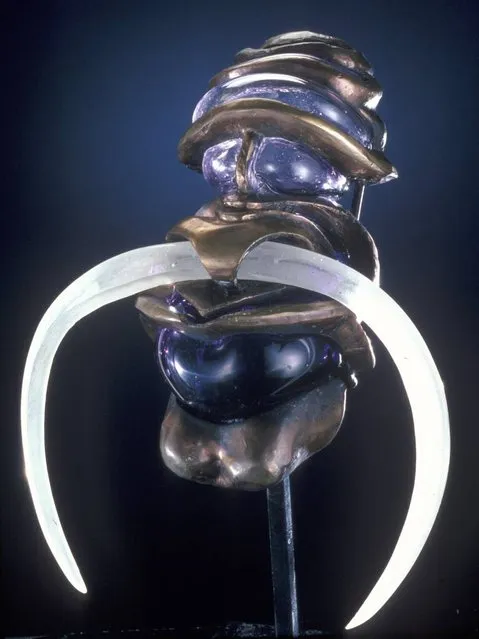
Miles Van Rensselaer using everything from glass and crystal to bronze and iron, from gold and silver to tooth and bone, from steel, copper and lead to wood, clay, feather and hair. He has been fortunate enough to work – and humbled by working – with and among talented artists from all over the world. His work is his homage to these people and their vanishing ways of life, his translation of their technique, imagery, idea of “primitive” art into modern Western materials.
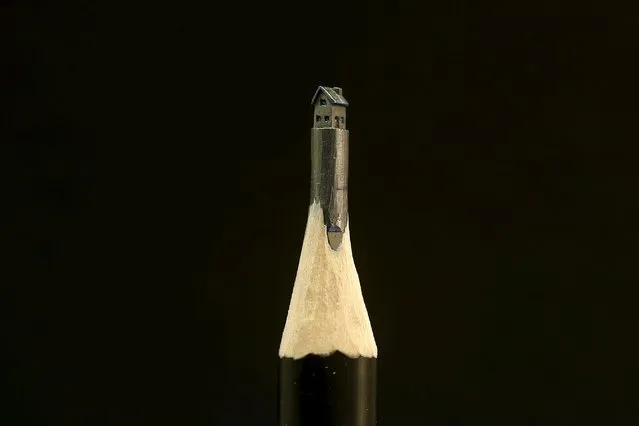
A miniature sculpture in the shape of a home, created by self-taught artist Jadranko Djordjevic on a graphite pencil, is seen in Tuzla, Bosnia and Herzegovina April 26, 2016. (Photo by Dado Ruvic/Reuters)
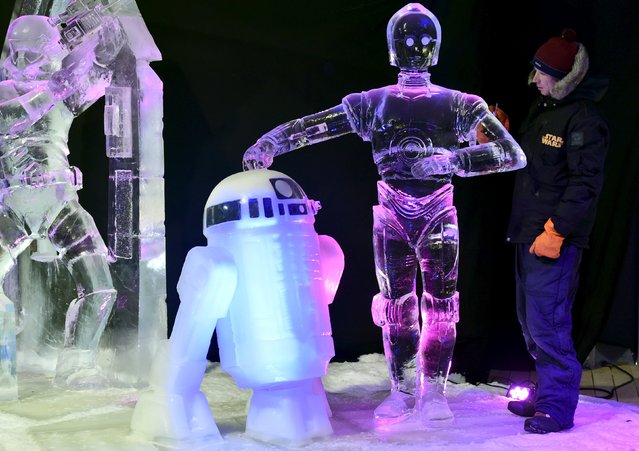
Canada's Yuri Nazarkin carves Star Wars character C-3PO (R) and R2-D2 for the ice sculpture festival in Liege, Belgium, November 13, 2015. (Photo by Eric Vidal/Reuters)
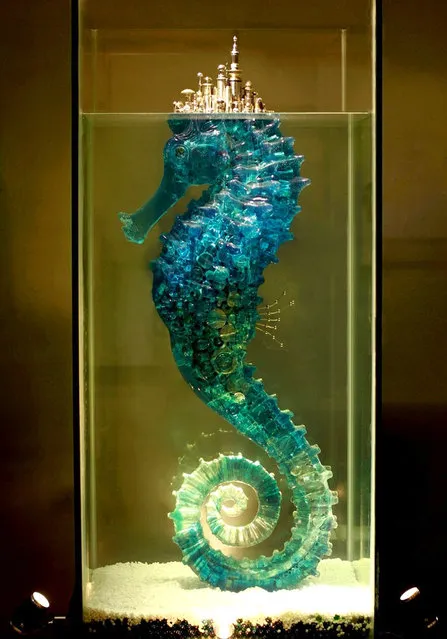
Hu Shaoming is a fantastic artist from China, who has learnt Fine Arts at Guangzhou Academy. The most complex sculpture of all his works is a mechanical seahorse, constructed from many tiny details. The whole composition consists of two complete opposites, including the top part of the seahorse`s head that looks like a golden town, and the bottom which resembles an amazing blue creature. An important problem is reflected in such an idea; it shows how a man forces the nature into submission. The contrast in the opposition of the human buildings and conquered Mother Nature suggests the thought of keeping our natural environment safe.