Loading...
Done
A little boy shouts “Earthquake!” during a shouting contest, part of the annual evacuation drill on the National Disaster Prevention Day on September 1, 1986. The contest was aimed at teaching youngsters the importance of telling neighbors quickly and loudly of a disaster when it hits. The drill is annually conducted through out the country on the day marking the anniversary of the Great Kanto Earthquake that hit the Japanese capital and its vicinity on September 1, 1923, killing more than 104,000 people. (Photo by Sadayuki Mikami/AP Photo)

A little boy shouts “Earthquake!” during a shouting contest, part of the annual evacuation drill on the National Disaster Prevention Day on September 1, 1986. The contest was aimed at teaching youngsters the importance of telling neighbors quickly and loudly of a disaster when it hits. The drill is annually conducted through out the country on the day marking the anniversary of the Great Kanto Earthquake that hit the Japanese capital and its vicinity on September 1, 1923, killing more than 104,000 people. (Photo by Sadayuki Mikami/AP Photo)
Details
02 Sep 2015 11:58:00
U.S. Corporal Stanley Suski, left, and Miss Tamako, a Geisha girl, whirl a bit of Jitterbug, in a bar, in Tokyo, Japan, on October 1, 1945. (Photo by AP Photo)

U.S. Corporal Stanley Suski, left, and Miss Tamako, a Geisha girl, whirl a bit of Jitterbug, in a bar, in Tokyo, Japan, on October 1, 1945. (Photo by AP Photo)
Details
06 Oct 2015 08:07:00
Demonstrators wear skull masks during an anti government protest, as Chile's President Michelle Bachelet delivers a speech inside the National Congress, in Valparaiso city, Chile May 21, 2016. (Photo by Ivan Alvarado/Reuters)

Demonstrators wear skull masks during an anti government protest, as Chile's President Michelle Bachelet delivers a speech inside the National Congress, in Valparaiso city, Chile May 21, 2016. (Photo by Ivan Alvarado/Reuters)
Details
22 May 2016 06:53:00
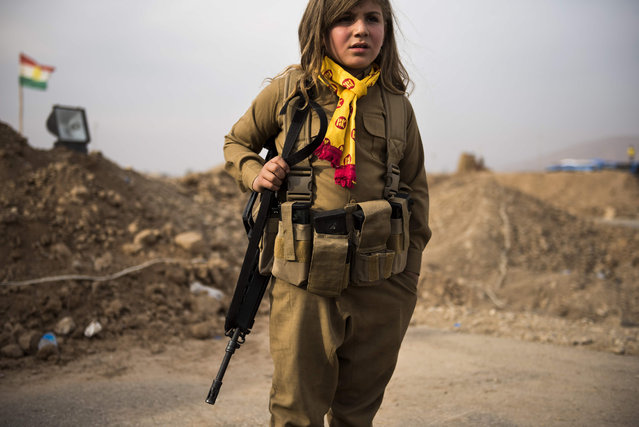
A Kurdish girl wears her relative's assault rifle and ammunition belt as she waits at the  Iraqi Kurdish Shaqouli checkpoint, some 35 kilometres east of Mosul, on November 10, 2016. Since the start of the Mosul offensive the Kurds have moved their border some 10 kms closer to Iraq's second city, marking it out with a line in the sand. (Photo by Odd Andersen/AFP Photo)

A Kurdish girl wears her relative's assault rifle and ammunition belt as she waits at the Iraqi Kurdish Shaqouli checkpoint, some 35 kilometres east of Mosul, on November 10, 2016. Since the start of the Mosul offensive the Kurds have moved their border some 10 kms closer to Iraq's second city, marking it out with a line in the sand. (Photo by Odd Andersen/AFP Photo)
Details
11 Nov 2016 08:02:00
Model Juliana Paesthe (C) of Viradouro samba school participates in the annual carnival parade in Rio de Janeiro's Sambadrome, February 15, 2015. (Photo by Ricardo Moraes/Reuters)

Model Juliana Paesthe (C) of Viradouro samba school participates in the annual carnival parade in Rio de Janeiro's Sambadrome, February 15, 2015. (Photo by Ricardo Moraes/Reuters)
Details
17 Feb 2015 11:41:00
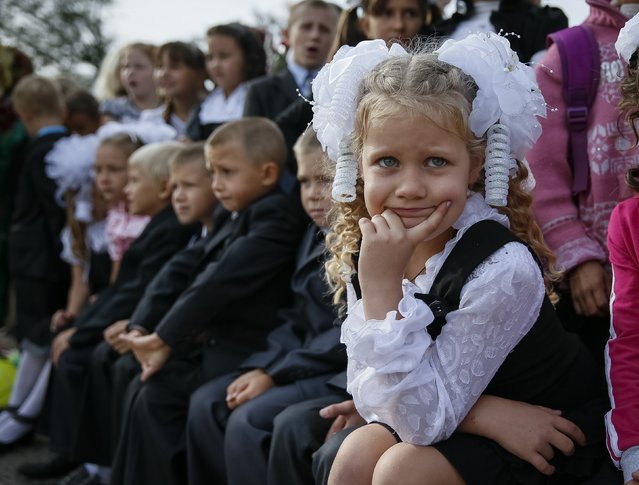
First graders attend a festive ceremony to mark the start of another school year in Slaviansk, September 1, 2014. (Photo by Gleb Garanich/Reuters)

First graders attend a festive ceremony to mark the start of another school year in Slaviansk, September 1, 2014. September 1 marks the start of a new academic year for students in Ukraine. (Photo by Gleb Garanich/Reuters)
Details
02 Sep 2014 12:38:00
Crime Tatoo  Part 1

Tattoos are commonly used among criminals to show gang membership and record the wearer's personal history—such as his or her skills, specialties, accomplishments and convictions. They are also used as a means of personal expression. Certain designs have developed recognized coded meanings. The code systems can be quite complex and because of the nature of what they encode, the tattoo designs are not widely recognized.
Details
23 Apr 2013 10:29:00
Serbian police officers of the Special Anti-Terrorist Unit pose for a picture in their base outside Belgrade October 8, 2014. (Photo by Marko Djurica/Reuters)

Serbian police officers of the Special Anti-Terrorist Unit pose for a picture in their base outside Belgrade October 8, 2014. When the killing of an unarmed black teenager by a white policeman in Ferguson, Missouri, in August sparked sometimes violent protests, the response of police in camouflage gear and armoured vehicles wielding stun grenades and assault rifles seemed more like a combat operation than a public order measure. Some U.S. police departments have recently acquired U.S. military-surplus hardware from wars abroad, but there are many law enforcers around the world whose rules of engagement also allow the use of lethal force with relatively few restrictions. But for every regulation that gives police wide scope to use firearms, there is another code that sharply limits their use. In Serbia, police may use measures ranging from batons to special vehicles, water cannon and tear gas on groups of people who have gathered illegally and are behaving in a way that is violent or could cause violence, but they may use firearms only when life is endangered. (Photo by Marko Djurica/Reuters)
Details
27 Nov 2014 14:53:00