Loading...
Done
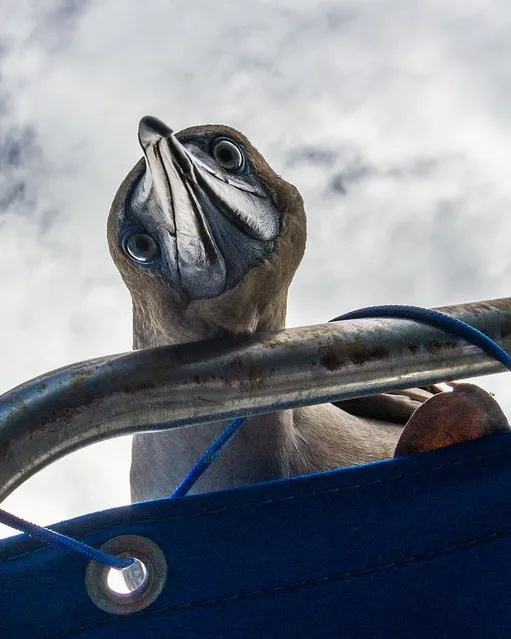
“Close-up. We had a juvenile Red-Footed Booby come visit us on the sun deck. I got some closeups with my ultrawide 11-16mm Tokina”. (Photo by Carl Fredrickson)

Situated in the Pacific Ocean some 620 miles (1,000 km) from the South American continent, these 19 islands and the surrounding marine reserve have been called a unique “living museum and showcase of evolution”. Photo: “Close-up. We had a juvenile Red-Footed Booby come visit us on the sun deck. I got some closeups with my ultrawide 11-16mm Tokina”. (Photo by Carl Fredrickson)
Details
04 Sep 2013 11:49:00


Greetings, sickly monkeys! Planet Nibiru is near already. Confess, parasites! Love you! Yours truly, Avax
Details
16 May 2012 15:07:00
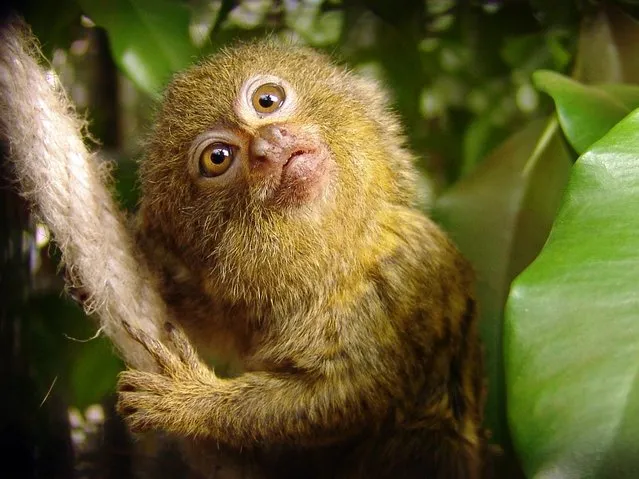
Pygmy Marmoset - The Smallest Monkey

The pygmy marmoset (Cebuella pygmaea) is a small New World monkey native to rainforests of the western Amazon Basin in South America. It is notable for being the smallest monkey in the world at just over 100 grams (3.5 oz). It is generally found in evergreen and river edge forests and is a gum-feeding specialist
Details
29 Jan 2014 12:59:00
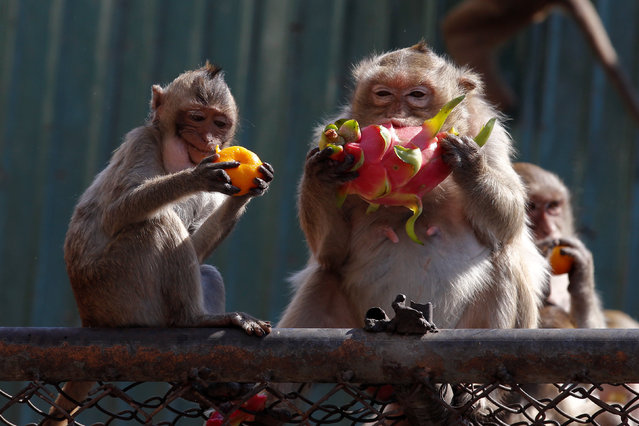
Monkeys eat fruits during the Monkey Buffet Festival, near the Phra Prang Sam Yot temple in Lopburi province, north of Bangkok, Thailand November 27, 2016. (Photo by Chaiwat Subprasom/Reuters)

Monkeys eat fruits during the Monkey Buffet Festival, near the Phra Prang Sam Yot temple in Lopburi province, north of Bangkok, Thailand November 27, 2016. (Photo by Chaiwat Subprasom/Reuters)
Details
28 Nov 2016 12:09:00
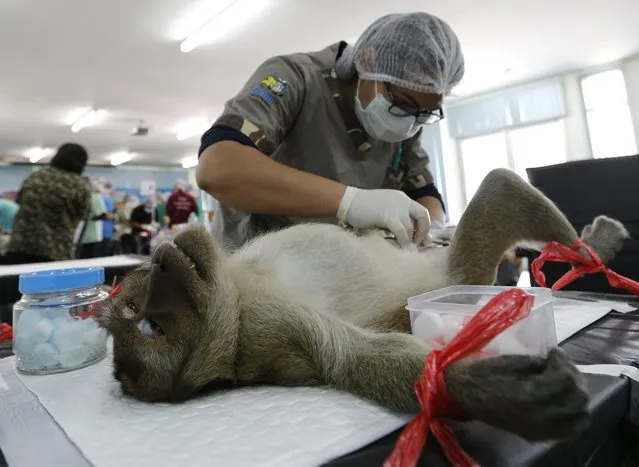
A Thai veterinarian sterilizes a monkey in a bid to control the birth rate of the monkey population in Hua Hin city, Prachuap Khiri Khan Province, Thailand, 15 July 2017. (Photo by Narong Sangnak/EPA/EFE)

A Thai veterinarian sterilizes a monkey in a bid to control the birth rate of the monkey population in Hua Hin city, Prachuap Khiri Khan Province, Thailand, 15 July 2017. (Photo by Narong Sangnak/EPA/EFE)
Details
17 Jul 2017 08:03:00
A large bull walrus returns to the shores of Prins Karl Forland after diving and feeding on clams

A large bull walrus returns to the shores of Prins Karl Forland after diving and feeding on clams. (Photo by Paul Nicklen/National Geographic). Svalbard, Norway, 2011
Details
14 Apr 2012 11:53:00
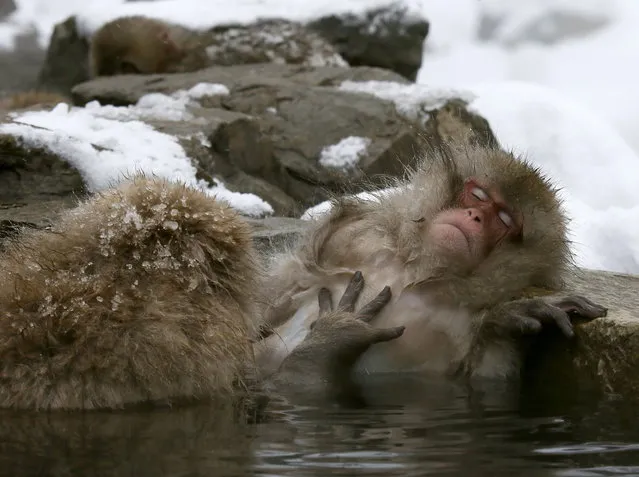
Japanese Macaque monkeys soak in the warmth of mountain hotsprings at Jigokudani Monkey Park, in Yamanouchi, central Japan, 19 January 2014. The Japanese Macaques (Macaca fuscata), also referred to as Snow Monkeys, live freely in this area that is covered by snow one third of the year. (Photo by Kimimasa Mayama/EPA)

Japanese Macaque monkeys soak in the warmth of mountain hotsprings at Jigokudani Monkey Park, in Yamanouchi, central Japan, 19 January 2014. The Japanese Macaques (Macaca fuscata), also referred to as Snow Monkeys, live freely in this area that is covered by snow one third of the year. Jigokudani is the only known place in the world where monkeys bathe in natural hot springs. As a habit, they come down from the mountains where they spend the night and bath during the day. (Photo by Kimimasa Mayama/EPA)
Details
21 Jan 2014 11:36:00
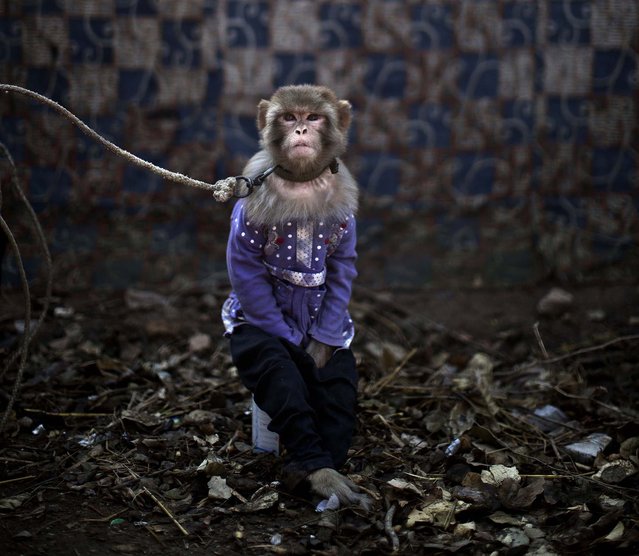
In this Tuesday, February 11, 2014, photo, a trained monkey, that makes a living for her Pakistani owner by performing to a crowd in public and private places, sits held by a leash, in Rawalpindi, Pakistan. For Pakistanis who raise and train the monkeys they are an important source of income in an impoverished country, and they form a strong bond with the animals. The monkeys are usually captured in the wild when they are babies and then trained. A trained monkey can fetch 20,000 to 30,000 rupees ($190 to $285). (Photo by Muhammed Muheisen/Associated Press)

In this Tuesday, February 11, 2014, photo, a trained monkey, that makes a living for her Pakistani owner by performing to a crowd in public and private places, sits held by a leash, in Rawalpindi, Pakistan. For Pakistanis who raise and train the monkeys they are an important source of income in an impoverished country, and they form a strong bond with the animals. The monkeys are usually captured in the wild when they are babies and then trained. A trained monkey can fetch 20,000 to 30,000 rupees ($190 to $285). (Photo by Muhammed Muheisen/Associated Press)
Details
23 Feb 2014 09:50:00