Loading...
Done
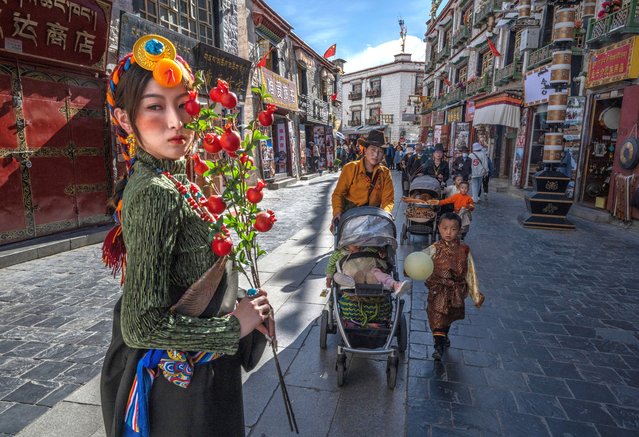
A woman has her photo taken wearing tradtional clothing as a Tibetan Buddhist woman and her family walk the kora near the Jokhang Temple, a UNESCO heritage site, during a government organized visit for journalists on June 1, 2021 in Lhasa, Tibet Autonomous Region, China. (Photo by Kevin Frayer/Getty Images)

A woman has her photo taken wearing tradtional clothing as a Tibetan Buddhist woman and her family walk the kora near the Jokhang Temple, a UNESCO heritage site, during a government organized visit for journalists on June 1, 2021 in Lhasa, Tibet Autonomous Region, China. (Photo by Kevin Frayer/Getty Images)
Details
22 Jun 2021 07:59:00
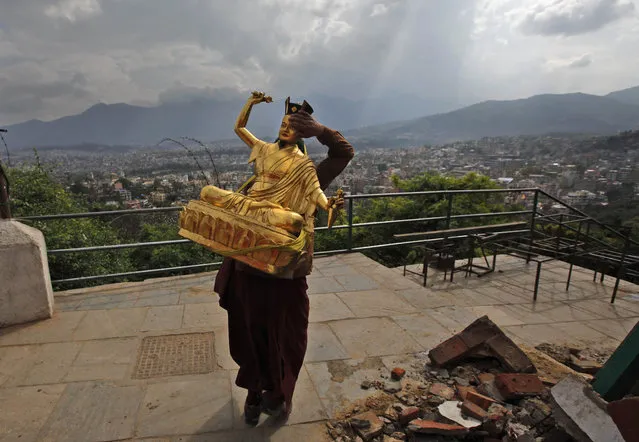
A Buddhist monk salvages a statue of a Buddhist deity from a monastery around the famous Swayambhunath stupa after it was damaged by Saturday's earthquake in  Kathmandu, Nepal, Thursday, April 30, 2015. In mere seconds, Saturday's earthquake devastated a swathe of Nepal. Three of the seven World Heritage sites in the Kathmandu Valley have been severely damaged, including Durbar Square with pagodas and temples dating from the 15th to 18th centuries, according to UNESCO, the United Nations cultural agency. (Photo by Niranjan Shrestha/AP Photo)

A Buddhist monk salvages a statue of a Buddhist deity from a monastery around the famous Swayambhunath stupa after it was damaged by Saturday's earthquake in Kathmandu, Nepal, Thursday, April 30, 2015. In mere seconds, Saturday's earthquake devastated a swathe of Nepal. Three of the seven World Heritage sites in the Kathmandu Valley have been severely damaged, including Durbar Square with pagodas and temples dating from the 15th to 18th centuries, according to UNESCO, the United Nations cultural agency. (Photo by Niranjan Shrestha/AP Photo)
Details
02 May 2015 14:35:00
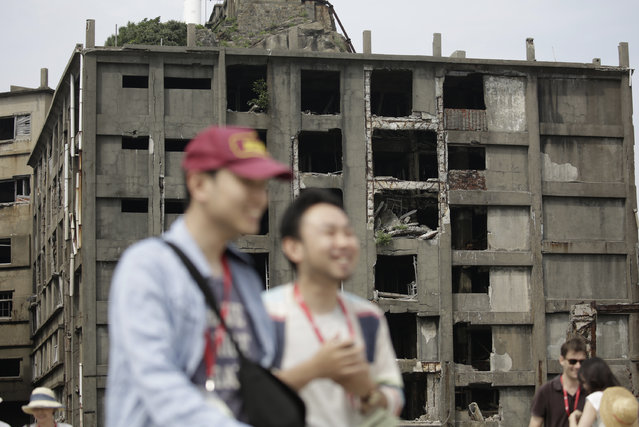
In this June 29, 2015 photo, forlorn buildings are seen at Hashima Island, commonly known as Gunkanjima, which means “Battleship Island”, off Nagasaki, Nagasaki Prefecture, southern Japan. (Photo by Eugene Hoshiko/AP Photo)

In this June 29, 2015 photo, forlorn buildings are seen at Hashima Island, commonly known as Gunkanjima, which means “Battleship Island”, off Nagasaki, Nagasaki Prefecture, southern Japan. The island is one of 23 old industrial facilities seeking UNESCO's recognition as world heritage “Sites of Japan's Meiji Industrial Revolution” meant to illustrate Japan's rapid transformation from a feudal farming society into an industrial power at the end of the 19th century. UNESCO's World Heritage Committee is expected to approve the proposal during a meeting being held in Bonn, Germany, through July 9. (Photo by Eugene Hoshiko/AP Photo)
Details
01 Jul 2015 13:41:00
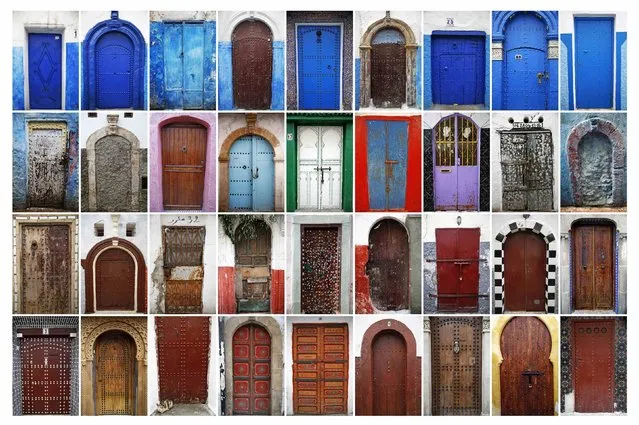
A combination photo shows some of the colourful doors seen in Rabat's Medina and Kasbah of the Udayas, September 2014. UNESCO made Rabat a World Heritage Site two years ago and media and tour operators call it a “must-see destination”. (Photo by Damir Sagolj/Reuters)

A combination photo shows some of the colourful doors seen in Rabat's Medina and Kasbah of the Udayas, September 2014. UNESCO made Rabat a World Heritage Site two years ago and media and tour operators call it a “must-see destination”. But it seems the tourist hordes have yet to find out. While visitors are getting squeezed through the better-known sites of Marrakesh and Fez, the old part of Rabat - with its beautiful Medina and Kasbah of the Udayas - remains an almost unspoiled oasis of calm. Smaller and more compact, its labyrinths of streets, passages and dead ends are a treasure trove of shapes and colours, of moments begging to be caught by the photographer's lens. (Photo by Damir Sagolj/Reuters)
Details
08 Oct 2014 12:08:00
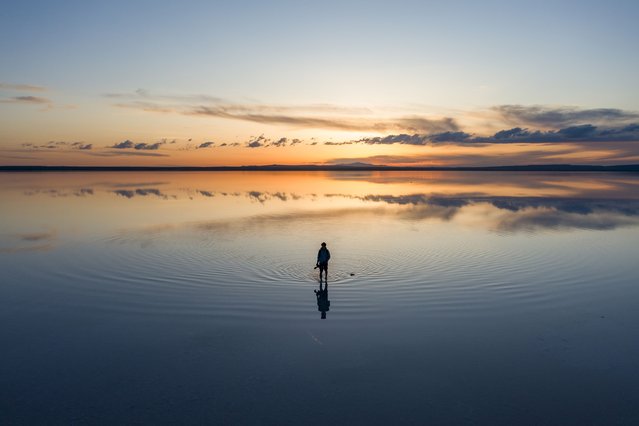
An aerial view of a man standing on Lake Tuz, Turkiye's second largest lake, during sunset in Ankara, Turkiye on April 22, 2024. The lake, which is on the UNESCO World Heritage Tentative List with its unique natural structure, welcomes many local and foreign tourists every year as it provides 70 per cent of the country's salt needs. (Photo by Hakan Nural/Anadolu via Getty Images)

An aerial view of a man standing on Lake Tuz, Turkiye's second largest lake, during sunset in Ankara, Turkiye on April 22, 2024. The lake, which is on the UNESCO World Heritage Tentative List with its unique natural structure, welcomes many local and foreign tourists every year as it provides 70 per cent of the country's salt needs. (Photo by Hakan Nural/Anadolu via Getty Images)
Details
01 Jul 2024 04:27:00
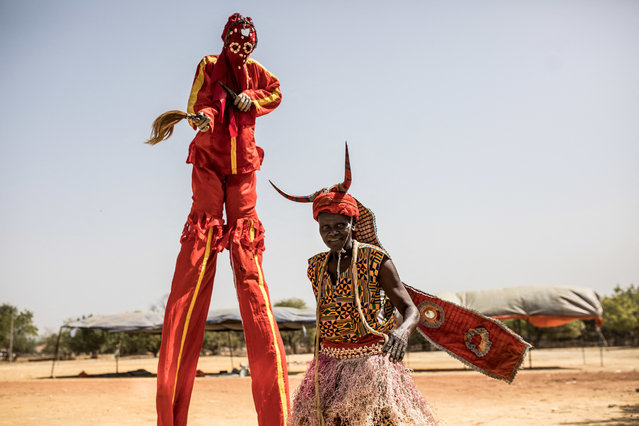
A masquerade dances to drums along the streets during the kankurang Festival in Janjanbureh on January 27, 2024. Listed as a UNESCO World Heritage Site since 2005, Kankurang, a combination of the Mandingo words “kango” and “Kurango”, literally translated as “voice” and “force”, ensures the transmission and teaching of the values and practices that form the basis of Mandingo cultural identity, a West African people whose historical home was the Mali empire. (Photo by Muhamadou Bittaye/AFP Photo)

A masquerade dances to drums along the streets during the kankurang Festival in Janjanbureh on January 27, 2024. Listed as a UNESCO World Heritage Site since 2005, Kankurang, a combination of the Mandingo words “kango” and “Kurango”, literally translated as “voice” and “force”, ensures the transmission and teaching of the values and practices that form the basis of Mandingo cultural identity, a West African people whose historical home was the Mali empire. (Photo by Muhamadou Bittaye/AFP Photo)
Details
13 Mar 2025 01:44:00
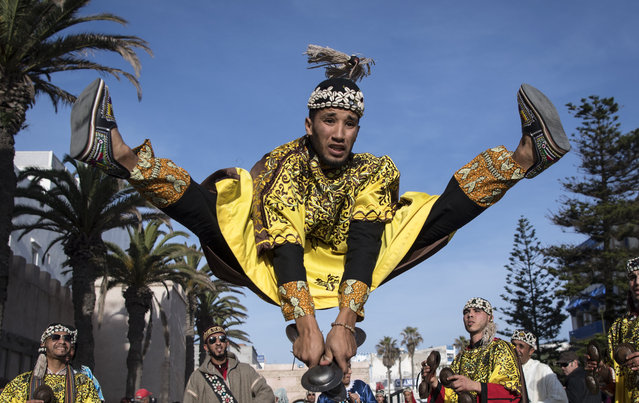
A Gnawa traditional group performs in the city of Essaouira on December 14, 2019, to celebrate the decision of adding the Gnawa culture to UNESCO's list of Intangible Cultural Heritage of Humanity. Gnawa culture, a centuries-old Moroccan practice rooted in music, African rituals and Sufi traditions, was added to UNESCO's list of Intangible Cultural Heritage of Humanity earlier in the week. Gnawa refers to a “set of musical productions, fraternal practices and therapeutic rituals where the secular mixes with the sacred”, according to the nomination submitted by Morocco. Often dressed in colourful outfits, Gnawa musicians play the guenbri, a type of lute with three strings, accompanied by steel castanets called krakebs. (Photo by Fadel Senna/AFP Photo)

A Gnawa traditional group performs in the city of Essaouira on December 14, 2019, to celebrate the decision of adding the Gnawa culture to UNESCO's list of Intangible Cultural Heritage of Humanity. Gnawa culture, a centuries-old Moroccan practice rooted in music, African rituals and Sufi traditions, was added to UNESCO's list of Intangible Cultural Heritage of Humanity earlier in the week. Gnawa refers to a “set of musical productions, fraternal practices and therapeutic rituals where the secular mixes with the sacred”, according to the nomination submitted by Morocco. Often dressed in colourful outfits, Gnawa musicians play the guenbri, a type of lute with three strings, accompanied by steel castanets called krakebs. (Photo by Fadel Senna/AFP Photo)
Details
18 Dec 2019 00:05:00
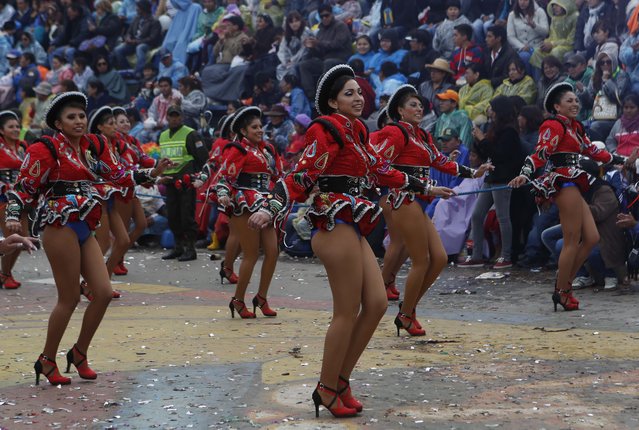
Caporal dancers perform during the carnival celebrations in Oruro, Bolivia, Saturday February 14, 2015. The Carnival of Oruro which is a religious festival dating back more than 2000 years in an ongoing pagan-catholic blend of religious practice in the region, and is one of UNESCO's Masterpieces of the Oral and Intangible Heritage of Humanity. (Photo by Juan Karita/AP Photo)

Caporal dancers perform during the carnival celebrations in Oruro, Bolivia, Saturday February 14, 2015. The Carnival of Oruro which is a religious festival dating back more than 2000 years in an ongoing pagan-catholic blend of religious practice in the region, and is one of UNESCO's Masterpieces of the Oral and Intangible Heritage of Humanity. (Photo by Juan Karita/AP Photo)
Details
17 Feb 2015 12:25:00