A Free Syrian Army fighter walks past a flag of al-Furqan brigade as a rifle hangs from a branch in the orchards of Kafar Zita in Hama countryside January 22, 2015. (Photo by Mohamad Bayoush/Reuters)
Rebel fighters from the Ahrar al-Sham Islamic Movement fire a heavy machine gun during what they said was an offensive to take the northwestern city of Idlib March 24, 2015. (Photo by Khalil Ashawi/Reuters)
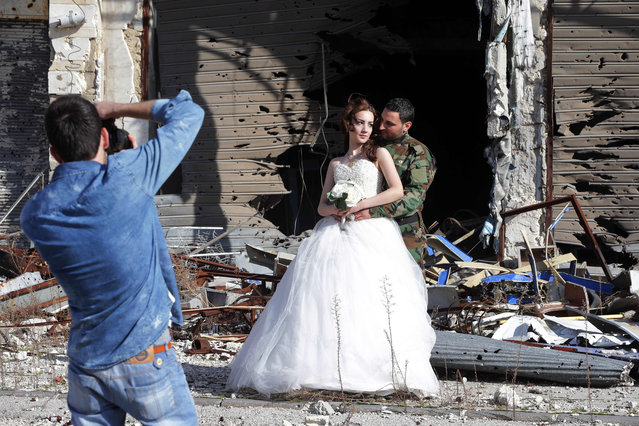
Newly-wed Syrian couple Nada Merhi, 18, and Hassan Youssef, 27, have their wedding pictures taken in front of a heavily damaged building in the war ravaged city of Homs on February 5, 2016. A Syrian photographer thought of using the destruction of Homs to take pictures of newly wed couples to show that life is stronger than death. (Photo by Joseph Eid/AFP Photo)
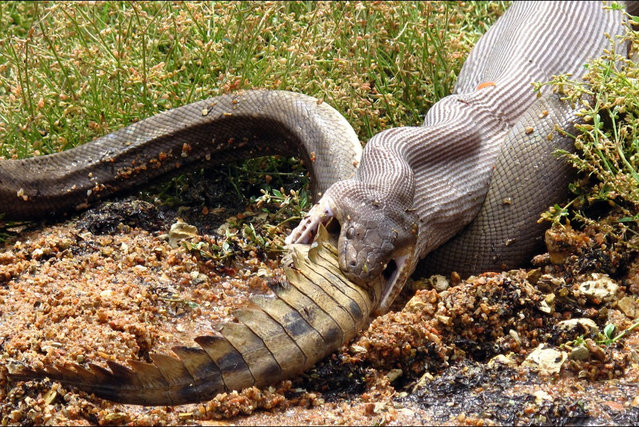
What happens in the wild is sometimes hard to imagine. Sometimes other animals can be others prey. In this case, here is a python and a crocodile who come across each other in Australia. This is a bit graphic, so beware.
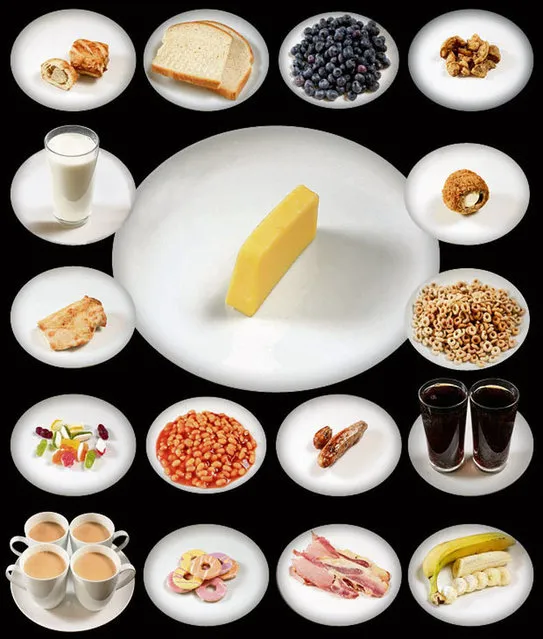
Some foods have significantly more Calories than others but what does the difference actually look like. Each of the photographs below represents 200 Calories of the particular type of food; the images are sorted from low to high calorie density. When you consider that an entire plate of broccoli contains the same number of Calories as a small spoonful of peanut butter, you might think twice the next time you decide what to eat. According to the U.S. Department of Agriculture, the average adult needs to consume about 2000 - 2500 Calories to maintain their weight. In other words, you have a fixed amount of Calories to "spend" each day; based on the following pictures, which would you eat?
A stunning photographic collection featuring portraits of people from 30 countries and the food they eat in one day. In this fascinating study of people and their diets, 80 profiles are organized by the total number of calories each person puts away in a day. Featuring a Japanese sumo wrestler, a Massai herdswoman, world-renowned Spanish chef Ferran Adria, an American competitive eater, and more, these compulsively readable personal stories also include demographic particulars, including age, activity level, height, and weight. Essays from Harvard primatologist Richard Wrangham, journalist Michael Pollan, and others discuss the implications of our modern diets for our health and for the planet. This compelling blend of photography and investigative reportage expands our understanding of the complex relationships among individuals, culture, and food.