Loading...
Done
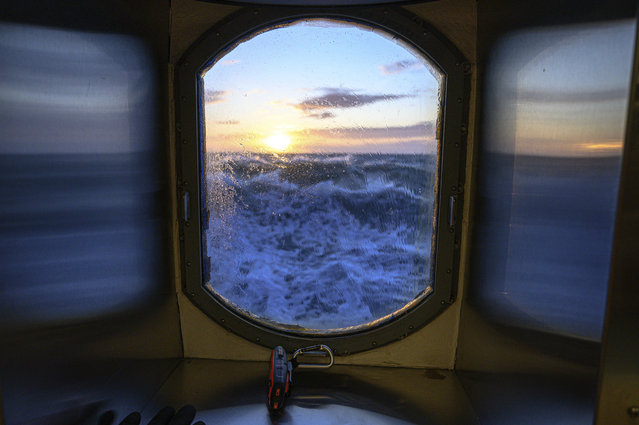
This November 8, 2019, photo provided by John Guillote shows a view from the main lab of the Sikuliaq in the Chukchi Sea. University of Washington scientists onboard the research vessel are studying the changes and how less sea ice will affect coastlines, which already are vulnerable to erosion because increased waves delivered by storms. More erosion would increase the chance of winter flooding in villages and danger to hunters in small boats. (Photo by John Guillote via AP Photo)

This November 8, 2019, photo provided by John Guillote shows a view from the main lab of the Sikuliaq in the Chukchi Sea. University of Washington scientists onboard the research vessel are studying the changes and how less sea ice will affect coastlines, which already are vulnerable to erosion because increased waves delivered by storms. More erosion would increase the chance of winter flooding in villages and danger to hunters in small boats. (Photo by John Guillote via AP Photo)
Details
26 Aug 2021 08:22:00
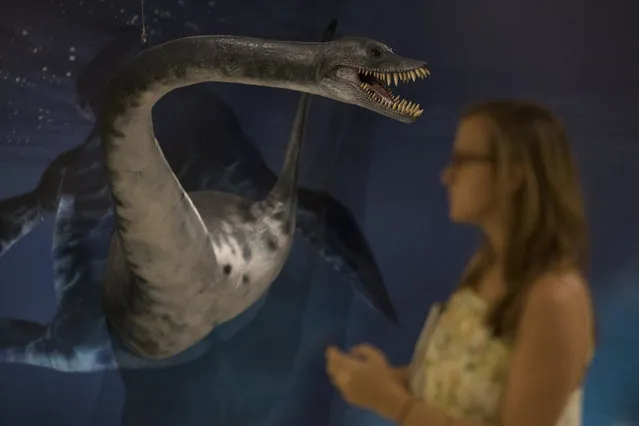
In this January 16, 2019 photo, a sculpture of a Plesiosaur is displayed at an exhibit about the studies of researchers from the National Museum made in Antartica, during a media presentation of the exhibit in Rio de Janeiro, Brazil. The National Museum will inaugurate on Jan. 17 their first exhibition after the fire, held at the building that houses the Cultural Center and Museum of Brazil's Mint. (Photo by Leo Correa/AP Photo)

In this January 16, 2019 photo, a sculpture of a Plesiosaur is displayed at an exhibit about the studies of researchers from the National Museum made in Antartica, during a media presentation of the exhibit in Rio de Janeiro, Brazil. The National Museum will inaugurate on Jan. 17 their first exhibition after the fire, held at the building that houses the Cultural Center and Museum of Brazil's Mint. (Photo by Leo Correa/AP Photo)
Details
18 Jan 2019 09:26:00
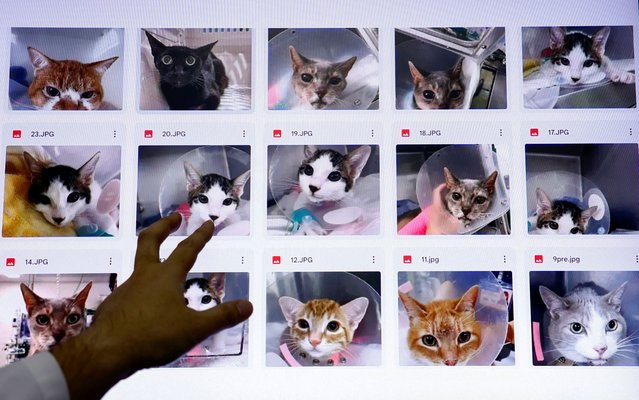
Nihon University professor and head of Nihon University Animal Medical Center Kazuya Edamura, 49, points to cat photos on a computer screen, which are used to train the AI of “CatsMe!”, an AI-driven smartphone application jointly developed by tech startup Carelogy and researchers at Nihon University that purports to tell when a cat is feeling pain, as he gives a lecture to students on diagnosing pain in cats, at the medical center in Fujisawa, south of Tokyo, Japan on June 11, 2024. (Photo by Issei Kato/Reuters)

Nihon University professor and head of Nihon University Animal Medical Center Kazuya Edamura, 49, points to cat photos on a computer screen, which are used to train the AI of “CatsMe!”, an AI-driven smartphone application jointly developed by tech startup Carelogy and researchers at Nihon University that purports to tell when a cat is feeling pain, as he gives a lecture to students on diagnosing pain in cats, at the medical center in Fujisawa, south of Tokyo, Japan on June 11, 2024. (Photo by Issei Kato/Reuters)
Details
29 Jun 2024 02:02:00
2000 attended a welcome party at TigerTiger Manchester which was the first event in set of big club night for new students to Manchester and Salford universities in Manchester, UK on September 19, 2016. This year, university bosses have stepped up security in Manchester. (Photo by Jordan Sinclair/UK News Pictures)

2000 attended a welcome party at TigerTiger Manchester which was the first event in set of big club night for new students to Manchester and Salford universities in Manchester, UK on September 19, 2016. This year, university bosses have stepped up security in Manchester. (Photo by Jordan Sinclair/UK News Pictures)
Details
20 Sep 2016 09:32:00
Census of Marine Life

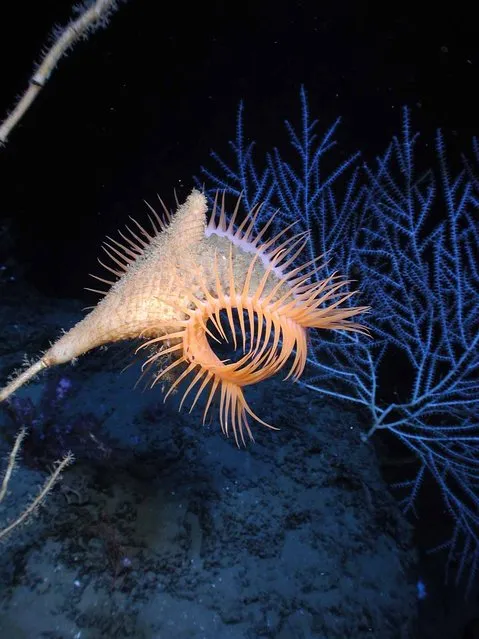
The Census of Marine Life was a global network of researchers in more than 80 nations engaged in a 10-year scientific initiative to assess and explain the diversity, distribution, and abundance of life in the oceans. The world's first comprehensive Census of Marine Life — past, present, and future — was released in 2010 in London.
Details
04 Jun 2015 12:08:00
Bird Nest By Sharon Beals Part2

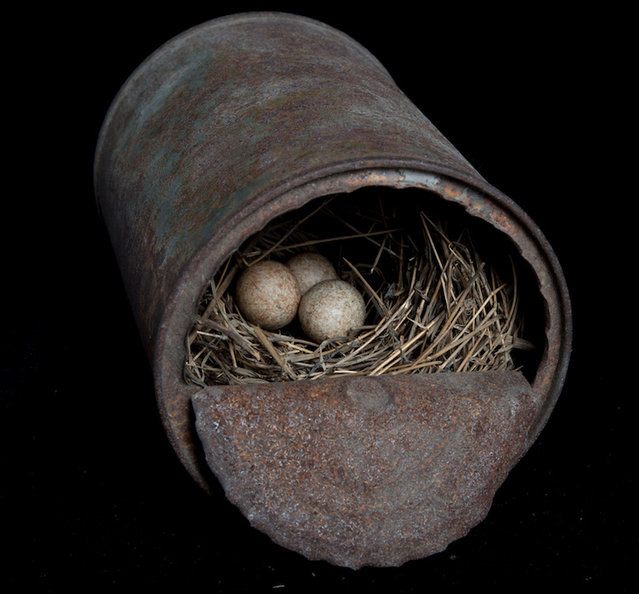
Sharon Beals is a San Francisco based photographer who has photographed nest and eggs specimens collected over the last two centuries at The California Academy of Sciences, The Museum of Vertebrate Zoology, and The Western Foundation of Vertebrate Zoology. While few nests are collected today, these nests and eggs are used for research, providing important information about their builder’s habitats, DNA, diseases and other survival issues.
Details
21 Aug 2013 11:34:00
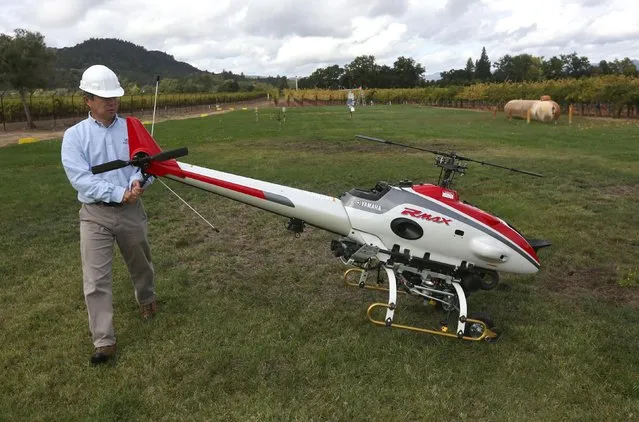
In this October 15, 2014 file photo, Katsu Nakamura, sky division manager for Yamaha USA, moves the RMax unmanned helicopter into position before a demonstration of its aerial application capabilities at the University of California, Davis' Oakville Station test vineyard in Oakville, Calif. Researchers at UC Davis have been studying the effectiveness of the drone's ability for spraying pest control and nutritional materials on the test vineyard in California's Napa Valley. (Photo by Rich Pedroncelli/AP Photo)

In this October 15, 2014 file photo, Katsu Nakamura, sky division manager for Yamaha USA, moves the RMax unmanned helicopter into position before a demonstration of its aerial application capabilities at the University of California, Davis' Oakville Station test vineyard in Oakville, Calif. Researchers at UC Davis have been studying the effectiveness of the drone's ability for spraying pest control and nutritional materials on the test vineyard in California's Napa Valley. (Photo by Rich Pedroncelli/AP Photo)
Details
07 Jan 2015 14:00:00
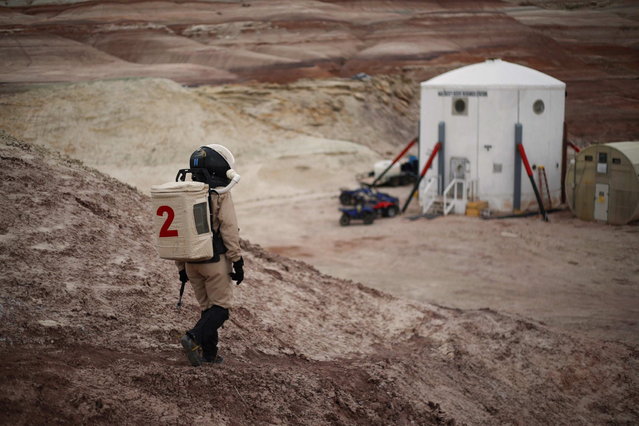
Csilla Orgel, a geologist of Crew 125 EuroMoonMars B mission, makes her way back to the Mars Desert Research Station (MDRS) in the Utah desert March 3, 2013. (Photo by Jim Urquhart/Reuters)

NASA says it could be another 20 years before humans touch down on Mars, but in a sense, the Mars Society has been exploring the red planet for more than a decade – in Utah. Photo: Csilla Orgel, a geologist of Crew 125 EuroMoonMars B mission, makes her way back to the Mars Desert Research Station (MDRS) in the Utah desert March 3, 2013. The MDRS aims to investigate the feasibility of a human exploration of Mars and uses the Utah desert's Mars-like terrain to simulate working conditions on the red planet. Scientists, students and enthusiasts work together developing field tactics and studying the terrain. All outdoor exploration is done wearing simulated spacesuits and carrying air supply packs and crews live together in a small communication base with limited amounts of electricity, food, oxygen and water. Everything needed to survive must be produced, fixed and replaced on site. (Photo by Jim Urquhart/Reuters)
Details
14 Mar 2013 12:11:00