Loading...
Done
The new curvy Barbie doll body shape (L) is seen next to the traditional Barbie in a combination of photos released by Mattel on January 28, 2016. Barbie, the world's most famous doll, has a new body. In fact, she has three new bodies – petite, tall and curvy. Some 57 years after the impossibly busty and narrow-waisted blue-eyed Barbie doll was first introduced, California-based toy maker Mattel on Thursday released the new models, which it says better reflect a changing world. (Photo by Reuters/Mattel)

The new curvy Barbie doll body shape (L) is seen next to the traditional Barbie in a combination of photos released by Mattel on January 28, 2016. Barbie, the world's most famous doll, has a new body. In fact, she has three new bodies – petite, tall and curvy. Some 57 years after the impossibly busty and narrow-waisted blue-eyed Barbie doll was first introduced, California-based toy maker Mattel on Thursday released the new models, which it says better reflect a changing world. (Photo by Reuters/Mattel)
Details
29 Jan 2016 12:23:00
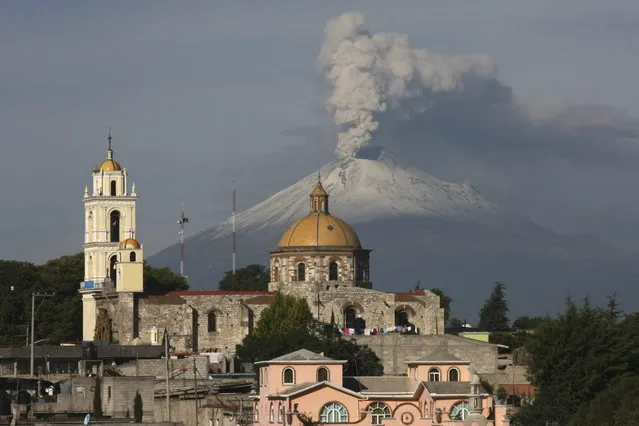
The main church in the town of San Damian Texoloc, Mexico stands in front of the Popocatepetl volcano as is spews ash and vapor early Tuesday, July 9, 2013. Last Saturday, Mexico's National Center for Disaster Prevention raised the volcano alert from Stage 2 Yellow to Stage 3 Yellow, the final step before a Red alert, when possible evacuations could be ordered after the Popocatepetl volcano spit out a cloud of ash and vapor 2 miles (3 kilometers) high over several days of eruptions. (Photo by J. Guadalupe Perez/AP Photo)

The main church in the town of San Damian Texoloc, Mexico stands in front of the Popocatepetl volcano as is spews ash and vapor early Tuesday, July 9, 2013. Last Saturday, Mexico's National Center for Disaster Prevention raised the volcano alert from Stage 2 Yellow to Stage 3 Yellow, the final step before a Red alert, when possible evacuations could be ordered after the Popocatepetl volcano spit out a cloud of ash and vapor 2 miles (3 kilometers) high over several days of eruptions. (Photo by J. Guadalupe Perez/AP Photo)
Details
10 Jul 2013 08:45:00
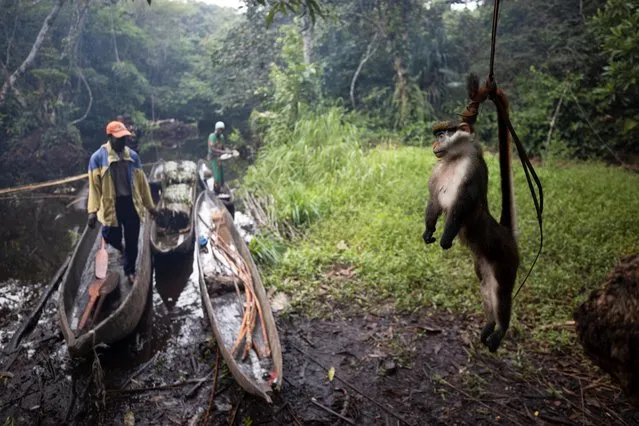
A dead red-tailed monkey hangs by its tail above the ground, in order to keep it away from ants, in the forest near the city of Mbandaka, Democratic Republic of the Congo, April 5, 2019. Bushmeat hunters are emptying Central Africa's forests at a high rate, researchers say. A growing appetite for wild meat in cities has ramped up the scale of hunting. Research shows around 6 million tonnes of bushmeat are sourced annually from the Congo Basin, whose forest spans across six countries and is second in size only to the Amazon. (Photo by Thomas Nicolon/Reuters)

A dead red-tailed monkey hangs by its tail above the ground, in order to keep it away from ants, in the forest near the city of Mbandaka, Democratic Republic of the Congo, April 5, 2019. Bushmeat hunters are emptying Central Africa's forests at a high rate, researchers say. A growing appetite for wild meat in cities has ramped up the scale of hunting. Research shows around 6 million tonnes of bushmeat are sourced annually from the Congo Basin, whose forest spans across six countries and is second in size only to the Amazon. (Photo by Thomas Nicolon/Reuters)
Details
14 Oct 2019 00:03:00
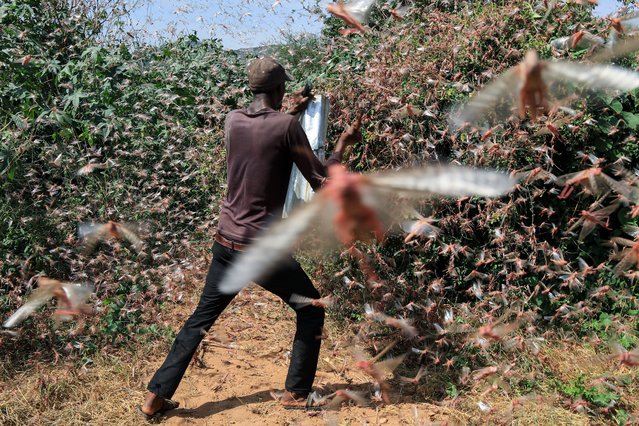
A man uses iron sheet to make noises, as a way of trying to disperse desert locusts that had invaded their farms during the second wave invasion in Kakongo village, in Nuu-Mwingi East, in Kitui, Kenya, 06 February 2021. The second wave invasion of the desert locusts in the country comes at a time where most famers are expecting to harvest their farm produce in the country. According to the United Nations Food and Agriculture Organization (FAO), on 04 February, warned numerous immature desert locust swarms persist in southern Ethiopia and Kenya. Some of the swarms are in community areas and therefore cannot be treated. In Kenya, immature swarms continue to spread westwards across northern and central counties where there are currently about 20 small swarms present, mostly about 50 hectares in size, it said. (Photo by Daniel Irungu/EPA/EFE)

A man uses iron sheet to make noises, as a way of trying to disperse desert locusts that had invaded their farms during the second wave invasion in Kakongo village, in Nuu-Mwingi East, in Kitui, Kenya, 06 February 2021. The second wave invasion of the desert locusts in the country comes at a time where most famers are expecting to harvest their farm produce in the country. (Photo by Daniel Irungu/EPA/EFE)
Details
25 Feb 2021 08:17:00
Boat crew members train on the waters of the Tonle Sap River on the morning of the first day of the Water Festival on November 13, 2016 in Phnom Penh, Cambodia. The yearly three-day Water Festival is one of the most important holidays in Cambodia and celebrates the end of the rainy season and the start of the rice harvesting. The Festival also coincides with the Tonle Sap river reversing course, which it does twice a year. Approximately 2 million people are expected to attend this year's festival, during which 259 boats and nearly 20,000 oarsmen will participate in the races. After a fatal stampede resulting in the death of some 353 people during the Water Festival in 2010, it has been cancelled four times over the past five years, with weather used as an official excuse. (Photo by Omar Havana/Getty Images)

Boat crew members train on the waters of the Tonle Sap River on the morning of the first day of the Water Festival on November 13, 2016 in Phnom Penh, Cambodia. The yearly three-day Water Festival is one of the most important holidays in Cambodia and celebrates the end of the rainy season and the start of the rice harvesting. The Festival also coincides with the Tonle Sap river reversing course, which it does twice a year. Approximately 2 million people are expected to attend this year's festival, during which 259 boats and nearly 20,000 oarsmen will participate in the races. After a fatal stampede resulting in the death of some 353 people during the Water Festival in 2010, it has been cancelled four times over the past five years, with weather used as an official excuse. (Photo by Omar Havana/Getty Images)
Details
15 Nov 2016 11:26:00
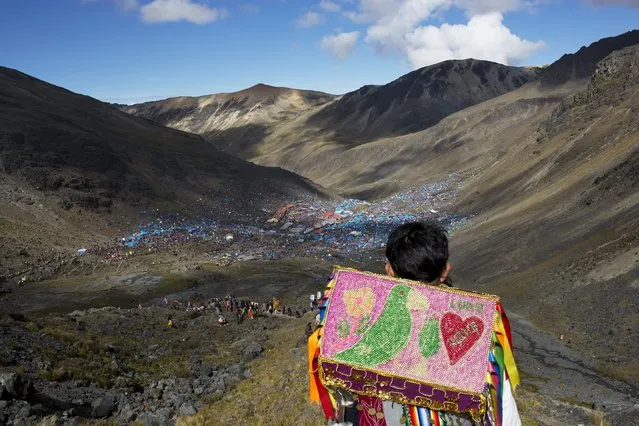
In this May 24, 2016 photo, a young boy descends the Qullqip'unqu mountain looking out at the tens of thousands of pilgrims gathered to celebrate the three-day festival Qoyllur Rit’i, translated from the Quechua language as Snow Star, in the Andean Sinakara Valley, in Peru's Cusco region. The celebration that mixes Catholic and indigenous beliefs honors Jesus as well as the area’s glacier, which is considered sacred among some indigenous people. While the native celebration is far older, the Christian part of the ritual stretches back to the 1700s, when Jesus is said to have appeared to a young shepherd in the form of another boy. (Photo by Rodrigo Abd/AP Photo)

In this May 24, 2016 photo, a young boy descends the Qullqip'unqu mountain looking out at the tens of thousands of pilgrims gathered to celebrate the three-day festival Qoyllur Rit’i, translated from the Quechua language as Snow Star, in the Andean Sinakara Valley, in Peru's Cusco region. The celebration that mixes Catholic and indigenous beliefs honors Jesus as well as the area’s glacier, which is considered sacred among some indigenous people. While the native celebration is far older, the Christian part of the ritual stretches back to the 1700s, when Jesus is said to have appeared to a young shepherd in the form of another boy. (Photo by Rodrigo Abd/AP Photo)
Details
04 Jun 2016 11:52:00
A model waits to present a creation by Chinese designer Hu Sheguang for his collection show during China Fashion Week S/S 2016 in Beijing October 26, 2015. (Photo by Jason Lee/Reuters)

A model waits to present a creation by Chinese designer Hu Sheguang for his collection show during China Fashion Week S/S 2016 in Beijing October 26, 2015. (Photo by Jason Lee/Reuters)
Details
29 Oct 2015 08:05:00
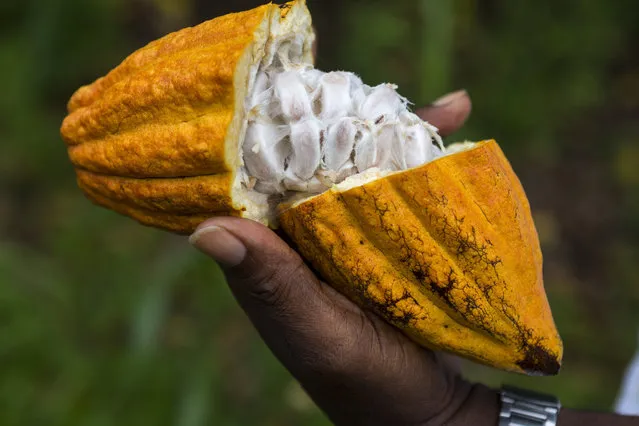
Farmer holding a freshly cut cocoa bean pod, revealing the pulp and seed inside on a rainforest farm. (Photo by Doug McKinlay/Getty Images)

Chocolate is the greatest gift the Earth has given us. The dessert table would be a sad sight without it. It’s so beloved, so appreciated, that the Swedish scientist who named the cocoa plant that gives us chocolate called it Theobroma cacao, which means “food of the gods”. Here: Farmer holding a freshly cut cocoa bean pod, revealing the pulp and seed inside on a rainforest farm. (Photo by Doug McKinlay/Getty Images)
Details
10 Aug 2016 10:20:00