Loading...
Done
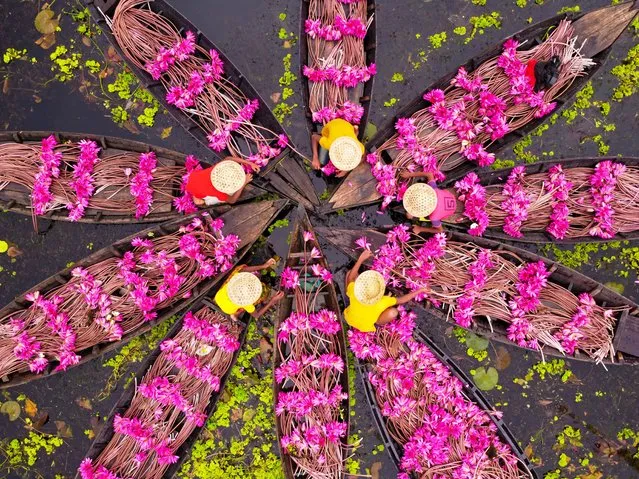
Farmers arrange bunches of water lilies after harvesting them from the wetlands in Barishal, Bangladesh on March 21, 2023. Floating through 10,000 acres of canal, farmers use their little boats to fetch the flowers. They break through the layer of water lilies on the surface of the water as they practice the traditional craft of picking water lilies by hand. Every flower is carefully hand-picked, collected inside the farmers' little wooden boat, tied in bundles, and sold to markets. After working for an entire day, a farmer can pick around 80 to 120 bundles of water lilies. Water lily harvesting is a major source of income for more than 250 families in the area. (Photo by Joy Saha/Cover Images)

Farmers arrange bunches of water lilies after harvesting them from the wetlands in Barishal, Bangladesh on March 21, 2023. Floating through 10,000 acres of canal, farmers use their little boats to fetch the flowers. (Photo by Joy Saha/Cover Images)
Details
01 May 2023 04:00:00
A “Federahannes”, a jester figure from Rottweil, participates in the “Narrensprung” (jester jump) parade in Rottweil, southern Germany, Monday, February 27, 2016. About 4000 jesters paraded through the city among thousands of spectators. The Rottweil Narrensprung is the highlight of the Swabian-Alemannic Fastnacht and one of the traditional pre-Lenten carnival parades in southwestern Germany. (Photo by Michael Probst/AP Photo)

A “Federahannes”, a jester figure from Rottweil, participates in the “Narrensprung” (jester jump) parade in Rottweil, southern Germany, Monday, February 27, 2016. About 4000 jesters paraded through the city among thousands of spectators. The Rottweil Narrensprung is the highlight of the Swabian-Alemannic Fastnacht and one of the traditional pre-Lenten carnival parades in southwestern Germany. (Photo by Michael Probst/AP Photo)
Details
04 Mar 2017 00:03:00
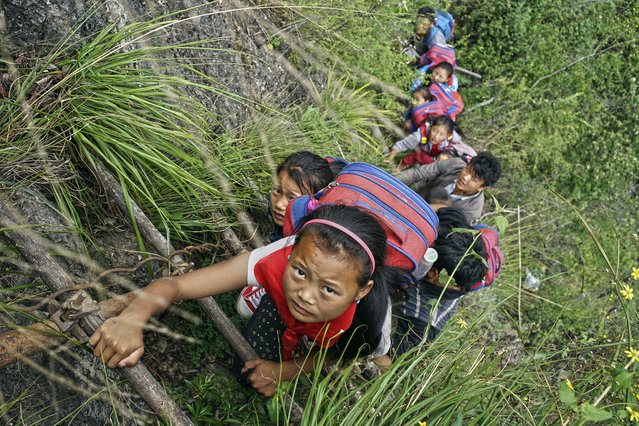
In this May 14, 2016 photo, children wearing their school backpacks climb on a cliff using a bamboo ladder on their way home from school in Zhaojue county, southwest China's Sichuan province. A village in China's mountainous west where schoolchildren must climb an 800-meter (2,625-foot)-high bamboo ladder secured to a sheer cliff face may get a set of steel stairs to improve it's safety. (Photo by Chinatopix via AP Photo)

In this May 14, 2016 photo, children wearing their school backpacks climb on a cliff using a bamboo ladder on their way home from school in Zhaojue county, southwest China's Sichuan province. A village in China's mountainous west where schoolchildren must climb an 800-meter (2,625-foot)-high bamboo ladder secured to a sheer cliff face may get a set of steel stairs to improve it's safety. (Photo by Chinatopix via AP Photo)
Details
27 May 2016 12:47:00
Danila Shmelev, an artist from Moscow, Russia, works on a 3-D picture in Dubai, United Arab Emirates, Monday, February 27, 2017. Artists who focus on 3-D pictures have gathered in Dubai for the Dubai Canvas 3-D Art Festival, which runs from March 1 through March 7. (Photo by Jon Gambrell/AP Photo)

Danila Shmelev, an artist from Moscow, Russia, works on a 3-D picture in Dubai, United Arab Emirates, Monday, February 27, 2017. Artists who focus on 3-D pictures have gathered in Dubai for the Dubai Canvas 3-D Art Festival, which runs from March 1 through March 7. (Photo by Jon Gambrell/AP Photo)
Details
28 Feb 2017 11:18:00
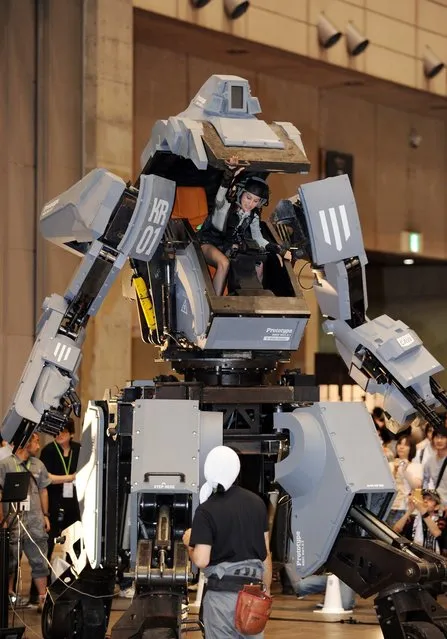
Female “pilot” Anna (C) climbs out the cockpit of Japanese electronics company Suidobashi Heavy Industry's newly unveiled robot “Kuratas” at the Wonder Festival in Chiba, suburban Tokyo on July 29, 2012. The Kuratas robot, which will go on sale with a price tag of one million USD, measures four meters in height, weighs four tons and has four wheeled legs that can either be controlled remotely through the 3G network or by a human seated within the cockpit.

Female pilot Anna climbs out the cockpit of Japanese electronics company Suidobashi Heavy Industry's newly unveiled robot “Kuratas” at the Wonder Festival in Chiba, suburban Tokyo on July 29, 2012. The “Kuratas” robot, which will go on sale with a price tag of one million USD, measures four meters in height, weighs four tons and has four wheeled legs that can either be controlled remotely through the 3G network or by a human seated within the cockpit. (Photo by Yoshikazu Tsuno/AFP Photo)
Details
30 Jul 2012 09:26:00
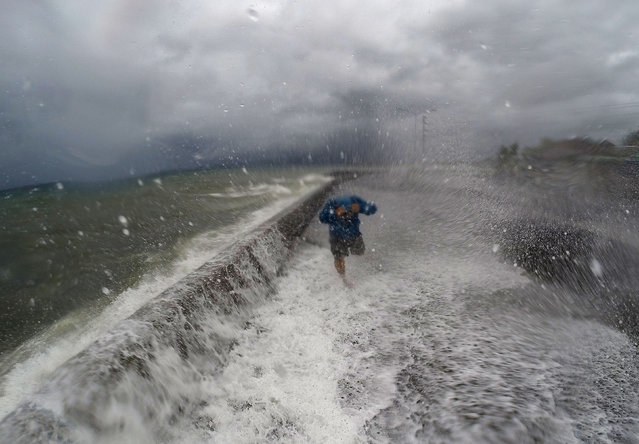
A resident walks past big waves spilling over a wall onto a coastal road in the city of Legaspi in Albay province, south of Manila on December 14, 2015, as typhoon Melor approaches the city. More than 700,000 people fled the central Philippines amid threats of giant waves, floods and landslides as powerful Typhoon Melor approached the archipelago nation, officials said December 14. (Photo by Charism Sayat/AFP Photo)

A resident walks past big waves spilling over a wall onto a coastal road in the city of Legaspi in Albay province, south of Manila on December 14, 2015, as typhoon Melor approaches the city. More than 700,000 people fled the central Philippines amid threats of giant waves, floods and landslides as powerful Typhoon Melor approached the archipelago nation, officials said December 14. (Photo by Charism Sayat/AFP Photo)
Details
15 Dec 2015 11:34:00
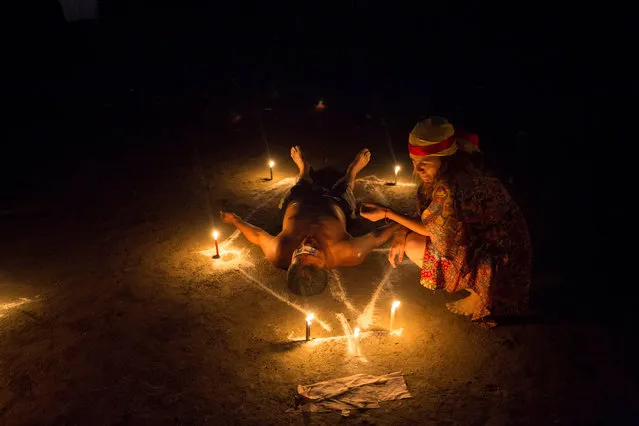
A man lies on the floor during a ritual at the Sorte Mountain on the outskirts of Chivacoa, in the state of Yaracuy, Venezuela October 10, 2015. (Photo by Marco Bello/Reuters)

A man lies on the floor during a ritual at the Sorte Mountain on the outskirts of Chivacoa, in the state of Yaracuy, Venezuela October 10, 2015. One long night every year in a mountainous rainforest in Venezuela, hundreds gather to dance on red-hot embers, enter trance-like states, and worship an ancient goddess known as Maria Lionza. Those who travel to the mountain known as Sorte in central Venezuela are practitioners of a cult that is built on local indigenous traditions. (Photo by Marco Bello/Reuters)
Details
08 Jul 2016 12:19:00
A view of traditional bolinhos de bacalhau (fried codfish balls) in Rio de Janeiro, Brazil, May 7, 2016. (Photo by Sergio Moraes/Reuters)

If the most popular foods of Rio de Janeiro have one thing in common, it is their informality. You can find fine restaurants in the city, but they do not set Rio apart from other places. What does set it apart, and what invariably brings its residents, known as "Cariocas," together is the unpretentious food they eat in bright, loud, crowded bars and restaurants, on busy street corners, or after a day at the beach. Here: A view of traditional bolinhos de bacalhau (fried codfish balls) in Rio de Janeiro, Brazil, May 7, 2016. (Photo by Sergio Moraes/Reuters)
Details
05 Aug 2016 13:20:00