Models promote the game “Diamond Dogs” during the Gamescom 2015 fair in Cologne, Germany August 5, 2015. Hundreds of thousands of visitors will enjoy one of the world's largest computer and video game events until Sunday. (Photo by Kai Pfaffenbach/Reuters)
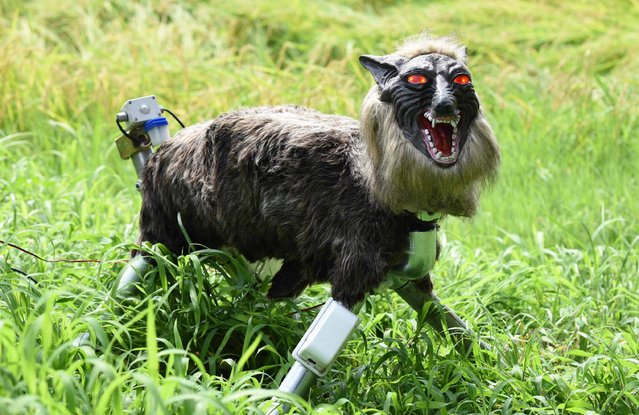
A wolf-like robot “Super Monster Wolf” stands beside a rice field to drive away wild animals that cause damages to crops in Kisarazu, Chiba prefecture, on August 25, 2017. The agricultural coopetative association JA Kisarazu-shi introduced the 65cm-long and 50cm-high robot recently on a trial basis which can detect wild animals such as boars and deers with an infrared ray sensor when they approach and intimidates them, flashing the red LED eyes and blaring 48 types of sounds including a wolf growl and human voice. (Photo by Toru Yamanaka/AFP Photo)
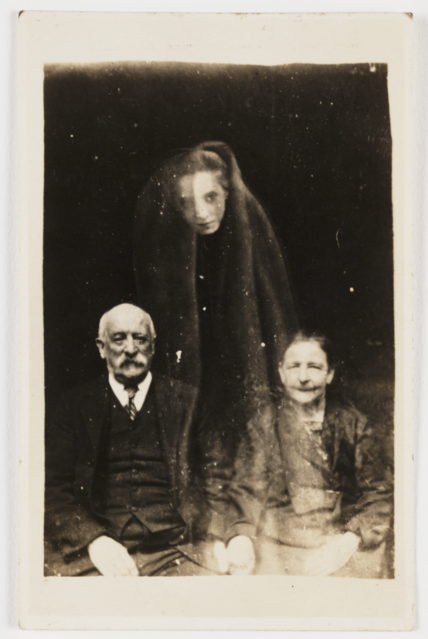
“William Hope (1863 – 8 March 1933) was a pioneer of so-called “spirit photography” (spirit photography is a type of photography whose primary attempt is to capture images of ghosts and other spiritual entities, especially in ghost hunting). Based in Crewe, England, he was a member of the well known spiritualists group, the Crewe Circle”. – Wikipedia
January 22, 2017; Atlanta, GA, USA; Atlanta Falcons cheerleaders take a picture in the confetti after the game against the Green Bay Packers in the 2017 NFC Championship Game at the Georgia Dome. Atlanta defeated Green Bay 44-21. (Photo by Jason Getz/USA TODAY Sports)
Belgian Fran Vanhoutte celebrates as she crosses the finish line at the finals of the women's 500m +D speed skating event, at the World Games 2025, in Chenghdu, China, on Thursday 14 August 2025. This year, the World Games take place from 7 to 17 August. (Photo by Rex Features/Shutterstock)
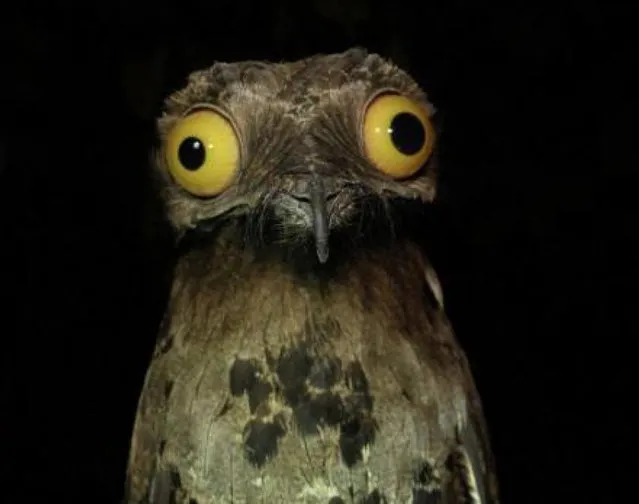
Potoos (family Nyctibiidae) are a group of near passerine birds related to the nightjars and frogmouths. They are sometimes called Poor-me-ones, after their haunting calls. There are seven species in one genus, Nyctibius, in tropical Central and South America.
These are nocturnal insectivores which lack the bristles around the mouth found in the true nightjars. They hunt from a perch like a shrike or flycatcher. During the day they perch upright on tree stumps, camouflaged to look like part of the stump. The single spotted egg is laid directly on the top of a stump.