Loading...
Done
“People and Space”. Winner: Wanderer in Patagonia by Yuri Zvezdny (Russia) A lone stargazer stares up at the stars of our galaxy, the Milky Way, as they stretch across the night sky over the glacier “White Stones” (Piedras Blancas) in the Los Glaciares National Park, Argentina. El Chaltén, Santa Cruz Province, Argentina, 27 September 2016 iOptron Sky-Tracker mount, Sony A7S camera, 18 mm f/2.8 lens, ISO 5000, 30-second exposure Wanderer in Patagonia. (Photo by Yuri Zvezdny/Insight Astronomy Photographer of the Year 2017)

“People and Space”. Winner: Wanderer in Patagonia by Yuri Zvezdny (Russia) A lone stargazer stares up at the stars of our galaxy, the Milky Way, as they stretch across the night sky over the glacier “White Stones” (Piedras Blancas) in the Los Glaciares National Park, Argentina. El Chaltén, Santa Cruz Province, Argentina, 27 September 2016 iOptron Sky-Tracker mount, Sony A7S camera, 18 mm f/2.8 lens, ISO 5000, 30-second exposure Wanderer in Patagonia. (Photo by Yuri Zvezdny/Insight Astronomy Photographer of the Year 2017)
Details
18 Sep 2017 07:09:00
The launch of a rocket into space is projected on Dubai's Burj Khalifa on February 9, 2021 as the UAE's “Al-Amal” – Arabic for “Hope” – probe's to Mars carries out a tricky manoeuvre to enter the Red Planet's orbit. A tense half-hour today will determine the fate of “Hope”. If successful, the probe which is designed to reveal the secrets of Martian weather, will become the first of three spacecraft to arrive at the Red Planet this month. (Photo by Giuseppe Cacace/AFP Photo)

The launch of a rocket into space is projected on Dubai's Burj Khalifa on February 9, 2021 as the UAE's “Al-Amal” – Arabic for “Hope” – probe's to Mars carries out a tricky manoeuvre to enter the Red Planet's orbit. A tense half-hour today will determine the fate of “Hope”. If successful, the probe which is designed to reveal the secrets of Martian weather, will become the first of three spacecraft to arrive at the Red Planet this month. (Photo by Giuseppe Cacace/AFP Photo)
Details
20 May 2021 08:46:00
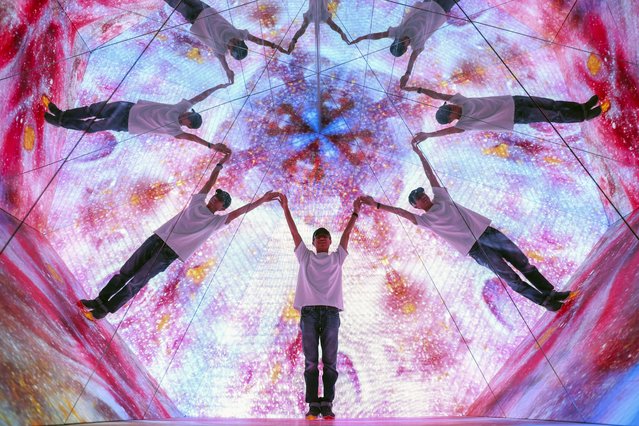
A man reacts inside the projection mapping and interactive installation known as “Illusion Road” at the multi-dimensional media art gallery Immersify KL in Kuala Lumpur, Malaysia, 04 March 2025. Immersify KL attracts visitors with interactive installations, high-definition visuals, and 3D spatial sound, creating breathtaking zones, including the country's first 360-degree, 12-meter-high projection space inside a 30,000-square-foot area with 11 sections of different immersive zones. (Photo by Fazry Ismail/EPA)

A man reacts inside the projection mapping and interactive installation known as “Illusion Road” at the multi-dimensional media art gallery Immersify KL in Kuala Lumpur, Malaysia, 04 March 2025. Immersify KL attracts visitors with interactive installations, high-definition visuals, and 3D spatial sound, creating breathtaking zones, including the country's first 360-degree, 12-meter-high projection space inside a 30,000-square-foot area with 11 sections of different immersive zones. (Photo by Fazry Ismail/EPA)
Details
03 Apr 2025 04:32:00
On August 31, 2012, a long filament of solar material that had been hovering in the sun's atmosphere, the corona, erupted out into space at 4:36 p.m. EDT. The coronal mass ejection, or CME, traveled at over 900 miles per second. The CME did not travel directly toward Earth, but did connect with Earth's magnetic environment, or magnetosphere, causing aurora to appear on the night of Monday, September 3. (Photo by NASA/GSFC/SDO)

On August 31, 2012, a long filament of solar material that had been hovering in the sun's atmosphere, the corona, erupted out into space at 4:36 p.m. EDT. The coronal mass ejection, or CME, traveled at over 900 miles per second. The CME did not travel directly toward Earth, but did connect with Earth's magnetic environment, or magnetosphere, causing aurora to appear on the night of Monday, September 3. (Photo by NASA/GSFC/SDO via The Atlantic)
Details
14 Sep 2012 09:01:00
“The Sunsetter”. An EF-4 tornado rips through the open space of farmland near Rozel, Kansas. This tornado moves slowly but powerful towards the setting sun an gets its beautiful color right before sunset. Storm Chasers are spotting on the left side. Photo location: Rozel, Kansas. (Photo and caption by Dennis Oswald/National Geographic Photo Contest)

“The Sunsetter”. An EF-4 tornado rips through the open space of farmland near Rozel, Kansas. This tornado moves slowly but powerful towards the setting sun an gets its beautiful color right before sunset. Storm Chasers are spotting on the left side. Photo location: Rozel, Kansas. (Photo and caption by Dennis Oswald/National Geographic Photo Contest)

ATTENTION! All pictures are presented in high resolution. To see Hi-Res images – just TWICE click on any picture. In other words, click small picture – opens the BIG picture. Click BIG picture – opens VERY BIG picture.
Details
01 Dec 2013 11:03:00
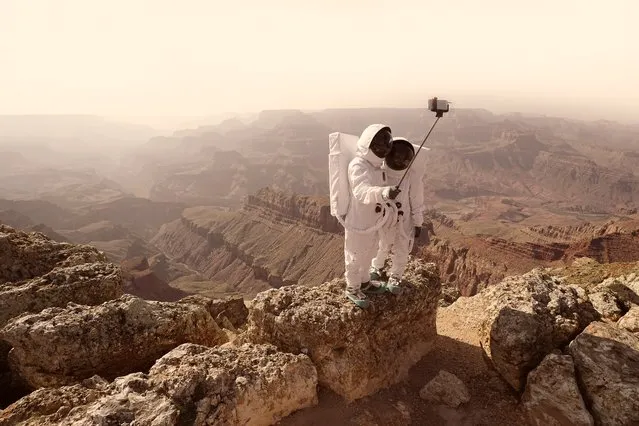
Professional conceptual category winner. Greetings from Mars, by Julien Mauve, France. Mauve says: “I have always wondered what it would be like to discover a totally different world ... and to photograph it for the first time as if I was Ansel Adams. So I came up with this project, which is about space exploration and discovery. But it’s also about our behavior in front of landscapes and how we create pictures that will share our personal story with the world”. (Photo by Julien Mauve)

Professional conceptual category winner. Greetings from Mars, by Julien Mauve, France. Mauve says: “I have always wondered what it would be like to discover a totally different world ... and to photograph it for the first time as if I was Ansel Adams. So I came up with this project, which is about space exploration and discovery. But it’s also about our behavior in front of landscapes and how we create pictures that will share our personal story with the world”. (Photo by Julien Mauve)
Details
23 Apr 2016 13:57:00
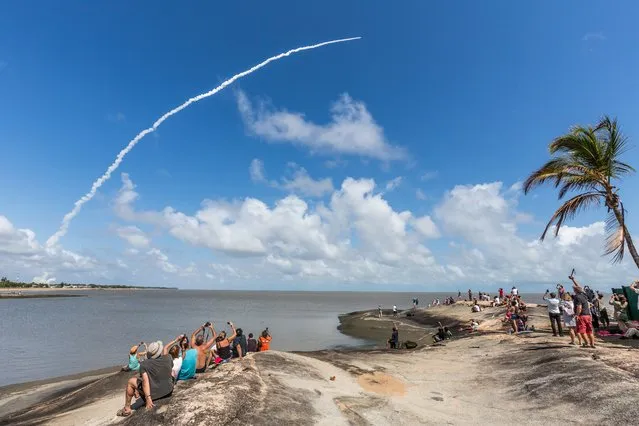
People take photos as an Ariane 5 space rocket with a payload of four Galileo satellites lifts off from ESA's European Spaceport in Kourou, French Guiana, on November 17, 2016. Ariane 5 successfully launched on November 17 four satellites which will be part of the Galileo global satellite navigation system. (Photo by Jody Amiet/AFP Photo)

People take photos as an Ariane 5 space rocket with a payload of four Galileo satellites lifts off from ESA's European Spaceport in Kourou, French Guiana, on November 17, 2016. Ariane 5 successfully launched on November 17 four satellites which will be part of the Galileo global satellite navigation system. (Photo by Jody Amiet/AFP Photo)
Details
18 Nov 2016 15:38:00
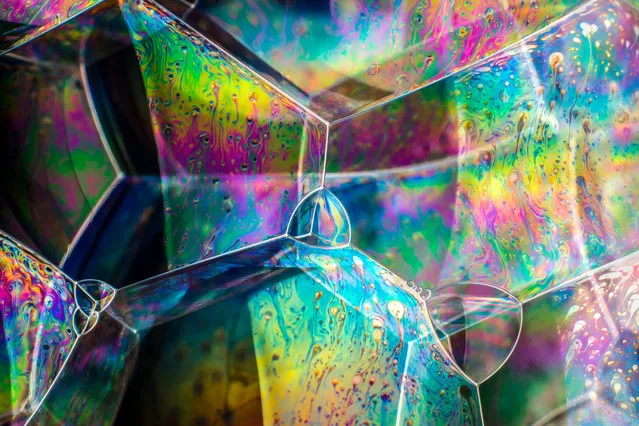
Soap Bubble Structures by Kym Cox. Bubbles optimise space and minimise their surface area for a given volume of air. This phenomenon makes them a useful tool in many areas of research, in particular, materials science and ‘packing’ – how things fit together. Bubble walls drain under gravity, thin at the top, thick at the bottom, which interferes with travelling lightwaves to create bands of colour. Black spots show the wall is too thin for interference colours, indicating the bubble is about to burst. (Photo by Kym Cox/2019 Science Photographer of the Year/RPS)

Soap Bubble Structures by Kym Cox. Bubbles optimise space and minimise their surface area for a given volume of air. This phenomenon makes them a useful tool in many areas of research, in particular, materials science and “packing” – how things fit together. Bubble walls drain under gravity, thin at the top, thick at the bottom, which interferes with travelling lightwaves to create bands of colour. Black spots show the wall is too thin for interference colours, indicating the bubble is about to burst. (Photo by Kym Cox/2019 Science Photographer of the Year/RPS)
Details
15 Aug 2019 00:03:00