Loading...
Done
A man wearing a hazmat suit and a mask holds a sign reading “The end is near – call grandma” at Times Square on March 14, 2020 in New York City. The World Health Organization said March 13, 2020 it was not yet possible to say when the COVID-19 pandemic, which has killed more than 5,000 people worldwide, will peak. “It's impossible for us to say when this will peak globally”, Maria Van Kerkhove, who heads the WHO's emerging diseases unit, told a virtual press conference, adding that “we hope that it is sooner rather than later”. (Photo by Johannes Eisele/AFP Photo)

A man wearing a hazmat suit and a mask holds a sign reading “The end is near – call grandma” at Times Square on March 14, 2020 in New York City. The World Health Organization said March 13, 2020 it was not yet possible to say when the COVID-19 pandemic, which has killed more than 5,000 people worldwide, will peak. “It's impossible for us to say when this will peak globally”, Maria Van Kerkhove, who heads the WHO's emerging diseases unit, told a virtual press conference, adding that “we hope that it is sooner rather than later”. (Photo by Johannes Eisele/AFP Photo)
Details
16 Mar 2020 00:07:00
A woman wearing a protective mask is seen behind a girl dressed in a Plague Doctor Mask in Western-Ukrainian city of Lviv, Ukraine, 22 March 2020. Ukrainian Designer Anastasia Markovska sewed protective masks looking like Plague Doctor Masks, the traditional costume of Venice Carnival, for herself and her friends due to the ongoing pandemic of the COVID-19 disease caused by the SARS-CoV-2 coronavirus. In Ukraine had been 47 laboratory-confirmed cases of COVID-19, including three deaths and one recovery as Ukraine's Health Ministry announced. (Photo by Pavlo Palamarchuk/EPA/EFE)

A woman wearing a protective mask is seen behind a girl dressed in a Plague Doctor Mask in Western-Ukrainian city of Lviv, Ukraine, 22 March 2020. Ukrainian Designer Anastasia Markovska sewed protective masks looking like Plague Doctor Masks, the traditional costume of Venice Carnival, for herself and her friends due to the ongoing pandemic of the COVID-19 disease caused by the SARS-CoV-2 coronavirus. In Ukraine had been 47 laboratory-confirmed cases of COVID-19, including three deaths and one recovery as Ukraine's Health Ministry announced. (Photo by Pavlo Palamarchuk/EPA/EFE)
Details
02 May 2020 00:05:00
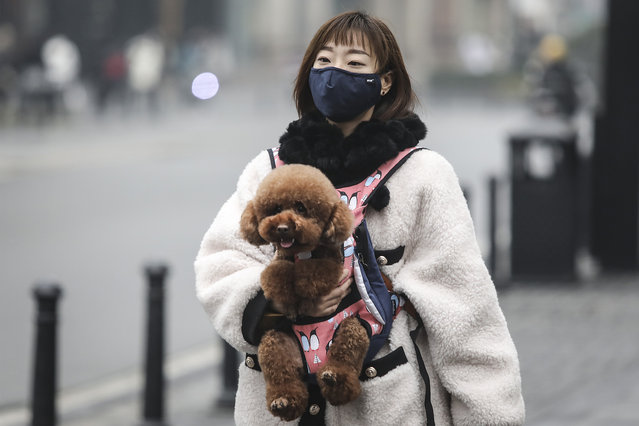
A woman wears a mask while carrying a dog in the street on January 22, 2020 in Wuhan, Hubei province, China. A new infectious coronavirus known as “2019-nCoV” was discovered in Wuhan as the number of cases rose to over 400 in mainland China. Health officials stepped up efforts to contain the spread of the pneumonia-like disease which medicals experts confirmed can be passed from human to human. The death toll has reached 17 people as the Wuhan government issued regulations today that residents must wear masks in public places. Cases have been reported in other countries including the United States, Thailand, Japan, Taiwan, and South Korea. (Photo by Getty Images/China Stringer Network)

A woman wears a mask while carrying a dog in the street on January 22, 2020 in Wuhan, Hubei province, China. A new infectious coronavirus known as “2019-nCoV” was discovered in Wuhan as the number of cases rose to over 400 in mainland China. Health officials stepped up efforts to contain the spread of the pneumonia-like disease which medicals experts confirmed can be passed from human to human. The death toll has reached 17 people as the Wuhan government issued regulations today that residents must wear masks in public places. Cases have been reported in other countries including the United States, Thailand, Japan, Taiwan, and South Korea. (Photo by Getty Images/China Stringer Network)
Details
31 Dec 2020 00:01:00
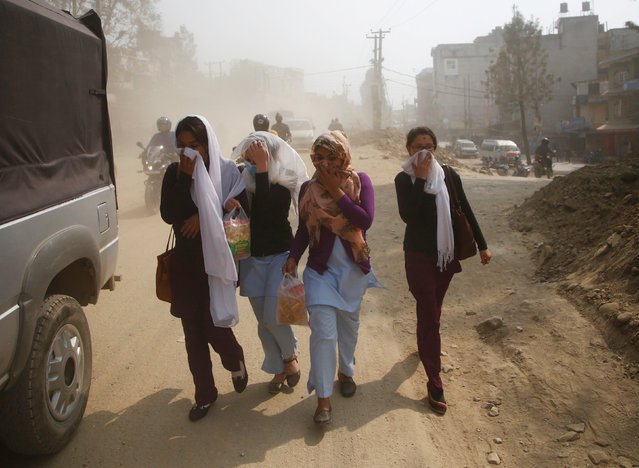
Pedestrians cover their face as they walk along the dusty road in Kathmandu, Nepal February 27, 2017. Nepal has forced 2,500 old vehicles off roads in its capital city of Kathmandu, part of a fight against alarming air pollution levels that have hit nine times World Health Organisation (WHO) limits. Air pollution has been a chronic problem in rapidly growing Kathmandu, which sits in a Himalayan valley and is home to more than 3mn people. Rising public anger with the smog is turning into a headache for a beleaguered government headed by former Maoist rebels. Dust from road works, exhaust from old, poorly maintained vehicles and smoke from coal-burning brick kilns blend in a murky haze that hangs over the ancient city, raising the risk of cancer, stroke, asthma and high blood pressure, experts say. Officials hope the ban on vehicles more than 20 years old will be a step towards a cleaner future. (Photo by Navesh Chitrakar/Reuters)

Pedestrians cover their face as they walk along the dusty road in Kathmandu, Nepal February 27, 2017. Nepal has forced 2,500 old vehicles off roads in its capital city of Kathmandu, part of a fight against alarming air pollution levels that have hit nine times World Health Organisation (WHO) limits. Air pollution has been a chronic problem in rapidly growing Kathmandu, which sits in a Himalayan valley and is home to more than 3mn people. (Photo by Navesh Chitrakar/Reuters)
Details
04 Mar 2017 00:04:00
What the World Eats By Peter Menzel And Faith D'Aluisio Part 2

A stunning photographic collection featuring portraits of people from 30 countries and the food they eat in one day. In this fascinating study of people and their diets, 80 profiles are organized by the total number of calories each person puts away in a day. Featuring a Japanese sumo wrestler, a Massai herdswoman, world-renowned Spanish chef Ferran Adria, an American competitive eater, and more, these compulsively readable personal stories also include demographic particulars, including age, activity level, height, and weight. Essays from Harvard primatologist Richard Wrangham, journalist Michael Pollan, and others discuss the implications of our modern diets for our health and for the planet. This compelling blend of photography and investigative reportage expands our understanding of the complex relationships among individuals, culture, and food.
Details
02 May 2014 09:20:00
Damai, 3 years old Bornean orang utan plays courtyard at Surabaya Zoo as he prepares to be released into the wild on May 19, 2014 in Surabaya, Indonesia. The two baby orangutans, brothers, were found in Kutai National Park in a critical condition having been abandoned by their mother on May 14, 2014. (Photo by Robertus Pudyanto/Getty Images)

Damai, 3 years old Bornean orang utan plays courtyard at Surabaya Zoo as he prepares to be released into the wild on May 19, 2014 in Surabaya, Indonesia. The two baby orangutans, brothers, were found in Kutai National Park in a critical condition having been abandoned by their mother on May 14, 2014. The Centre for Orangutan Protection (COP) have since been nursing the animals back to health, treating them for malnourishment and 16 wounds predominantly to the feet and hands. (Photo by Robertus Pudyanto/Getty Images)
Details
20 May 2014 10:41:00
Lisibeht Martinez (L), 30, who was sterilized one year ago, sits next to her children while they play in a bathtub in the backyard of their house in Los Teques, Venezuela July 19, 2016. (Photo by Carlos Garcia Rawlins/Reuters)

Venezuela's food shortages, inflation and crumbling medical sector have become such a source of anguish that a growing number of young women are reluctantly opting for sterilizations rather than face the hardship of pregnancy and child-rearing. Traditional contraceptives like condoms or birth control pills have virtually vanished from store shelves, pushing women towards the hard-to-reverse surgery. While no recent national statistics on sterilizations are available, doctors and health workers say demand for the procedure is growing. (Photo by Carlos Garcia Rawlins/Reuters)
Details
04 Aug 2016 12:22:00


“Dog meat refers to edible parts and the flesh derived from (predominantly domestic) dogs. Human consumption of dog meat has been recorded in many parts of the world, including ancient China, ancient Mexico, and ancient Rome. According to contemporary reports, dog meat is consumed in a variety of countries such as Switzerland, China, Vietnam, the Philippines, and Korea. In addition, dog meat has also been used as survival food in times of war and/or other hardships”. – Wikipedia

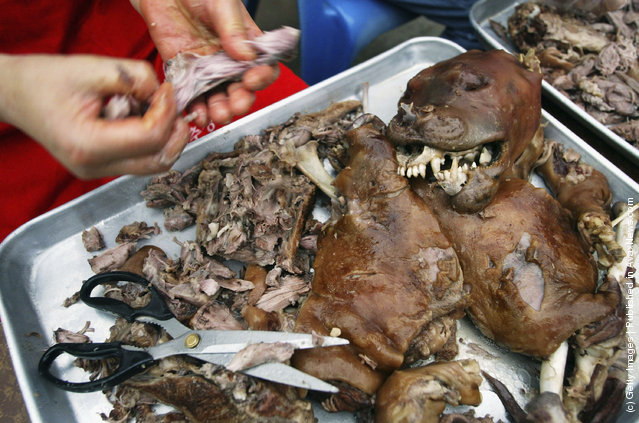
Photo: A chef prepares dog meat at a restaurant on July 4, 2005 in Gwacheon, South Korea. Dog meat is a traditional dish in Korea dating back to the Samkuk period (period of the three kingdoms BC 57 – AD 668). Although many recipes existed historically for dog meat, now chefs only make soups, or dishes using boiled or roasted meat. Koreans traditionally eat dog meat on the hottest day of the summer, for it's reputed benefits of virility, invigoration and health. (Photo by Chung Sung-Jun/Getty Images)
Details
24 Jul 2011 13:21:00