Loading...
Done
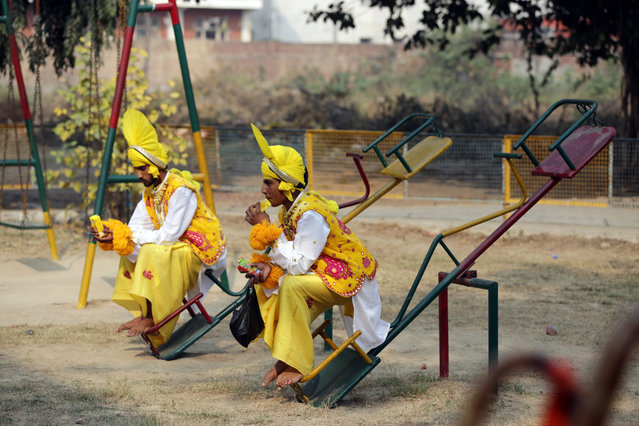
Indian young men wearing traditional folk dance “Bhangra” attire of Punjab, sit on see-saws and sip on soft drinks at a park before their performance during the Khalsa College International Folk Festival 2017 in Amritsar, India, 29 November 2017. The festival is aimed to promote cultural ties between India and participating countries. (Photo by Raminder Pal Singh/EPA/EFE)

Indian young men wearing traditional folk dance “Bhangra” attire of Punjab, sit on see-saws and sip on soft drinks at a park before their performance during the Khalsa College International Folk Festival 2017 in Amritsar, India, 29 November 2017. The festival is aimed to promote cultural ties between India and participating countries. (Photo by Raminder Pal Singh/EPA/EFE)
Details
11 Dec 2017 08:30:00
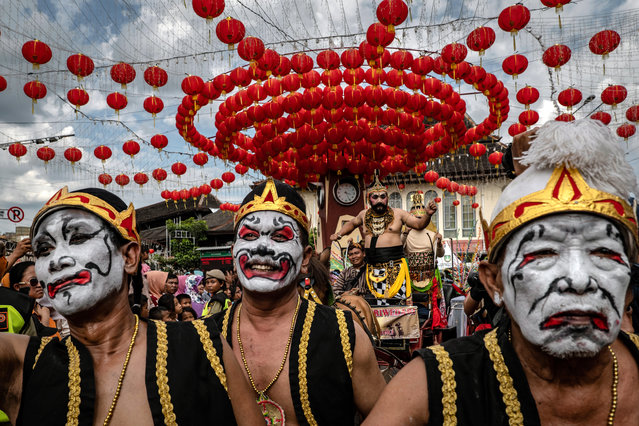
Participants perform parade in the street during Grebeg Sudiro festival on January 19, 2020 in Solo City, Central Java, Indonesia. Grebeg Sudiro festival is held as a prelude to the Chinese New Year, which falls on January 25th this year, welcoming the Year of the Rat. People bring offerings known as gunungan, including Chinese sweetcakes piled up into the shape of mountains, which are paraded in the streets followed by Chinese and Javanese performers. (Photo by Ulet Ifansasti/Getty Images)

Participants perform parade in the street during Grebeg Sudiro festival on January 19, 2020 in Solo City, Central Java, Indonesia. Grebeg Sudiro festival is held as a prelude to the Chinese New Year, which falls on January 25th this year, welcoming the Year of the Rat. People bring offerings known as gunungan, including Chinese sweetcakes piled up into the shape of mountains, which are paraded in the streets followed by Chinese and Javanese performers. (Photo by Ulet Ifansasti/Getty Images)
Details
23 Jan 2020 00:01:00
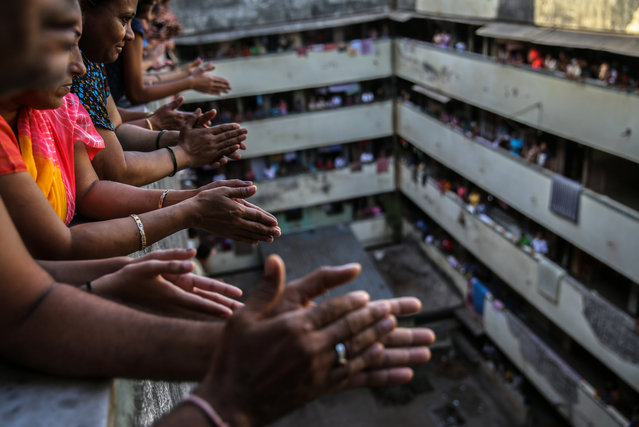
Indian people bang utensils and clap from the balconies of a residential building in Mumbai, India, 22 March 2020. Prime Minister Narendra Modi asks citizens to impose self-curfew to fight Coronavirus COVID-19 and also ask them to clap, bang the bells and utensils at 5pm Indian time to mark of respect and to thank the medical staff and others working 24 hours, during Covid-19 outbreak to keeping the Indians safe. (Photo by Divyakant Solanki/EPA/EFE)

Indian people bang utensils and clap from the balconies of a residential building in Mumbai, India, 22 March 2020. Prime Minister Narendra Modi asks citizens to impose self-curfew to fight Coronavirus COVID-19 and also ask them to clap, bang the bells and utensils at 5pm Indian time to mark of respect and to thank the medical staff and others working 24 hours, during Covid-19 outbreak to keeping the Indians safe. (Photo by Divyakant Solanki/EPA/EFE)
Details
29 Mar 2020 00:05:00
A four-legged robot dog called SPOT patrols a park as it undergoes testing to be deployed as a safe distancing ambassador, following the coronavirus disease (COVID-19) outbreak, in Singapore on May 8, 2020. (Photo by Edgar Su/Reuters)

A four-legged robot dog called SPOT patrols a park as it undergoes testing to be deployed as a safe distancing ambassador, following the coronavirus disease (COVID-19) outbreak, in Singapore on May 8, 2020. (Photo by Edgar Su/Reuters)
Details
10 May 2020 00:07:00
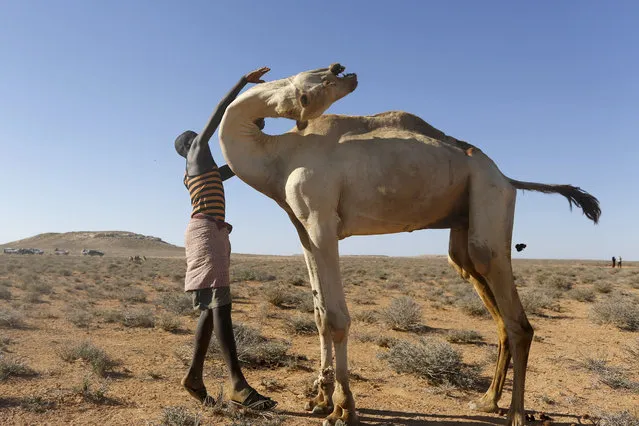
Ali Asair, who has left his family behind and traveled hundreds of kilometers in search for a pasture for his animals, attends to his camel in a pastoralists' settlement in the Bandarbeyla district in Somalia's semi-autonomous region of Puntland, Somalia, 24 March 2017. According to media reports, the United Nations says only 31 percent of 864 million US dollars appeal for a drought-hit Somalia is funded. The UN said the world is facing the largest humanitarian crisis since 1945, adding that more than 20 million people are facing the threat of famine in Somalia, Yemen, South Sudan and Nigeria and 1.4 million children could die from starvation this year. (Photo by Dai Kurokawa/EPA)

Ali Asair, who has left his family behind and traveled hundreds of kilometers in search for a pasture for his animals, attends to his camel in a pastoralists' settlement in the Bandarbeyla district in Somalia's semi-autonomous region of Puntland, Somalia, 24 March 2017. According to media reports, the United Nations says only 31 percent of 864 million US dollars appeal for a drought-hit Somalia is funded. The UN said the world is facing the largest humanitarian crisis since 1945, adding that more than 20 million people are facing the threat of famine in Somalia, Yemen, South Sudan and Nigeria and 1.4 million children could die from starvation this year. (Photo by Dai Kurokawa/EPA)
Details
28 Mar 2017 09:01:00
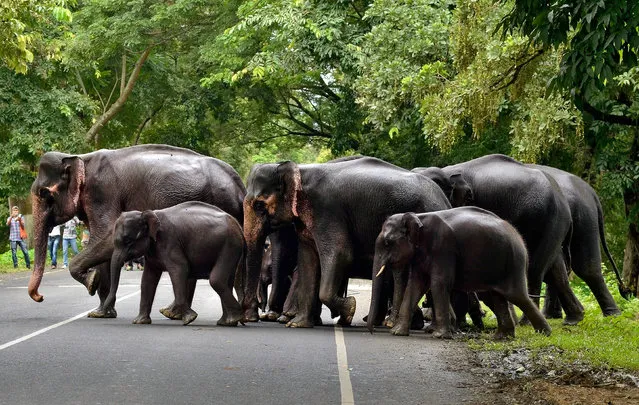
A herd of elephants cross a road that passes through the flooded Kaziranga National Park in the northeastern state of Assam, India, July 12, 2017. (Photo by Anuwar Hazarika/Reuters)

A herd of elephants cross a road that passes through the flooded Kaziranga National Park in the northeastern state of Assam, India, July 12, 2017. (Photo by Anuwar Hazarika/Reuters)
Details
15 Jul 2017 08:26:00
VIETNAM: A Vietnamese woman, wearing the traditional “ao dai” long dress, poses for photos along peach blossom flowers ahead of the Vietnamese “Tet” (Lunar New Year festival), in a field in Hanoi, Vietnam, February 2, 2016. (Photo by Reuters/Kham)

VIETNAM: A Vietnamese woman, wearing the traditional “ao dai” long dress, poses for photos along peach blossom flowers ahead of the Vietnamese “Tet” (Lunar New Year festival), in a field in Hanoi, Vietnam, February 2, 2016. (Photo by Reuters/Kham)
Details
26 Dec 2016 07:22:00
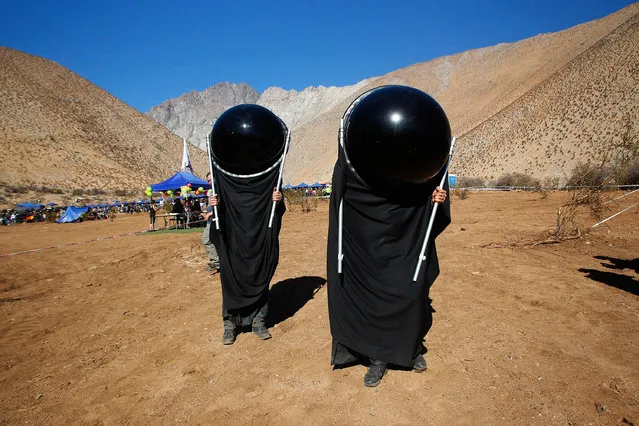
Chileans watch the sky with special suits prior to a total solar eclipse on July 2, 2019 in Paiguano, Chile. Around 25,0000 tourists arrived to Paiguano, a small town of around 1,000 inhabitants in the Elqui Valley, 650 km away Santiago. This is the only Earth's total solar eclipse of 2019 and the first one since 2017. From this point, the sun will fully disappear for around two minutes. It is best visible from a stripe in the South Pacific, Chile and Argentina. (Photo by Marcelo Hernandez/Getty Images)

Chileans watch the sky with special suits prior to a total solar eclipse on July 2, 2019 in Paiguano, Chile. Around 25,0000 tourists arrived to Paiguano, a small town of around 1,000 inhabitants in the Elqui Valley, 650 km away Santiago. This is the only Earth's total solar eclipse of 2019 and the first one since 2017. From this point, the sun will fully disappear for around two minutes. It is best visible from a stripe in the South Pacific, Chile and Argentina. (Photo by Marcelo Hernandez/Getty Images)
Details
04 Jul 2019 00:05:00