Loading...
Done
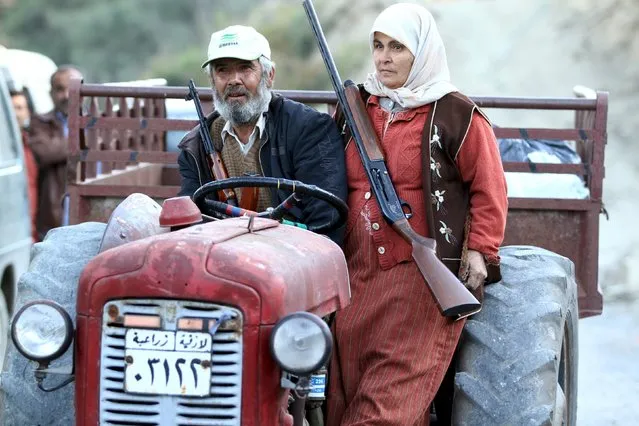
Armed Syrian Turkmen villagers are seen near the northern Syrian village of Yamadi, near the Turkish-Syrian border, Syria, November 24, 2015. Turkey shot down a Russian warplane near the Syrian border on Tuesday saying it had repeatedly violated its air space, one of the most serious publicly acknowledged clashes between a NATO member country and Russia for half a century. (Photo by Reuters/Stringer)

Armed Syrian Turkmen villagers are seen near the northern Syrian village of Yamadi, near the Turkish-Syrian border, Syria, November 24, 2015. Turkey shot down a Russian warplane near the Syrian border on Tuesday saying it had repeatedly violated its air space, one of the most serious publicly acknowledged clashes between a NATO member country and Russia for half a century. (Photo by Reuters/Stringer)
Details
25 Nov 2015 08:07:00
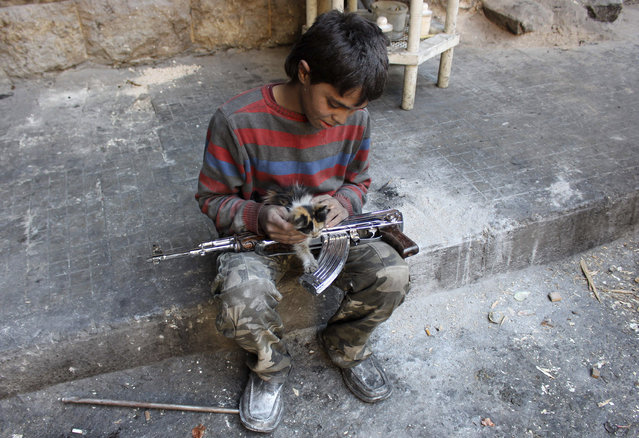
Mohammad, a 13-year-old fighter from the “Free Syrian Army”, plays with a cat in Aleppo's Bustan al-Basha district, Syria October 28, 2013. Mohammad joined the Free Syrian Army after his father died during clashes with the Syrian regime. The gun he is using was his father's. (Photo by Molhem Barakat/Reuters)

Mohammad, a 13-year-old fighter from the “Free Syrian Army”, plays with a cat in Aleppo's Bustan al-Basha district, Syria October 28, 2013. Mohammad joined the Free Syrian Army after his father died during clashes with the Syrian regime. The gun he is using was his father's. (Photo by Molhem Barakat/Reuters)
Details
13 May 2015 10:44:00
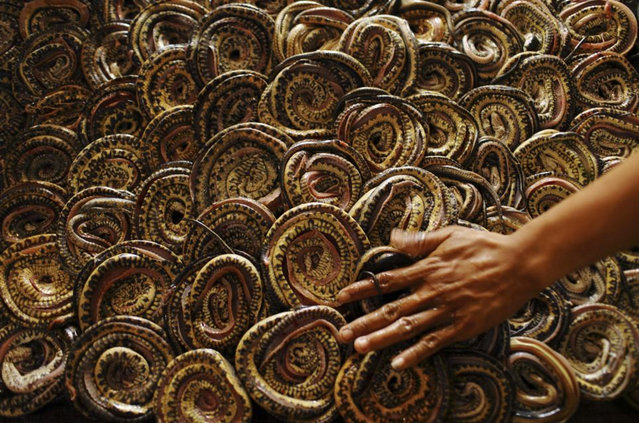
How Snakeskin Handbags Are Made

Images from a snake slaughterhouse at Kapetakan village in Indonesia’s West Java province. Wakira, who is known as “Boss Cobra”, owns the slaughterhouse that produces snake meat and skin. Snake meat is believed by some to be a remedy for skin diseases and asthma, as well as an aid to increase virility. The snake skins, measuring in the hundreds of metres, are sold to bag factories in the West and Central Java provinces on a monthly basis. The price of a bag made from snake skin costs between 150,000 rupiah ($ 15.60) and 300,000 rupiah ($31.20), depending on its size. That snakeskin handbag you’ll buy is costing a hell of a lot more.
Details
20 Feb 2013 12:00:00
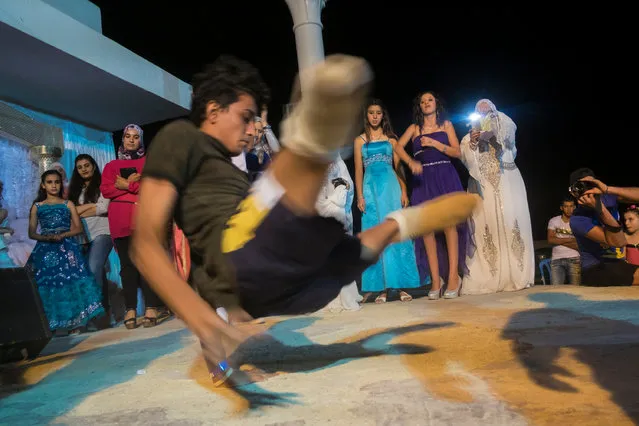
He performs his moves during the wedding celebrations, with his prosthetic limbs removed. (Photo by Yassine Alaoui Ismaili/The Guardian)

Street photographer Yassine Alaoui Ismaili follows 16-year-old Emeer Guesmi, aka B-boy Zulu Rema, as he trains and performs breakdance moves – all without the use of his legs. At a breakdance championship in Tunisia, Casablanca-based street photographer Yassine Alaoui Ismaili noticed an unusual competitor: Emeer Guesmi, dancing without the aid of his lower legs. He started following him as he trained and performed. (Photo by Yassine Alaoui Ismaili/The Guardian)
Details
23 Nov 2016 12:33:00


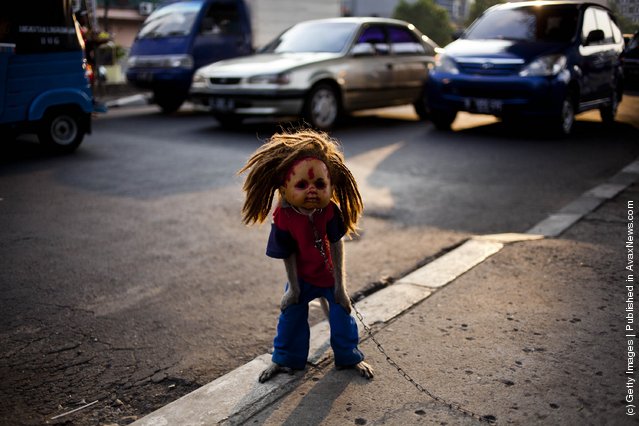
Ucil, a trained monkey, takes part in a street performance on June 1, 2011 in Jakarta, Indonesia. The street performances usually involve the monkeys wearing masks, such as dolls' heads or attire to mimic humans, with the monkeys trained to act out human activities such as shopping, riding bicycles or other simulations of human behaviour. Poverty drives the handlers to exploit the monkeys in the hope of earning small change, but the effect and cruelty to the monkeys is a cause that charities such as the Jakarta Animal Aid Network are increasingly taking up. (Photo by Ulet Ifansasti/Getty Images)
Details
02 Jun 2011 12:14:00
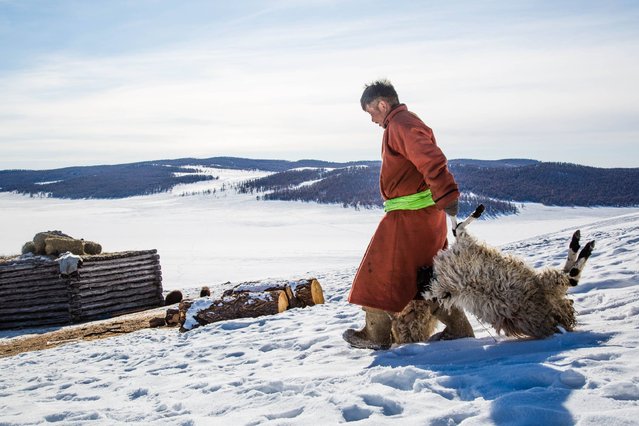
This handout photo taken on February 12, 2017 and released on February 16 by the International Federation of Red Cross and Red Crescent Societies (IFRC) shows Mongolian herder Munkhbat Bazarragchaa (C) dragging two sheep – which recently died due to the weather - to a pile of dead animals behind his “ger” in Khuvsgul province, northern Mongolia. Thousands of Mongolian herders face disastrous livestock losses from dreaded severe weather  known as the “dzud”, the Red Cross said on February 16, 2017 in launching an international emergency aid appeal. (Photo by Mirva Helenius/AFP Photo/IFRC)

This handout photo taken on February 12, 2017 and released on February 16 by the International Federation of Red Cross and Red Crescent Societies (IFRC) shows Mongolian herder Munkhbat Bazarragchaa (C) dragging two sheep – which recently died due to the weather - to a pile of dead animals behind his “ger” in Khuvsgul province, northern Mongolia. Thousands of Mongolian herders face disastrous livestock losses from dreaded severe weather known as the “dzud”, the Red Cross said on February 16, 2017 in launching an international emergency aid appeal. (Photo by Mirva Helenius/AFP Photo/IFRC)
Details
17 Feb 2017 11:40:00
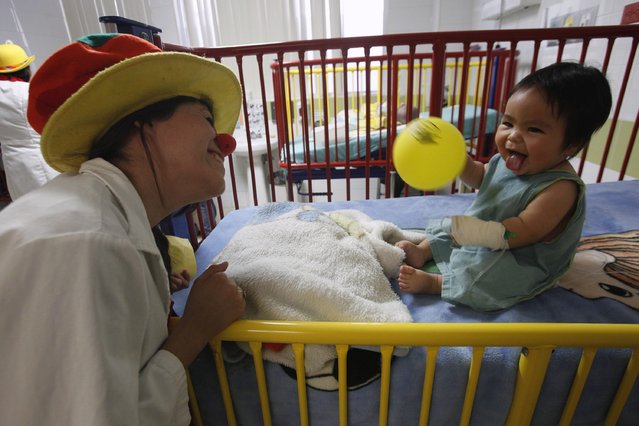
A member of “Laughter Doctors of Ciudad Juarez” performs at a children's hospital in Ciudad Juarez March 11, 2015. (Photo by Jose Luis Gonzalez/Reuters)

A member of “Laughter Doctors of Ciudad Juarez” performs at a children's hospital in Ciudad Juarez March 11, 2015. Through clown performances, music and interactive activities, the group of doctors visit different hospitals throughout the border city, using laughter to help aid the recovery of young and elderly patients suffering from serious illness or injury, as well as provide hope for the hospitalized patients and their families, local media reported. (Photo by Jose Luis Gonzalez/Reuters)
Details
15 Mar 2015 06:23:00
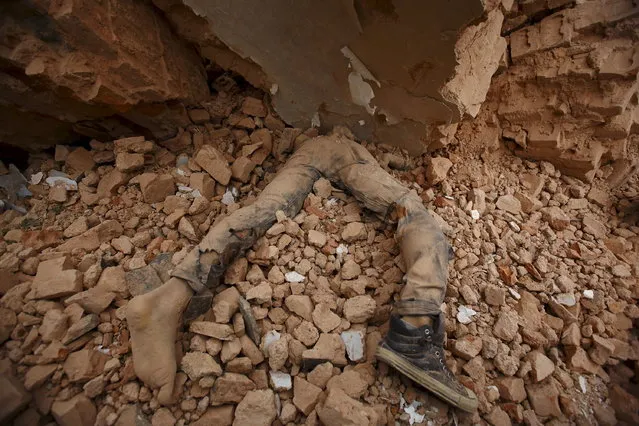
A body of a victim lies trapped in the debris after an earthquake hit, in Kathmandu, Nepal April 25, 2015. (Photo by Navesh Chitrakar/Reuters)

A body of a victim lies trapped in the debris after an earthquake hit, in Kathmandu, Nepal April 25, 2015. Rescue efforts in Nepal are intensifying after nearly 2,000 people were killed on Saturday in the worst earthquake there in more than 80 years. Many countries and charities have offered aid to deal with the disaster. Seventeen people have been killed on Mount Everest by avalanches – the mountain's worst-ever disaster. Meanwhile a powerful aftershock was felt on Sunday in Nepal, India and Bangladesh, and more avalanches were reported near Everest. (Photo by Navesh Chitrakar/Reuters)
Details
26 Apr 2015 09:11:00