Loading...
Done
The eruption of Cordon Caulle began on June 4, 2011, located in the Region of Los Rios in Chile. For about 12 months, people and animals became accustomed to living with the daily fall of ash, which also caused problems in the air traffic in South America. The explosions and lightning during first days of the eruption could be seen from hundreds of miles around. This photograph was taken on the second night of eruption from the town of Lago Ranco. (Photo and caption by Francisco Negroni/National Geographic Traveler Photo Contest)

The eruption of Cordon Caulle began on June 4, 2011, located in the Region of Los Rios in Chile. For about 12 months, people and animals became accustomed to living with the daily fall of ash, which also caused problems in the air traffic in South America. The explosions and lightning during first days of the eruption could be seen from hundreds of miles around. This photograph was taken on the second night of eruption from the town of Lago Ranco. (Photo and caption by Francisco Negroni/National Geographic Traveler Photo Contest)

ATTENTION! All pictures are presented in high resolution. To see Hi-Res images – just TWICE click on any picture. In other words, click small picture – opens the BIG picture. Click BIG picture – opens VERY BIG picture.
Details
23 Jun 2013 11:24:00
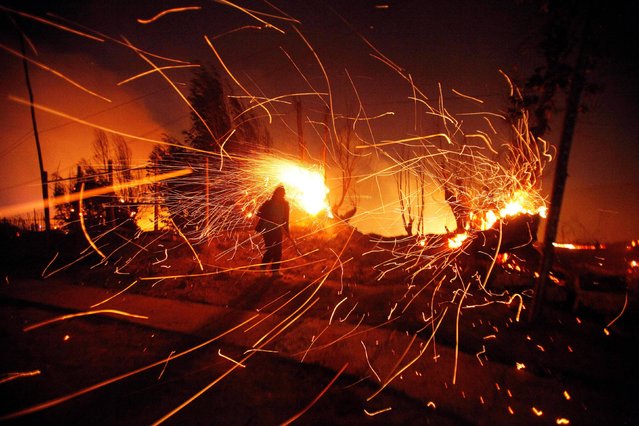
A person tries to extinguish flames as sparks fly during a wild forest fire in Valparaiso, Chile, Sunday April 13, 2014. Authorities say the fires have destroyed hundreds of homes, forced the evacuation of thousands and claimed the lives of at least seven people. (Photo by Luis Hidalgo/AP Photo)

A person tries to extinguish flames as sparks fly during a wild forest fire in Valparaiso, Chile, Sunday April 13, 2014. Authorities say the fires have destroyed hundreds of homes, forced the evacuation of thousands and claimed the lives of at least seven people. (Photo by Luis Hidalgo/AP Photo)
Details
29 Apr 2014 09:30:00
A man pushes a tub carrying children as he gets them back home after school at a flooded area in Duchang, Jiangxi Province, China, June 27, 2016. (Photo by Reuters/Stringer)

A man pushes a tub carrying children as he gets them back home after school at a flooded area in Duchang, Jiangxi Province, China, June 27, 2016. (Photo by Reuters/Stringer)
Details
30 Jun 2016 11:43:00
People walk past a sculpture entitled “Reunion” by artist Sam Jinks at a preview of the Melbourne Art Fair in Melbourne on August 1, 2018. The sculpture is made of silicone, pigment, resin and human hair. (Photo by William West/AFP Photo)

People walk past a sculpture entitled “Reunion” by artist Sam Jinks at a preview of the Melbourne Art Fair in Melbourne on August 1, 2018. The sculpture is made of silicone, pigment, resin and human hair. (Photo by William West/AFP Photo)
Details
02 Aug 2018 08:53:00
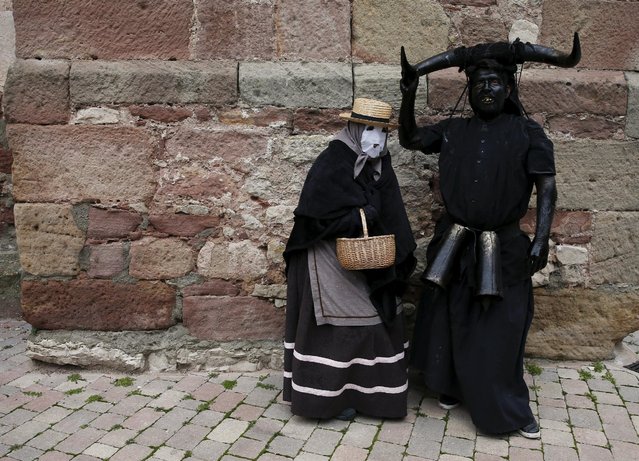
A reveller (R), dressed as “Diablos de Luzon” (Luzon Devils), stands next to a person dressed as a “Mascaritas” during carnival celebrations in the village of Luzon, Spain, February 6, 2016. (Photo by Sergio Perez/Reuters)

A reveller (R), dressed as “Diablos de Luzon” (Luzon Devils), stands next to a person dressed as a “Mascaritas” during carnival celebrations in the village of Luzon, Spain, February 6, 2016. The “Diablos” cover themselves in a mixture of soot and oil and adorn their heads with black-stained bull horns as they parade throughout the village with cowbells clanging around their waists to expel the evil spirits. (Photo by Sergio Perez/Reuters)
Details
08 Feb 2016 11:49:00
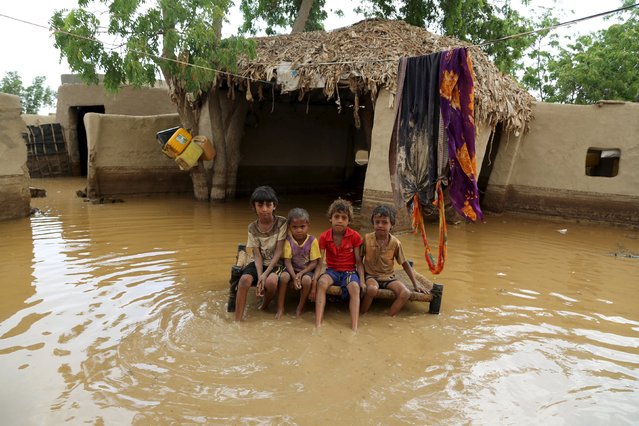
Children sit on a bed in a flooded house following heavy rain in a village in Yemen's Red Sea province of Houdieda April 15, 2016. (Photo by Abduljabbar Zeyad/Reuters)

Children sit on a bed in a flooded house following heavy rain in a village in Yemen's Red Sea province of Houdieda April 15, 2016. (Photo by Abduljabbar Zeyad/Reuters)
Details
17 Apr 2016 10:15:00
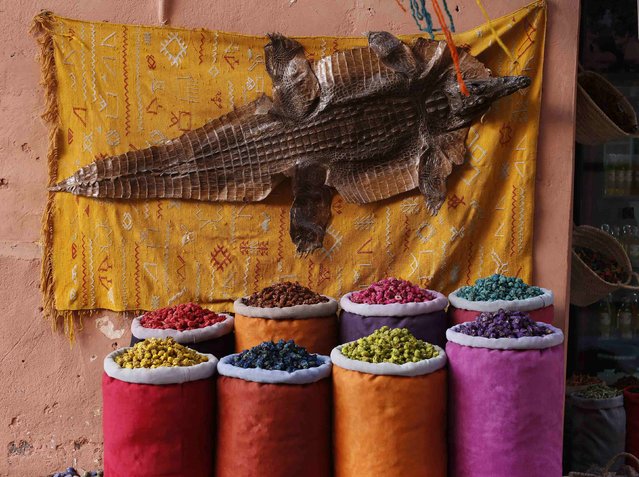
Crocodile skin is seen at a workshop in the old Medina of Marrakesh December 13, 2014. (Photo by Youssef Boudlal/Reuters)

Crocodile skin is seen at a workshop in the old Medina of Marrakesh December 13, 2014. (Photo by Youssef Boudlal/Reuters)
Details
19 Feb 2015 14:48:00
Syrian Tulin Hashemi waits for a job interview at a hotel in Vidigal slum in Rio de Janeiro, Brazil, September 22, 2015. Tulin, whose mother arrived two days ago, has been living in Brazil for two months. As she does not speak Portuguese, Tulin says it is difficult for her to find a job and therefore she is staying at the slum as it is one of the cheaper neighbourhoods to live in. (Photo by Pilar Olivares/Reuters)

Syrian Tulin Hashemi waits for a job interview at a hotel in Vidigal slum in Rio de Janeiro, Brazil, September 22, 2015. Tulin, whose mother arrived two days ago, has been living in Brazil for two months. As she does not speak Portuguese, Tulin says it is difficult for her to find a job and therefore she is staying at the slum as it is one of the cheaper neighbourhoods to live in. According to the National Committee for Refugees (CONARE), 2,077 people fleeing the Syrian civil war have settled in Brazil, whilst a quarter of the 8,400 refugees in the Latin American country come from Syria. (Photo by Pilar Olivares/Reuters)
Details
25 Sep 2015 08:05:00