Loading...
Done
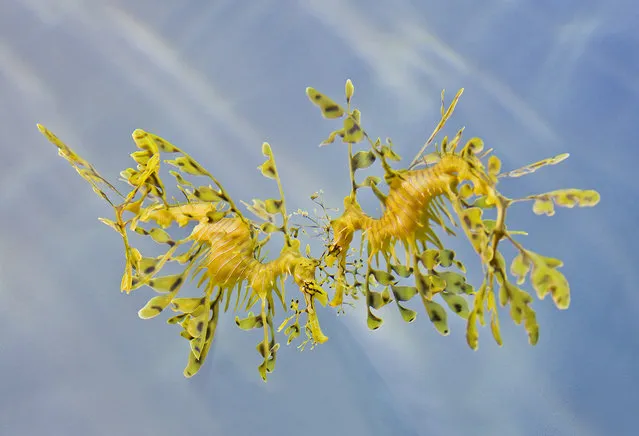
Leafy sea dragon

The leafy seadragon or Glauert's seadragon, Phycodurus eques, is a marine fish in the family Syngnathidae, which also includes the seahorses. It is the only member of the genus Phycodurus. It is found along the southern and western coasts of Australia. The name is derived from the appearance, with long leaf-like protrusions coming from all over the body. These protrusions are not used for propulsion; they serve only as camouflage. The leafy seadragon propels itself by means of a pectoral fin on the ridge of its neck and a dorsal fin on its back closer to the tail end. These small fins are almost completely transparent and difficult to see as they undulate minutely to move the creature sedately through the water, completing the illusion of floating seaweed.
Details
05 Sep 2012 08:51:00
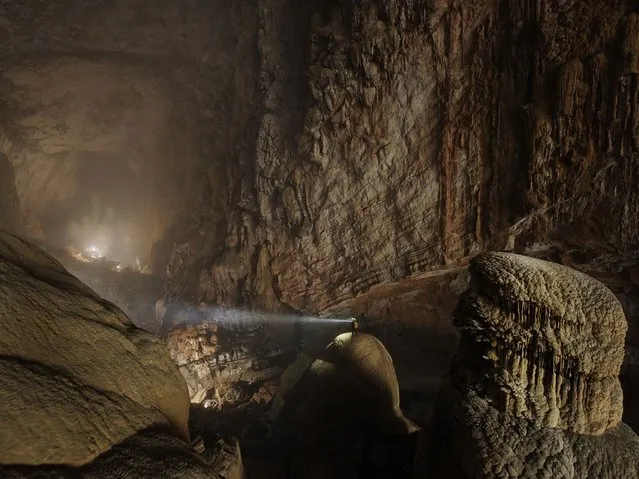
Son Doong Cave

Son doong cave is a cave in Phong Nha-Kẻ Bàng National Park, Bố Trạch district, Quảng Bình Province, Vietnam. Currently the biggest known cave in the world, the cave is located near the Laos-Vietnam border. Inside is a large, fast-flowing underground river.
In early August 2013, the first tourist group explored the cave on a guided tour at a cost of US$3,000 each. The group had six members from Australia, Norway, Russia and USA and spent 7 days and 6 nights for the tour. Next exploration trips will be arranged.
Details
22 Sep 2013 12:30:00
Art By Thomas Barbey

Thomas Barbèy grew up in Geneva, Switzerland, across the street from the “Caran D'ache” factory, the largest manufacturer of art supplies. He started drawing seriously at the age of 13, using black “encre de Chine” and gouaches for color. His influences were Philippe Druillet, Roger Dean and H.R. Giger. After living in Geneva for 17 years and designing posters for musical bands, he decided to move to Italy, where he lived in Milan for 15 years making a living as a successful recording artist, lyricist and fashion photographer.
Details
26 Sep 2013 10:31:00
A "scissors" dancer grabs her shoe with her mouth while performing in a national scissors dance competition in the outskirts of Lima December 1, 2013. (Photo by Enrique Castro-Mendivil/Reuters)

A “scissors” dancer grabs her shoe with her mouth while performing in a national scissors dance competition in the outskirts of Lima December 1, 2013. The Danza de las tijeras, or scissors dance, is a traditional dance from the Peruvian southern region of the Andes, in which two or more performers take turns dancing while accompanied with music from a harp and a violin. Dancers would display various skills and moves, which include cutting the air with the use of a scissors. (Photo by Enrique Castro-Mendivil/Reuters)
Details
03 Dec 2013 11:43:00
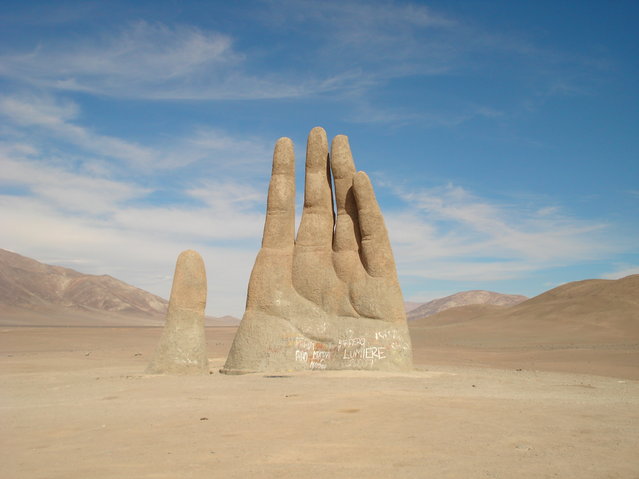
The Giant Hand of Atacama

The Mano de Desierto is a large-scale sculpture of a hand located in the Atacama Desert in Chile, 75 km to the south of the city of Antofagasta, on the Panamerican Highway. The nearest point of reference is the “Ciudad Empresarial La Negra” (La Negra Business City). The sculpture was constructed by the Chilean sculptor Mario Irarrázabal at an altitude of 1,100 meters above sea level. Irarrázabal used the human figure to express emotions like injustice, loneliness, sorrow and torture. Its exaggerated size is said to emphasize human vulnerability and helplessness. The work has a base of iron and cement, and stands 11 metres (36 ft) tall. Funded by Corporación Pro Antofagasta, a local booster organization, the sculpture was inaugurated on March 28, 1992.
Details
21 Dec 2013 10:18:00
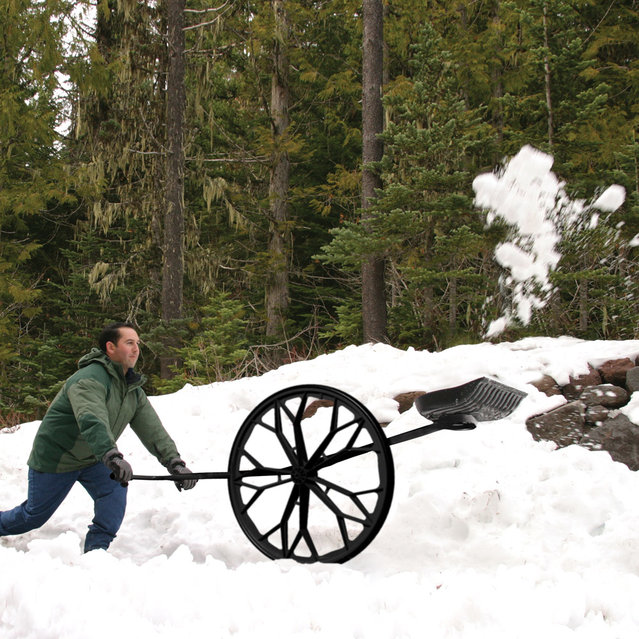
Wovel - The Ultimate Snow Shovel

The Wovel could possibly be the most advanced human snow removal machine ever created, next to simply getting someone else to do it. The revolutionary wheel design reduces the risks associated with heart attacks and back injuries because it uses adjustable leverage and your own body weight to push, lift, and throw snow up to 18" deep. The best feature about the Wovel is compared to a gas-powered snow blower, this one will always start.
Details
22 Dec 2013 11:17:00


A Galapagos Tortoise shell is used as a foot rest at Heathrow Airport's Animal Reception Centre on January 25, 2011 in London, England. Many animals pass through the centre's doors ranging from exotic animals such as snow leopards and elephants, snakes and crocodiles, to the more common such as cats and dogs. In 2010 alone the centre processed approximately 10,500 cats and dogs, 1,300 birds, 105,000 day old chicks, 246,000 reptiles, 230 horses and 29 million fish. Most animals are part of zoo transfer schemes, the pet trade, or are pets in transit. (Photo by Dan Kitwood/Getty Images)
Details
21 Mar 2011 12:30:00
Tacos of Cochinita Pibil, a popular dish from Yucatan, are seen during an attempt to break the Guinness World Record for the world's longest taco in Guadalajara February 15, 2015. (Photo by Alejandro Acosta/Reuters)

Tacos of Cochinita Pibil, a popular dish from Yucatan, are seen during an attempt to break the Guinness World Record for the world's longest taco in Guadalajara February 15, 2015. Guadalajara broke the Guinness record for the longest taco of cochinita pibil, with a length of 2.5 kilometers, as part of the COME gastronomy festival, local media reported. For the preparation of the traditional dish, the chefs used 4 tons of pork, 36,000 tortillas and spices for 325 taco servings. (Photo by Alejandro Acosta/Reuters)
Details
17 Feb 2015 11:54:00