Loading...
Done
England's full-back Freddie Steward dives across the line to score a try chased by Japan's wing Lomano Lemeki (L) during the France 2023 Rugby World Cup Pool D match between England and Japan at Stade de Nice in Nice, southern France on September 17, 2023. (Photo by Nicolas Tucat/AFP Photo)

England's full-back Freddie Steward dives across the line to score a try chased by Japan's wing Lomano Lemeki (L) during the France 2023 Rugby World Cup Pool D match between England and Japan at Stade de Nice in Nice, southern France on September 17, 2023. (Photo by Nicolas Tucat/AFP Photo)
Details
26 Sep 2023 02:58:00
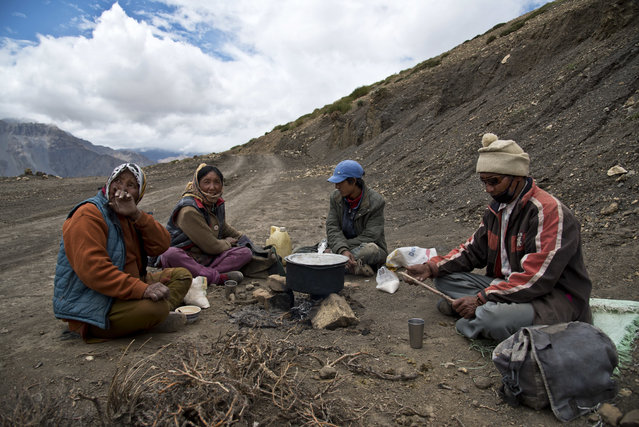
In this August 17, 2016, photo, from left to right, Chhering Chodom, 60, Tashi Yangzom, 50, Lobsang Chhering, 27, and Dorje Tandup, 58, drink milk tea on the side of the road. For centuries, the sleepy valley nestled in the Indian Himalayas remained a hidden Buddhist enclave forbidden to outsiders. Enduring the harsh year-round conditions of the high mountain desert, the people of Spiti Valley lived by a simple communal code – share the Earth's bounty, be hospitable to neighbors, and eschew greed and temptation at all turns. That's all starting to change, for better or worse. Since India began allowing its own citizens as well as outsiders to visit the valley in the early 1990s, tourism and trade have boomed. And the marks of modernization, such as solar panels, asphalt roads and concrete buildings, have begun to appear around some of the villages that dot the remote landscape at altitudes above 4,000 meters (13,000 feet). (Photo by Thomas Cytrynowicz/AP Photo)

In this August 17, 2016, photo, from left to right, Chhering Chodom, 60, Tashi Yangzom, 50, Lobsang Chhering, 27, and Dorje Tandup, 58, drink milk tea on the side of the road. For centuries, the sleepy valley nestled in the Indian Himalayas remained a hidden Buddhist enclave forbidden to outsiders. Enduring the harsh year-round conditions of the high mountain desert, the people of Spiti Valley lived by a simple communal code – share the Earth's bounty, be hospitable to neighbors, and eschew greed and temptation at all turns. That's all starting to change, for better or worse. (Photo by Thomas Cytrynowicz/AP Photo)
Details
15 Sep 2016 09:22:00
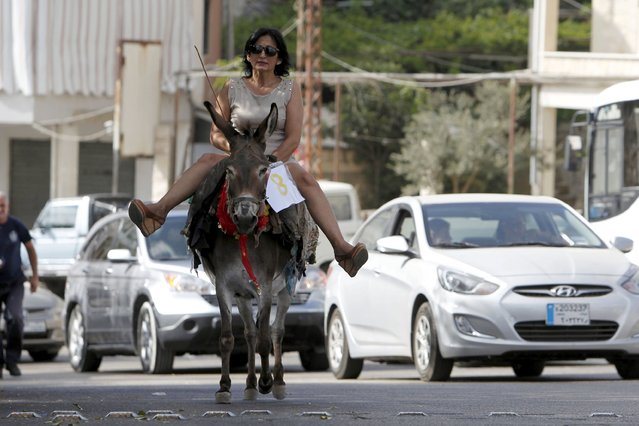
A woman rides a donkey during a donkey race in Roum village, Jizeen countryside, southern Lebanon, August 9, 2015. (Photo by Ali Hashisho/Reuters)

A woman rides a donkey during a donkey race in Roum village, Jizeen countryside, southern Lebanon, August 9, 2015. (Photo by Ali Hashisho/Reuters)
Details
10 Aug 2015 09:11:00
Hungary's athlete Anna Toth receives help after a fall in the women's 100m hurdles semifinal during the European Athletics Championships at the Olympic stadium in Rome on June 8, 2024. (Photo by Anne-Christine Poujoulat/AFP Photo)

Hungary's athlete Anna Toth receives help after a fall in the women's 100m hurdles semifinal during the European Athletics Championships at the Olympic stadium in Rome on June 8, 2024. (Photo by Anne-Christine Poujoulat/AFP Photo)
Details
17 Jun 2024 04:25:00
Children are engulfed by foam during the Bubble Show event in Beijing, China, Sunday, June 26, 2016. Thousands of residents enjoy colored foam churned out by machines along a running track at the event designed for children and parents'  interaction. (Photo by Ng Han Guan/AP Photo)

Children are engulfed by foam during the Bubble Show event in Beijing, China, Sunday, June 26, 2016. Thousands of residents enjoy colored foam churned out by machines along a running track at the event designed for children and parents' interaction. (Photo by Ng Han Guan/AP Photo)
Details
27 Jun 2016 12:40:00
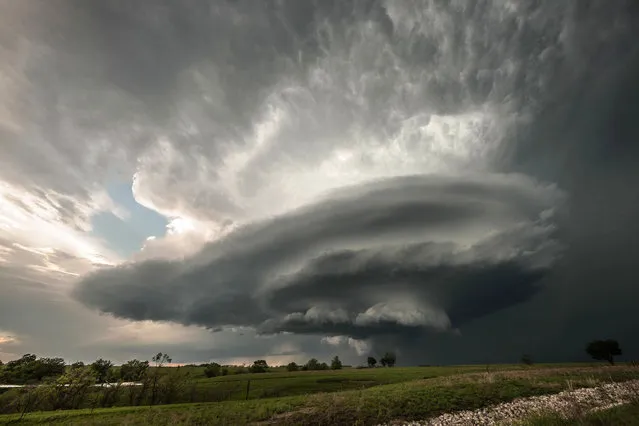
The rotating updraft base of a supercell thunderstorm, and a rear flank downdraft containing rain and hail, backlit by the setting sun, on May 10, 2014, in Climax, Kansas, United States. To most of us, dark clouds on the horizon usually means rain – but here in Kansas, they can also signal the start of a supercell. The huge formations, also known as rotating thunderstorms, are among the most powerful weather phenomenon found over land. (Photo by Stephen Locke/Barcroft Media)

The rotating updraft base of a supercell thunderstorm, and a rear flank downdraft containing rain and hail, backlit by the setting sun, on May 10, 2014, in Climax, Kansas, United States. To most of us, dark clouds on the horizon usually means rain – but here in Kansas, they can also signal the start of a supercell. The huge formations, also known as rotating thunderstorms, are among the most powerful weather phenomenon found over land. They can occur anywhere where the conditions are right, but are normally found in more arid climates. These awe-inspiring supercells were captured south of Climax city by storm chaser Stephen Locke. (Photo by Stephen Locke/Barcroft Media)
Details
18 Jul 2014 12:01:00
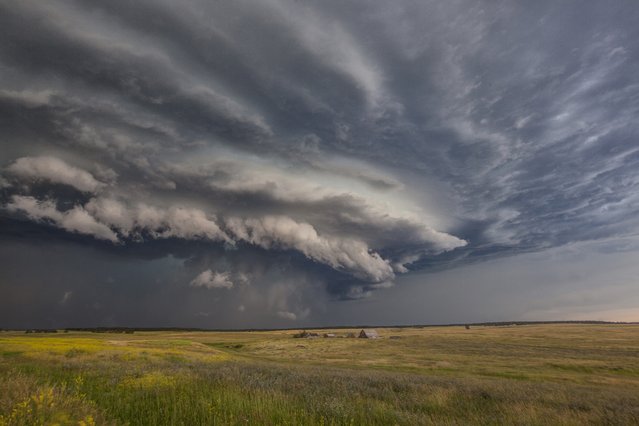
Double tornadoes, lightning storms and rotating supercells – this is what it's like to chase storms for a year. These dramatic images show apocalyptic weather throughout 2014 from a lightning storm to a pair of rainbows. Roger Hill, 57, has been chasing storms in the United States for thirty years and runs a tour operation with his wife Caryn. (Photo by Roger Hill/Barcroft Media)

Double tornadoes, lightning storms and rotating supercells – this is what it's like to chase storms for a year. These dramatic images show apocalyptic weather throughout 2014 from a lightning storm to a pair of rainbows. Roger Hill, 57, has been chasing storms in the United States for thirty years and runs a tour operation with his wife Caryn. Here: a hailstorm rolls over fields, on July 22, 2014, in South Dakota. (Photo by Roger Hill/Barcroft Media)
Details
04 Jan 2015 13:08:00
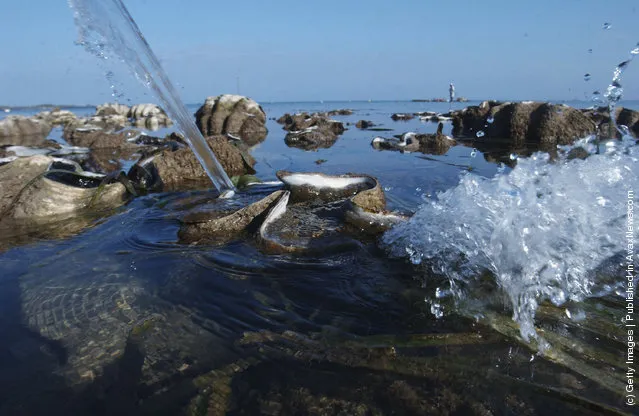
Tridacna Gigas, or Giant Clams

“The giant clam, Tridacna gigas (known as pā’ua in Cook Islands Māori), is the largest living bivalve mollusc. T. gigas is one of the most endangered clam species. It was mentioned as early as 1825 in scientific reports. One of a number of large clam species native to the shallow coral reefs of the South Pacific and Indian oceans, they can weigh more than 200 kilograms (440 lb) measure as much as 120 cm (47 in) across, and have an average lifespan in the wild of 100 years or more”. – Wikipedia

Photo: Tridacna Gigas, or Giant Clams spew water as a traditional fisherman passes by a small sanctuary on January 23, 2004 near Bolinao in the Northern Philippines. The clams, prime builders for coral reefs and providing shelter for spawning fish and other marine life, are exposed by low tides in the sanctuary. Overfishing and pollution throughout the country are not only threatening food security, but are also starting to choke one of the few working clam sanctuaries in the world. (Photo by David Greedy/Getty Images)
Details
01 Oct 2011 13:10:00