Loading...
Done
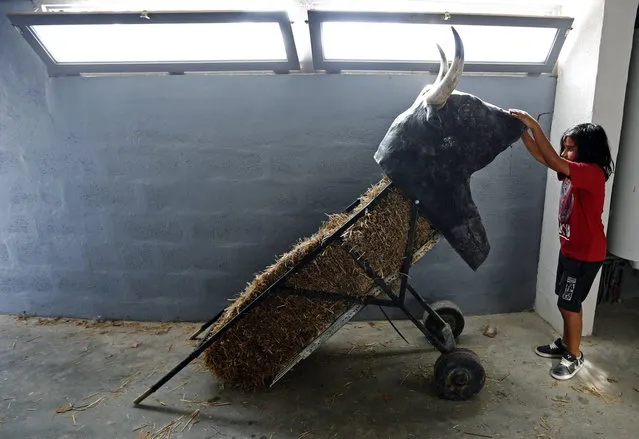
Nino, a ten-year-old toreador apprentice of the French Tauromachy Centre, nicknamed El Nino, touches a practice bull at the bullring of Garons, near Nimes, September 25, 2013. (Photo by Jean-Paul Pelissier/Reuters)

Nino, a ten-year-old toreador apprentice of the French Tauromachy Centre, nicknamed El Nino, touches a practice bull at the bullring of Garons, near Nimes, September 25, 2013. Since 1983, the French Tauromachy Centre in Nimes has trained some 1,000 youths in the art of bullfighting. Twenty of them have gone on to become professional matadors, facing fighting bulls in the arena. Twice a week, students take courses with a matador to learn the movements and gestures of the bullfighter in the ring, but without an animal present. Students train with calves in the surrounding fields during spring, and regularly participate in beginner's bullfights (becerradas) without killing calves. Solal has been taking courses for three years and Nino, for just a year now. Both are normally enrolled in French public schools, but have one thought in mind – bullfighting. They share a passion linked to the city of Nimes, famous for its ferias and bullring. (Photo by Jean-Paul Pelissier/Reuters)
Details
06 Nov 2013 10:12:00
Mayu adjusts Koiku’s kimono, as Koiku wears a protective face mask while posing for a photograph, before they work at a party where they will entertain with other geisha at Japanese luxury restaurant Asada in Tokyo, Japan, June 23, 2020. The coronavirus pandemic has made Tokyo's geisha fear for their centuries-old profession as never before. Though the number of geisha - famed for their witty conversation, beauty and skill at traditional arts - has been falling for years, they were without work for months due to Japan's state of emergency and now operate under awkward social distancing rules. Engagements are down 95 percent, and come with new rules: no pouring drinks for customers or touching them even to shake hands, and sitting 2 meters apart. Masks are hard to wear with their elaborate wigs, so they mostly don't. “I was just full of anxiety”, said Mayu, 47. “I went through my photos, sorted my kimonos ... The thought of a second wave is terrifying”. (Photo by Kim Kyung-Hoon/Reuters)

Mayu adjusts Koiku’s kimono, as Koiku wears a protective face mask while posing for a photograph, before they work at a party where they will entertain with other geisha at Japanese luxury restaurant Asada in Tokyo, Japan, June 23, 2020. (Photo by Kim Kyung-Hoon/Reuters)
Details
23 Jul 2020 00:03:00
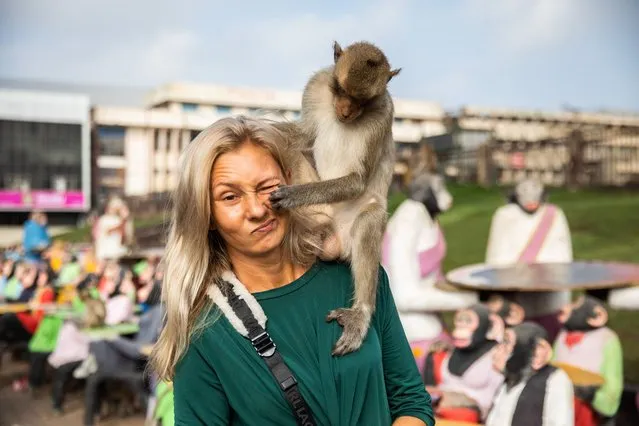
A monkey grabs the face of a tourist during the Lopburi Monkey Festival on November 27, 2022 in Lop Buri, Thailand. Lopburi holds its annual Monkey Festival where local citizens and tourists gather to provide a banquet to the thousands of long-tailed macaques that live in central Lopburi. (Photo by Lauren DeCicca/Getty Images)

A monkey grabs the face of a tourist during the Lopburi Monkey Festival on November 27, 2022 in Lop Buri, Thailand. Lopburi holds its annual Monkey Festival where local citizens and tourists gather to provide a banquet to the thousands of long-tailed macaques that live in central Lopburi. (Photo by Lauren DeCicca/Getty Images)
Details
10 Jan 2024 19:17:00
UK Eurovision girlband Remember Monday feature pals Lauren Byrne, Holly-Anne Hull and Charlotte Steele, 2025. (Photo by Rob Parfitt)

UK Eurovision girlband Remember Monday feature pals Lauren Byrne, Holly-Anne Hull and Charlotte Steele, 2025. (Photo by Rob Parfitt)
Details
16 Mar 2025 04:21:00
Palestinians kids from the West Bank Palestinian village Umm Al Rajaj cross the Meitar checkpoint into Israel on their way to the beach of Tel Aviv for the first time, Israel, 10 August 2016. A group of humanitarian Israeli women called in Arabic “Min Al Baher” (from the sea) voluntarily arranges authorizations and transportation for Palestinians families that live in the West Bank to cross into Israel in order to visit the sea for the first time. (Photo by Abir Sultan/EPA)

Palestinians kids from the West Bank Palestinian village Umm Al Rajaj cross the Meitar checkpoint into Israel on their way to the beach of Tel Aviv for the first time, Israel, 10 August 2016. A group of humanitarian Israeli women called in Arabic “Min Al Baher” (from the sea) voluntarily arranges authorizations and transportation for Palestinians families that live in the West Bank to cross into Israel in order to visit the sea for the first time. (Photo by Abir Sultan/EPA)
Details
02 Sep 2016 13:41:00
A woman tries to take selfie photos in front of a photo spot featuring Christmas season scene and masks at Tokyo Mask Land, a face-mask theme exhibition and its speciality shop, amid the coronavirus disease (COVID-19) outbreak, in Yokohama, Japan on December 1, 2020. (Photo by Issei Kato/Reuters)

A woman tries to take selfie photos in front of a photo spot featuring Christmas season scene and masks at Tokyo Mask Land, a face-mask theme exhibition and its speciality shop, amid the coronavirus disease (COVID-19) outbreak, in Yokohama, Japan on December 1, 2020. (Photo by Issei Kato/Reuters)
Details
03 Dec 2020 00:03:00
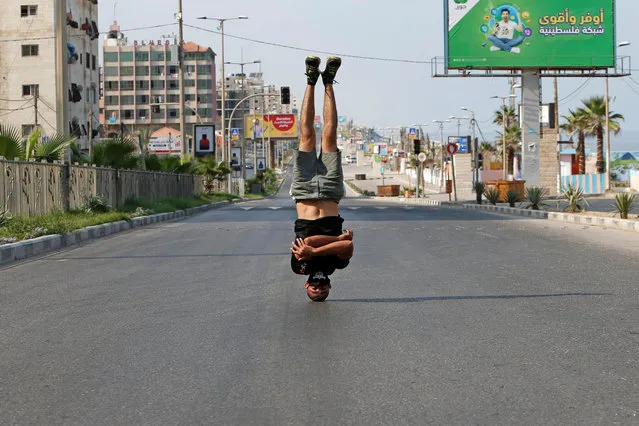
Palestinian athlete Ahmed Abu Hasira demonstrates his parkour skills during a lockdown amid the coronavirus disease (COVID-19) outbreak in Gaza City on September 8, 2020. (Photo by Mohammed Salem/Reuters)

Palestinian athlete Ahmed Abu Hasira demonstrates his parkour skills during a lockdown amid the coronavirus disease (COVID-19) outbreak in Gaza City on September 8, 2020. (Photo by Mohammed Salem/Reuters)
Details
10 Oct 2020 00:03:00
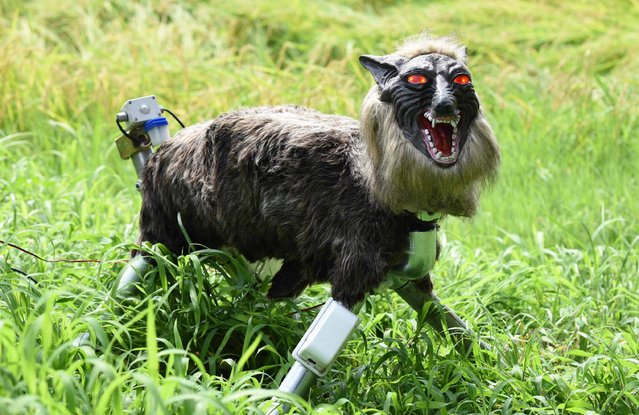
A wolf-like robot “Super Monster Wolf” stands beside a rice field to drive away wild animals that cause damages to crops in Kisarazu, Chiba prefecture, on August 25, 2017. The agricultural coopetative association JA Kisarazu-shi introduced the 65cm-long and 50cm-high robot recently on a trial basis which can detect wild animals such as boars and deers with an infrared ray sensor when they approach and intimidates them, flashing the red LED eyes and blaring 48 types of sounds including a wolf growl and human voice. (Photo by Toru Yamanaka/AFP Photo)

A wolf-like robot “Super Monster Wolf” stands beside a rice field to drive away wild animals that cause damages to crops in Kisarazu, Chiba prefecture, on August 25, 2017. The agricultural coopetative association JA Kisarazu-shi introduced the 65cm-long and 50cm-high robot recently on a trial basis which can detect wild animals such as boars and deers with an infrared ray sensor when they approach and intimidates them, flashing the red LED eyes and blaring 48 types of sounds including a wolf growl and human voice. (Photo by Toru Yamanaka/AFP Photo)
Details
27 Aug 2017 07:17:00