Loading...
Done
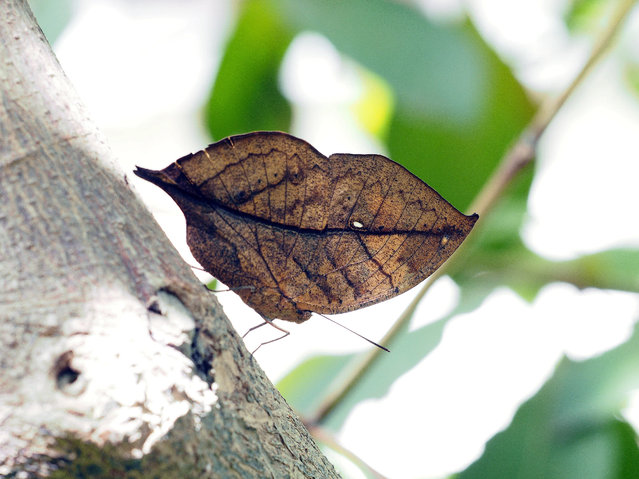
A Dead Leaf butterfly (Kallima inachu formosana, also called Orange Oakleaf Butterfly) rests on a tree trunk at the Taipei Zoo in Taipei, Tawian, 03 August 2019. Dead Leaf butterfly can be found in Tropical Asia from India to Japan. When its wings close, it resembles a dead leaf, providing camouflage against predators including birds, ants, spiders and wasps. (Photo by David Chang/EPA/EFE)

A Dead Leaf butterfly (Kallima inachu formosana, also called Orange Oakleaf Butterfly) rests on a tree trunk at the Taipei Zoo in Taipei, Tawian, 03 August 2019. Dead Leaf butterfly can be found in Tropical Asia from India to Japan. When its wings close, it resembles a dead leaf, providing camouflage against predators including birds, ants, spiders and wasps. (Photo by David Chang/EPA/EFE)
Details
18 Aug 2019 00:01:00
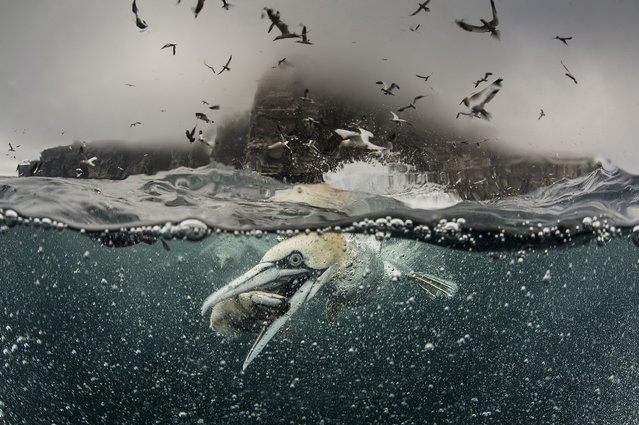
A gannet grabs a fish by its beak, 2014, in Shetland, Scotland. Hundreds of gannets crash into the sea in search of food – leaving a trail of air bubbles in their wake. Richard Shucksmith, 41, on the Shetland Isles, Scotland captured the remarkable scene as he took a boat to feed the large colony of seabirds that nested on the cliffs. The photographer has taken images of the gannets every summer for the last three years as the birds gather on the cliffs to breed. (Photo by Richard Shucksmith/Barcroft media)

A gannet grabs a fish by its beak, 2014, in Shetland, Scotland. Hundreds of gannets crash into the sea in search of food – leaving a trail of air bubbles in their wake. Richard Shucksmith, 41, on the Shetland Isles, Scotland captured the remarkable scene as he took a boat to feed the large colony of seabirds that nested on the cliffs. The photographer has taken images of the gannets every summer for the last three years as the birds gather on the cliffs to breed. (Photo by Richard Shucksmith/Barcroft media)
Details
26 Sep 2014 13:54:00
This November 11, 2014 aerial photo, shows a deforested area dotted with blue tarps, marking the area where miners reside, and craters filled with water, caused by illegal gold mining activities, in La Pampa, in Peru's Madre de Dios region. (Photo by Rodrigo Abd/AP Photo)

This November 11, 2014 aerial photo, shows a deforested area dotted with blue tarps, marking the area where miners reside, and craters filled with water, caused by illegal gold mining activities, in La Pampa, in Peru's Madre de Dios region. Less than a month before Peru plays host to global climate talks, the government sent a battalion of police into southeastern jungles to dismantle illegal gold-mining mining camps. Peru's anti-illegal mining czar, retired army Gen. Augusto Soto, marched the men to the wasteland known as La Pampa, where 50,000 hectares of rainforest have been obliterated in the past six years. (Photo by Rodrigo Abd/AP Photo)
Details
21 Nov 2014 12:35:00
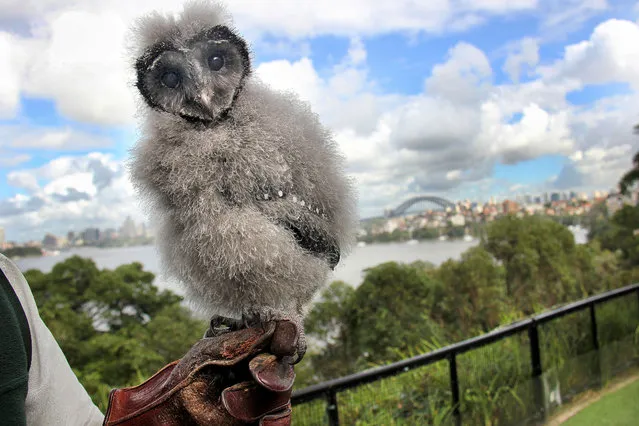
An adorable baby owl has proved to be a real heart-breaker thanks to its heart-shaped head. Although Griffin the Lesser Sooty Owl might look like a feather duster, the tiny eight-week old chick will soon be ready to fly. And the heart outline that surrounds his giant eyes and beak means he is set to be the star of the bird show at Taronga Zoo, Sydney. (Photo by Caters News Agency)

An adorable baby owl has proved to be a real heart-breaker thanks to its heart-shaped head. Although Griffin the Lesser Sooty Owl might look like a feather duster, the tiny eight-week old chick will soon be ready to fly. And the heart outline that surrounds his giant eyes and beak means he is set to be the star of the bird show at Taronga Zoo, Sydney. (Photo by Caters News Agency)
Details
16 May 2015 13:51:00
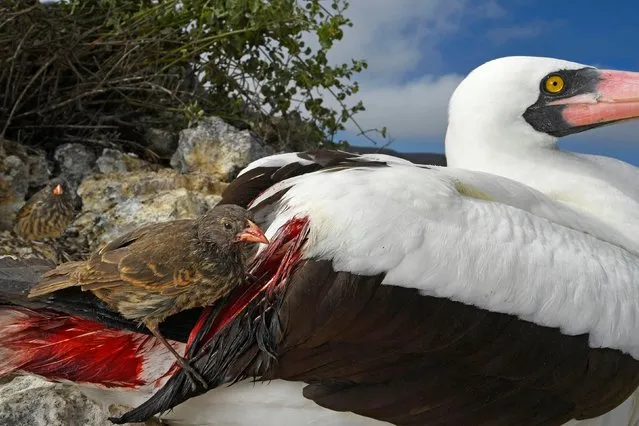
Bloodthirsty by Thomas P Peschak, Germany/South Africa — winner, Behaviour: birds. When rations run short on Wolf Island, in the remote northern Galápagos, the sharp-beaked ground finches become vampires. Their sitting targets are Nazca boobies and other large birds. The finches rely on a scant diet of seeds and insects, which regularly dries up, so they drink blood to survive. ‘I’ve seen more than half a dozen finches drinking from a single Nazca booby,’ says Tom. Rather than leave their nests the boobies tolerate the vampires, and the blood loss doesn’t seem to cause permanent harm. (Photo by Thomas P Peschak/2018 Wildlife Photographer of the Year)

Bloodthirsty by Thomas P. Peschak, Germany/South Africa — winner, Behaviour: birds. When rations run short on Wolf Island, in the remote northern Galápagos, the sharp-beaked ground finches become vampires. Their sitting targets are Nazca boobies and other large birds. The finches rely on a scant diet of seeds and insects, which regularly dries up, so they drink blood to survive. ‘I’ve seen more than half a dozen finches drinking from a single Nazca booby,’ says Tom. Rather than leave their nests the boobies tolerate the vampires, and the blood loss doesn’t seem to cause permanent harm. (Photo by Thomas P. Peschak/2018 Wildlife Photographer of the Year)
Details
19 Oct 2018 00:05:00
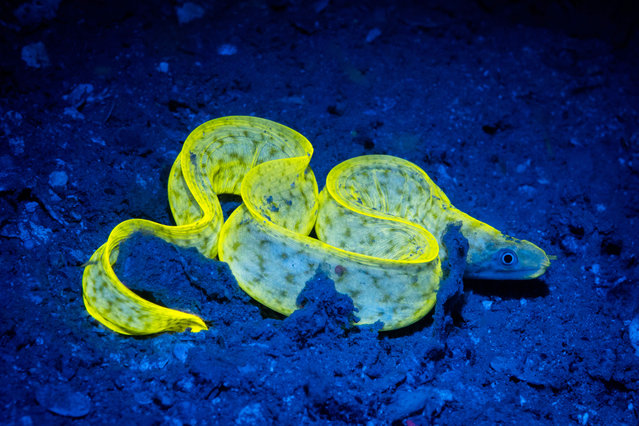
“In these photos, I was shining a blue light on the coral and various biofluorescent animals”. (Photo by Simon Pierce/Caters News Agency)

Neon sea creatures have been captured lighting up the ocean with their vibrant colors – in what looked like a scene from Avatar. Photographer Simon Pierce, 39, took the images over several months after visiting both Nosy Sakatia in Madagascar and Mafia Island in Tanzania recently. (Photo by Simon Pierce/Caters News Agency)
Details
12 Dec 2018 00:05:00
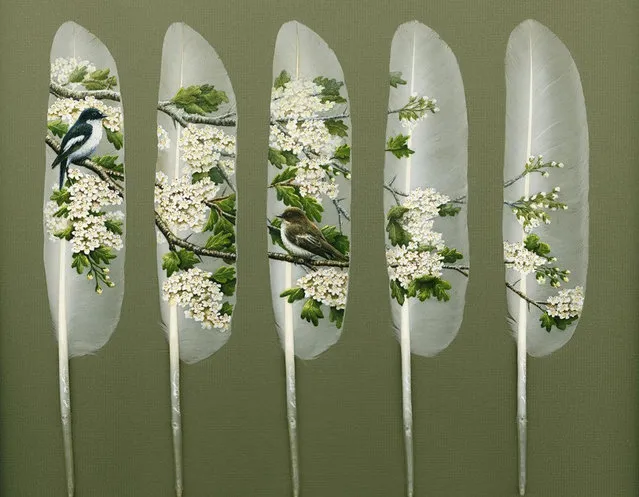
Feather Paintings By Julie Thompson

Many people have seen feathers as decorative items before. Today, ostrich, peacock and bird of paradise feathers can be seen in haute couture and in the costumes of indigenous peoples. They can be colorful and spectacular in their own right, but how much more stunning might they be when used as canvases for artists, eager to demonstrate their talent for the unusual? Alaskan-born and -bred artist Julie Thompson is an astounding exponent of this incredible art
form.
Details
10 Apr 2013 10:31:00
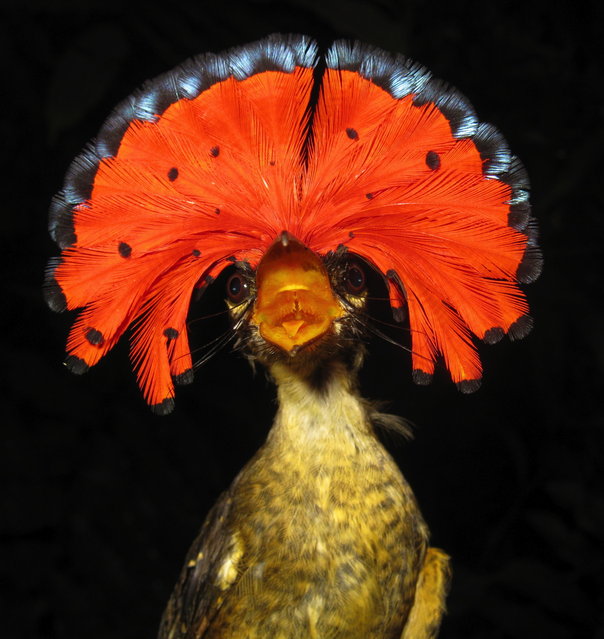
Royal Flycatcher

The Royal Flycatchers are birds in the genus Onychorhynchus in the Tityridae family. Depending on authority, it includes a single widespread, or four more localized species. The specific epithet of the type species, coronatus, and the common name of all the species in this genus, Royal Flycatcher, refer to the striking, colourful crest, which is seen displayed very rarely, except after mating, while preening, in courtship as well as being handled.
Details
02 Jun 2013 10:04:00