Loading...
Done
Disappointed Cat aka Foo-Chan

Disappointed Cat aka Foo-Chan is a three-year-old Chinchilla Golden has a heavy-set brow, causing him to appear depressed; his gloomy disposition has gone viral on a Japanese forum, where he's been praised as "cute, but troubled" or "worried all the time".

See also: Grumpy Cat
Details
03 Sep 2013 11:03:00
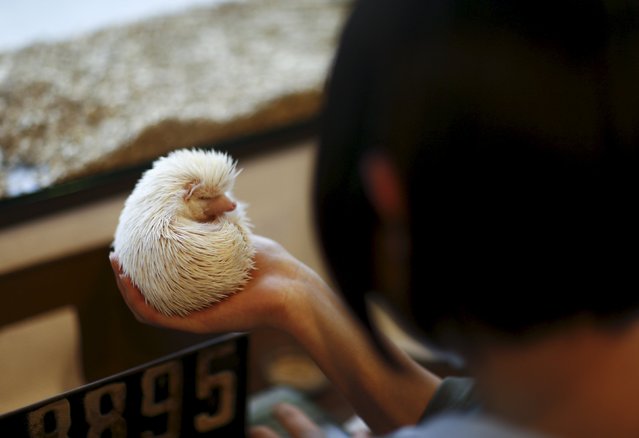
A woman holds a hedgehog at the Harry hedgehog cafe in Tokyo, Japan, April 5, 2016. (Photo by Thomas Peter/Reuters)

A woman holds a hedgehog at the Harry hedgehog cafe in Tokyo, Japan, April 5, 2016. In a new animal-themed cafe, 20 to 30 hedgehogs of different breeds scrabble and snooze in glass tanks in Tokyo's Roppongi entertainment district. Customers have been queuing to play with the prickly mammals, which have long been sold in Japan as pets. The cafe's name Harry alludes to the Japanese word for hedgehog, harinezumi. (Photo by Thomas Peter/Reuters)
Details
08 Apr 2016 14:56:00
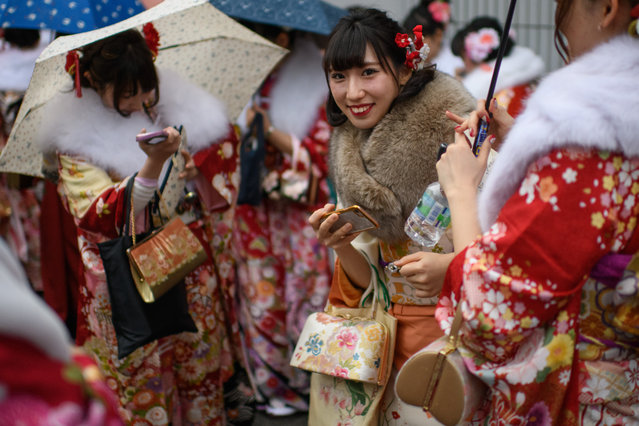
Women wearing kimonos gather after attending a Coming of Age ceremony on January 8, 2018 in Yokohama, Japan. (Photo by Carl Court/Getty Images)

Women wearing kimonos gather after attending a Coming of Age ceremony on January 8, 2018 in Yokohama, Japan. Coming of Age Day is a Japanese holiday held every January to celebrate people who have reached 20 – the official age of adulthood in Japan. Yokohama city, with almost 37,000 people turning 20 this year, is holding one of the largest events in the country. (Photo by Carl Court/Getty Images)
Details
11 Jan 2018 07:51:00
Mayu adjusts Koiku’s kimono, as Koiku wears a protective face mask while posing for a photograph, before they work at a party where they will entertain with other geisha at Japanese luxury restaurant Asada in Tokyo, Japan, June 23, 2020. The coronavirus pandemic has made Tokyo's geisha fear for their centuries-old profession as never before. Though the number of geisha - famed for their witty conversation, beauty and skill at traditional arts - has been falling for years, they were without work for months due to Japan's state of emergency and now operate under awkward social distancing rules. Engagements are down 95 percent, and come with new rules: no pouring drinks for customers or touching them even to shake hands, and sitting 2 meters apart. Masks are hard to wear with their elaborate wigs, so they mostly don't. “I was just full of anxiety”, said Mayu, 47. “I went through my photos, sorted my kimonos ... The thought of a second wave is terrifying”. (Photo by Kim Kyung-Hoon/Reuters)

Mayu adjusts Koiku’s kimono, as Koiku wears a protective face mask while posing for a photograph, before they work at a party where they will entertain with other geisha at Japanese luxury restaurant Asada in Tokyo, Japan, June 23, 2020. (Photo by Kim Kyung-Hoon/Reuters)
Details
23 Jul 2020 00:03:00
A file photograph dated 07 January 2006 and released by Greenpeace, showing the Yushin Maru, a factory ship in a Japanese whaling fleet, injuring a whale with it's first harpoon attempt. A UN court in The Hague on 31 March 2014 halted Japan's much-criticized whaling programme, ruling that it contravenes a 1986 moratorium on whale hunting. Japan must end its 'research whaling' programme, the International Court of Justice (ICJ) said. (Photo by Kate Davison/EPA)

A file photograph dated 07 January 2006 and released by Greenpeace, showing the Yushin Maru, a factory ship in a Japanese whaling fleet, injuring a whale with it's first harpoon attempt. A UN court in The Hague on 31 March 2014 halted Japan's much-criticized whaling programme, ruling that it contravenes a 1986 moratorium on whale hunting. Japan must end its 'research whaling' programme, the International Court of Justice (ICJ) said. Japan said the programme was for scientific research and permitted under international conventions. Australia had brought the case to the ICJ in 2010, charging that Japan was breaching international law by killing hundreds of whales every year for commercial purposes. Japan was “deeply disappointed” by the ruling, an unnamed government official was quoted by the Kyodo News agency as saying. But the official said Japan would stand by the ruling. (Photo by Kate Davison/EPA)
Details
01 Apr 2014 08:38:00
What the World Eats By Peter Menzel And Faith D'Aluisio Part 1

A stunning photographic collection featuring portraits of people from 30 countries and the food they eat in one day. In this fascinating study of people and their diets, 80 profiles are organized by the total number of calories each person puts away in a day. Featuring a Japanese sumo wrestler, a Massai herdswoman, world-renowned Spanish chef Ferran Adria, an American competitive eater, and more, these compulsively readable personal stories also include demographic particulars, including age, activity level, height, and weight. Essays from Harvard primatologist Richard Wrangham, journalist Michael Pollan, and others discuss the implications of our modern diets for our health and for the planet. This compelling blend of photography and investigative reportage expands our understanding of the complex relationships among individuals, culture, and food.
Details
23 Apr 2014 14:34:00


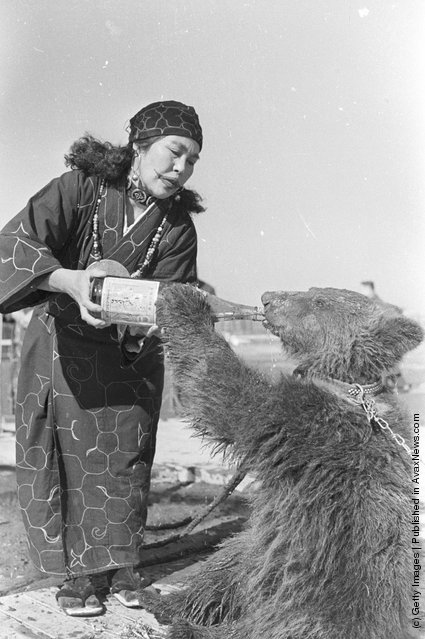
“The Ainu (アイヌ?), also called Aynu, Aino (アイノ), and in historical texts Ezo (蝦夷), are indigenous people or groups in Japan and Russia. Historically they spoke the Ainu language and related varieties and lived in Hokkaidō, the Kuril Islands, and much of Sakhalin. Most of those who identify themselves as Ainu still live in this same region, though the exact number of living Ainu is unknown. This is due to ethnic issues in Japan resulting in those with Ainu backgrounds hiding their identities and confusion over mixed heritages. In Japan, because of intermarriage over many years with Japanese, the concept of a 'pure Ainu' ethnic group is no longer feasible. Official estimates of the population are of around 25,000, while the unofficial number is upwards of 200,000 people”. – Wkipedia

Photo: A captive bear drinking from a large bottle held by an Ainu tribeswoman. (Photo by Evans/Three Lions/Getty Images). Circa 1955

Details
24 Mar 2011 14:01:00
An actor dressed as a zombie performs during a drive-in haunted house show by Kowagarasetai (Scare Squad), for people inside a car in order to maintain social distancing amid the spread of the coronavirus disease (COVID-19), at a garage in Tokyo, Japan on July 3, 2020. (Photo by Issei Kato/Reuters)

An actor dressed as a zombie performs during a drive-in haunted house show by Kowagarasetai (Scare Squad), for people inside a car in order to maintain social distancing amid the spread of the coronavirus disease (COVID-19), at a garage in Tokyo, Japan on July 3, 2020. A Japanese performance group is starting a run of drive-in horror shows for people who are scared of catching the coronavirus but still want to get close-up frights from ghouls and zombies. Audience members will drive into a garage in Tokyo, one car at a time, and listen to a murder story and sound effects blared out of speakers, as actors dressed as monsters bang on the side of the vehicle and spray fake blood over the windows. (Photo by Issei Kato/Reuters)
Details
05 Jul 2020 00:05:00