Loading...
Done
“The V-30 Warhawk was designed by Blackshaw Avionics as a long-range fighter and was primarily used by the Arcadian Air Force for escort duties. . (Jon Hall)

“The V-30 Warhawk was designed by Blackshaw Avionics as a long-range fighter and was primarily used by the Arcadian Air Force for escort duties. The plane pictured is the “Spirit of Freedom” and was one of the four planes that escorted the Arcadian Royal Airship during and after the Great War. The three other fighters were the “Spirit of Hope”, the “Spirit of Justice” and the “Spirit of Destiny”. All pilots were hand-picked by the Head of Airborne Forces and included some of the very finest pilots in the Kingdom. The crew consisted of one pilot and one gunner although both cabins were fitted so that if either crew member was killed the other could take over their duties. Each Warhawk was fitted with four Haverlock “Banshee” engines and four 24mm machine guns”. (Photo and comment by Jon Hall)


Details
11 Feb 2013 10:36:00
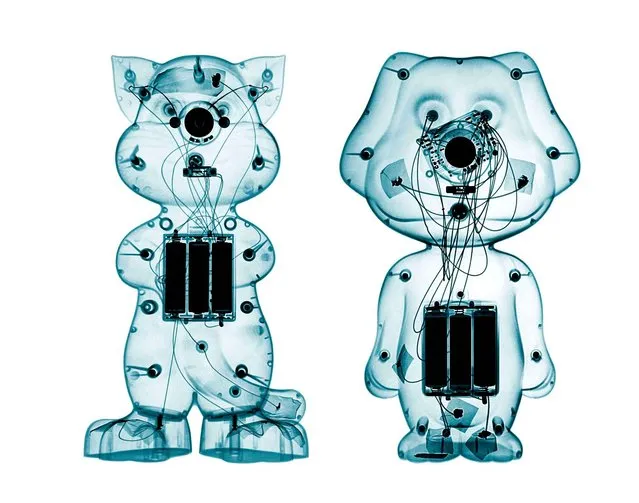
Australian photographer Brendan Fitzpatrick’s X-ray photographs expose the inner workings of toys. Fitzpatrick’s photographs are both whimsical and mechanical, evoking the curiosity of childhood and the desire to discover how things look and work from other perspectives. (Photo by Brendan Fitzpatrick)

Australian photographer Brendan Fitzpatrick’s X-ray photographs expose the inner workings of toys. Fitzpatrick’s photographs are both whimsical and mechanical, evoking the curiosity of childhood and the desire to discover how things look and work from other perspectives. The strategic placement of wires, batteries, and screws are revealed, the complexity of the inside contrasting with the seemingly simplistic design of the outside. Fitzpatrick uses chest X-ray and mammogram machines to photograph flowers, toys, and creatures, then enhances the color in the images in order to more effectively distinguish the various parts that have been exposed. This photographs are part of series he calls “Invisible Light”. (Photo by Brendan Fitzpatrick)
Details
08 Aug 2014 10:59:00
These stunning coloured images show detailed x-ray images of everything from skulls to light bulbs. Artist Paula Fontaine, from Westminster Massachusetts, created the images using a process called digital map painting. Here: Brain storm, conceptual composite X-ray. (Photo by Paula Fontaine/Barcroft Media)

These stunning coloured images show detailed x-ray images of everything from skulls to light bulbs. Artist Paula Fontaine, from Westminster Massachusetts, created the images using a process called digital map painting. To create the images the x-ray emission source – the head of the machine on an arm which focuses the beam – is placed over the object. Paula then retreats behind a shielded screen before activating the x-ray exposure. Here: Brain storm, conceptual composite X-ray. (Photo by Paula Fontaine/Barcroft Media)
Details
27 Mar 2015 13:34:00
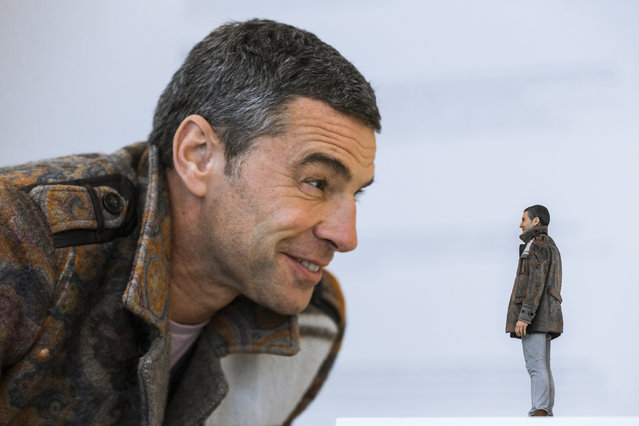
Customer Andreas Kroker looks at a 3D-printed figure of himself at the Twinkind 3D printing studio in Berlin, December 13, 2013. (Photo by Thomas Peter/Reuters)

Customer Andreas Kroker looks at a 3D-printed figure of himself at the Twinkind 3D printing studio in Berlin, December 13, 2013. A 3D-printed likeness is produced by taking a 360 degree photographic scan of a person, which is then rendered into a 3D digital model and retouched to meet the requirements for printing. The printing machine uses this digital model to produce a high-resolution solid figure. Twinkind co-founder Timo Schaedel said, people often come to the session well-groomed, with fresh hair-cuts and their best clothes, “just as they used to do in the past, when they had their portrait taken in a photo studio”. (Photo by Thomas Peter/Reuters)
Details
17 Jul 2014 11:22:00
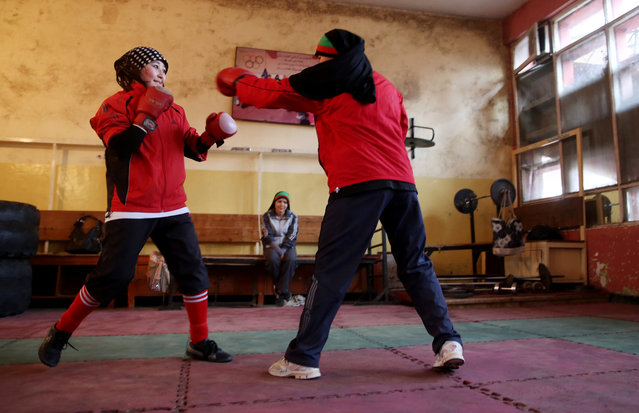
In this Wednesday, March, 5, 2014 photo, Afghan female boxers practice at the Kabul Stadium boxing club, Afghanistan. The women, who are 18 and older, don't have much more than determination, and a trainer who runs them through their paces, watches as they spar, corrects their technique, tells them when to jab, how to protect themselves, when to power through with a left and then a right. (Photo by Massoud Hossaini/AP Photo)

In this Wednesday, March, 5, 2014 photo, Afghan female boxers practice at the Kabul Stadium boxing club, Afghanistan. The women, who are 18 and older, don't have much more than determination, and a trainer who runs them through their paces, watches as they spar, corrects their technique, tells them when to jab, how to protect themselves, when to power through with a left and then a right. (Photo by Massoud Hossaini/AP Photo)
Details
11 Mar 2014 09:45:00
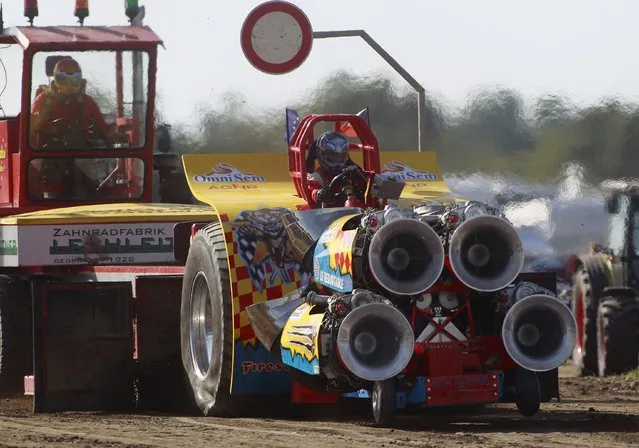
A driver competes in his tractor during the Tractor Pulling Euro Championships in the western German town of Fuechtorf September 9, 2012. Eighty teams from across Europe participated in the two-day competition where high-powered tractor prototypes must pull a trailer down a 100-metre (328 ft) track as far as possible. (Photo by Ina Fassbender/Reuters)

A driver competes in his tractor during the Tractor Pulling Euro Championships in the western German town of Fuechtorf September 9, 2012. Eighty teams from across Europe participated in the two-day competition where high-powered tractor prototypes must pull a trailer down a 100-metre (328 ft) track as far as possible. (Photo by Ina Fassbender/Reuters)
Details
22 Jul 2013 08:50:00


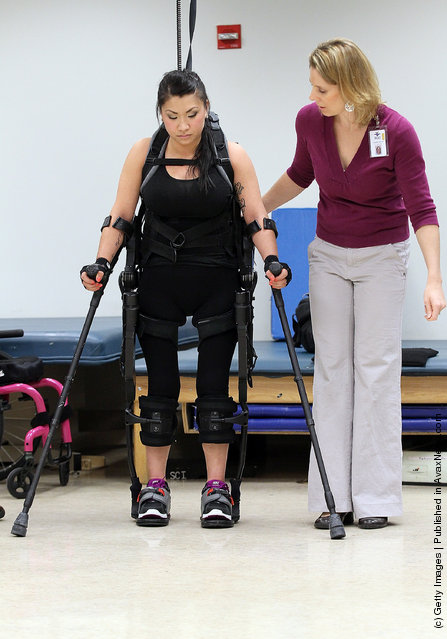
“eLEGS is a wearable, artificially intelligent, bionic device that enables people with paralysis to stand up and walk again. The exoskeleton is battery-powered and rechargeable, fitting comfortably and securely over clothing. Initially, eLEGS will be used under medical supervision for rehabilitation and training”. – BerkeleyBionics.com

Photo: Paralysis victim Stephanie Sablan (L) is helped by physical therapist Shonna Moran as she walks using eLEGS robotic legs at Santa Clara Valley Medical Center on May 25, 2011 in San Jose, California. Sablan, 24, was paralyzed from the waist down earlier this year when she was in a car accident and has begun using the newly developed eLEGS made by Berkeley Bionics. The robot-like battery powered eLEGS fit over clothing and enables people with paralysis to stand up and walk again. (Photo by Justin Sullivan/Getty Images)
Details
26 May 2011 09:56:00


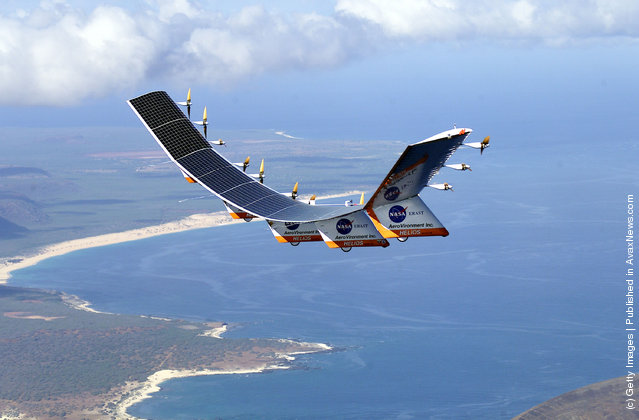
“NASA's Pathfinder, Pathfinder Plus, Centurion and Helios Prototype were an evolutionary series of solar- and fuel-cell-system-powered unmanned aerial vehicles. AeroVironment, Inc. developed the vehicles under NASA's Environmental Research Aircraft and Sensor Technology (ERAST) program. They were built to develop the technologies that would allow long-term, high-altitude aircraft to serve as “atmospheric satellites”, to perform atmospheric research tasks as well as serve as communications platforms”. – Wikipedia

Photo: The solar-electric Helios Prototype flying wing is flies over the Hawaiian islands of Niihau and Lehua during the first solar-powered test flight July 14, 2001 from the U.S. Navy's Pacific Missile Range Facility on Kauai, HI. The 18-hour flight was a functional checkout of the aircraft's systems and performance in preparation for an attempt to reach sustained flight at 100,000 feet altitude later in the summer. (Photo Courtesy of NASA/Getty Images)
Details
14 Jul 2011 09:24:00