Loading...
Done


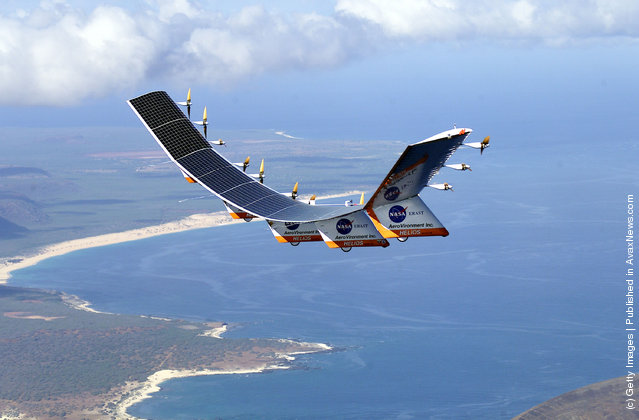
“NASA's Pathfinder, Pathfinder Plus, Centurion and Helios Prototype were an evolutionary series of solar- and fuel-cell-system-powered unmanned aerial vehicles. AeroVironment, Inc. developed the vehicles under NASA's Environmental Research Aircraft and Sensor Technology (ERAST) program. They were built to develop the technologies that would allow long-term, high-altitude aircraft to serve as “atmospheric satellites”, to perform atmospheric research tasks as well as serve as communications platforms”. – Wikipedia

Photo: The solar-electric Helios Prototype flying wing is flies over the Hawaiian islands of Niihau and Lehua during the first solar-powered test flight July 14, 2001 from the U.S. Navy's Pacific Missile Range Facility on Kauai, HI. The 18-hour flight was a functional checkout of the aircraft's systems and performance in preparation for an attempt to reach sustained flight at 100,000 feet altitude later in the summer. (Photo Courtesy of NASA/Getty Images)
Details
14 Jul 2011 09:24:00
Human canvases modelling world famous artworks including Van Gogh's Sunflowers and Edvard Munch's The Scream take to the streets of London in a bid to mend Britain's disconnect with art on September 25, 2017. Award winning body paint artist Sarah Attwell was commissioned by online art platform Rise Art to show that great art is for everybody, following research that revealed 1 in 6 Brits have never set foot in an art gallery. (Photo by Imagewise Ltd/Rex Features/Shutterstock)

Human canvases modelling world famous artworks including Van Gogh's Sunflowers and Edvard Munch's The Scream take to the streets of London in a bid to mend Britain's disconnect with art on September 25, 2017. Award winning body paint artist Sarah Attwell was commissioned by online art platform Rise Art to show that great art is for everybody, following research that revealed 1 in 6 Brits have never set foot in an art gallery. (Photo by Imagewise Ltd/Rex Features/Shutterstock)
Details
26 Sep 2017 09:21:00
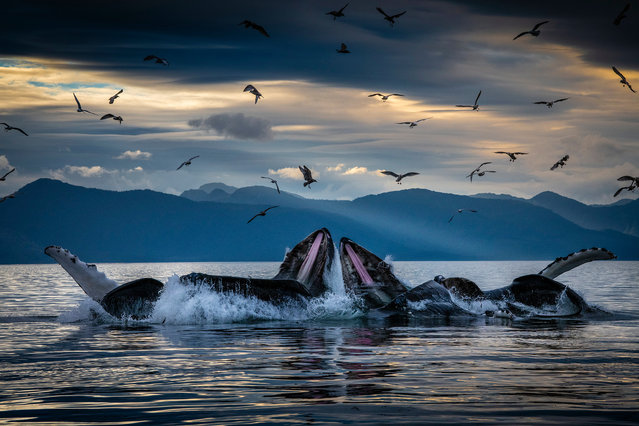
“Secrets of the Whales”. Skerry’s photographs celebrate the lives and culture of whales, illuminating recent research and their diverse behaviours. His latest work focuses on four key species: sperm whales, humpbacks, orca and beluga whales. Humpback whales bubble-net feeding off the coast of Alaska. They work cooperatively to feed on herring by blowing a perfect ring of bubbles underwater to form a net encircling the fish. The whales then swim up through the centre of the bubble net with their mouths open. (Photo by Brian Skerry/National Geographic Photo/Visa pour l'Image)

“Secrets of the Whales”. Skerry’s photographs celebrate the lives and culture of whales, illuminating recent research and their diverse behaviours. His latest work focuses on four key species: sperm whales, humpbacks, orca and beluga whales. Humpback whales bubble-net feeding off the coast of Alaska. They work cooperatively to feed on herring by blowing a perfect ring of bubbles underwater to form a net encircling the fish. The whales then swim up through the centre of the bubble net with their mouths open. (Photo by Brian Skerry/National Geographic Photo/Visa pour l'Image)
Details
04 Sep 2021 09:02:00
Isabel Schmalenbach, an environmental scientist with the Helgoland Biological Institute (Biologische Anstalt Helgoland), part of the Alfred Wegener Institute for Polar and Marine Research, holds a one-year old baby European lobster (Homarus gammarus) raised at the institute on August 3, 2013 on Helgoland Island, Germany. (Photo by Sean Gallup/Getty Images)

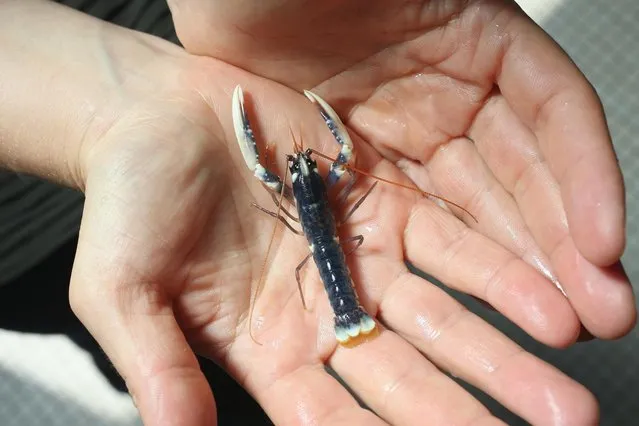
Isabel Schmalenbach, an environmental scientist with the Helgoland Biological Institute (Biologische Anstalt Helgoland), part of the Alfred Wegener Institute for Polar and Marine Research, holds a one-year old baby European lobster (Homarus gammarus) raised at the institute on August 3, 2013 on Helgoland Island, Germany. Later in the day Schmalenbach and her colleagues released a total of 415 one-year old lobsters into the North Sea as part of an effort to repopulate the lobster population around Helgoland (also called Heligoland). In the 19th century local fishermen caught up to 80,000 lobsters a year in the surrounding waters, combined with the heavy allied bombing of the island during and after World War II, as well as other environmental factors, decimated the lobster population. (Photo by Sean Gallup)
Details
05 Aug 2013 08:39:00
An undated handout photo made available by the Zerynthia Association shows the pupa of an amicta moneiba, a recently discovered species of moth endemic to La Gomera and El Hierro islands in the Canary Islands, Spain (issued 01 July 2020), as those two islands pulled apart from the rest of the Canary Islands 2.5 million years ago. The Institute of Evolutionary Biology of the Spanish National Research Council (CSIC) and the Zerynthia Association have recently discovered two new moth species in El Hierro and La Gomera. (Photo by Yeray Monasterio/Zerynthia/EPA/EFE)

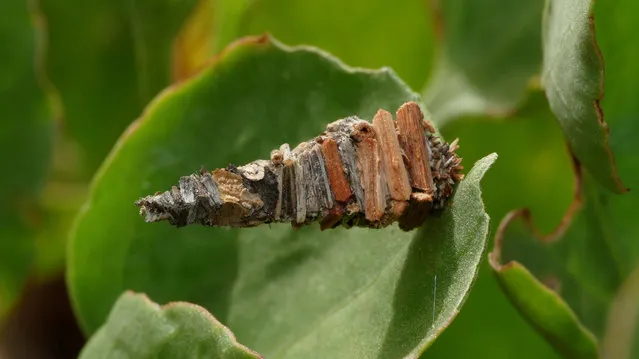
An undated handout photo made available by the Zerynthia Association shows the pupa of an amicta moneiba, a recently discovered species of moth endemic to La Gomera and El Hierro islands in the Canary Islands, Spain (issued 01 July 2020), as those two islands pulled apart from the rest of the Canary Islands 2.5 million years ago. The Institute of Evolutionary Biology of the Spanish National Research Council (CSIC) and the Zerynthia Association have recently discovered two new moth species in El Hierro and La Gomera. (Photo by Yeray Monasterio/Zerynthia/EPA/EFE)
Details
11 Oct 2020 00:01:00
Soap Bubble Structures by Kym Cox. Bubbles optimise space and minimise their surface area for a given volume of air. This phenomenon makes them a useful tool in many areas of research, in particular, materials science and ‘packing’ – how things fit together. Bubble walls drain under gravity, thin at the top, thick at the bottom, which interferes with travelling lightwaves to create bands of colour. Black spots show the wall is too thin for interference colours, indicating the bubble is about to burst. (Photo by Kym Cox/2019 Science Photographer of the Year/RPS)

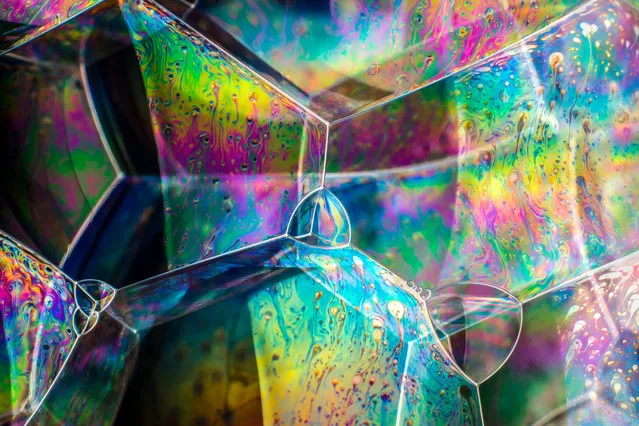
Soap Bubble Structures by Kym Cox. Bubbles optimise space and minimise their surface area for a given volume of air. This phenomenon makes them a useful tool in many areas of research, in particular, materials science and “packing” – how things fit together. Bubble walls drain under gravity, thin at the top, thick at the bottom, which interferes with travelling lightwaves to create bands of colour. Black spots show the wall is too thin for interference colours, indicating the bubble is about to burst. (Photo by Kym Cox/2019 Science Photographer of the Year/RPS)
Details
15 Aug 2019 00:03:00
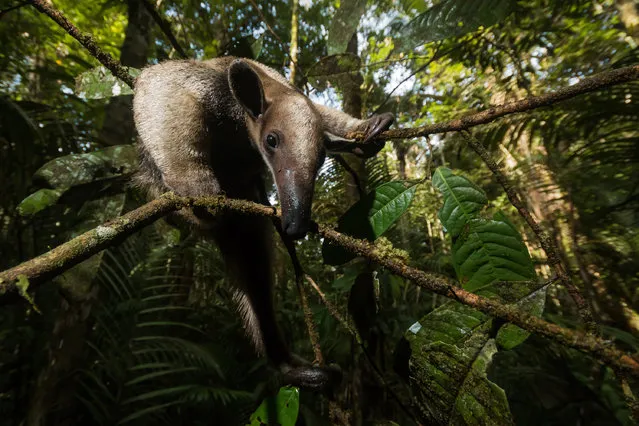
Individuals and populations student winner. Limbing in the Tropics, photographed in Manaus, Brazil. While walking in the Amazon rainforest looking for bat roosts to set up mist nets to capture bats for scientific research, a faint and almost imperceptible noise suddenly caught this photographer’s attention. An anteater was climbing with exceptional ability in a tangled mess of branches and lianas. With an unbelievable calmness, the animal watched the photographer at work and seemed to enjoy being the subject of an impromptu photography session in the most biodiverse ecosystem on Earth. (Photo by Adrià López Baucells/University of Lisbon/British Ecological Society)

Individuals and populations student winner. Limbing in the Tropics, photographed in Manaus, Brazil. While walking in the Amazon rainforest looking for bat roosts to set up mist nets to capture bats for scientific research, a faint and almost imperceptible noise suddenly caught this photographer’s attention. An anteater was climbing with exceptional ability in a tangled mess of branches and lianas. (Photo by Adrià López Baucells/University of Lisbon/British Ecological Society)
Details
05 Dec 2018 00:03:00
A man wear a phallic-shaped hat during Kanamara Matsuri (Festival of the Steel Phallus) on April 1, 2018 in Kawasaki, Japan. The Kanamara Festival is held annually on the first Sunday of April. The pen*s is the central theme of the festival, focused at the local pen*s-venerating shrine which was once frequented by prostitutes who came to pray for business prosperity and protection against sexually transmitted diseases. Today the festival has become a popular tourist attraction and is used to raise money for HIV awareness and research. (Photo by Carl Court/Getty Images)

A man wear a phallic-shaped hat during Kanamara Matsuri (Festival of the Steel Phallus) on April 1, 2018 in Kawasaki, Japan. The Kanamara Festival is held annually on the first Sunday of April. The pen*s is the central theme of the festival, focused at the local pen*s-venerating shrine which was once frequented by prostitutes who came to pray for business prosperity and protection against sexually transmitted diseases. Today the festival has become a popular tourist attraction and is used to raise money for HIV awareness and research. (Photo by Carl Court/Getty Images)
Details
04 Apr 2018 09:41:00