Loading...
Done
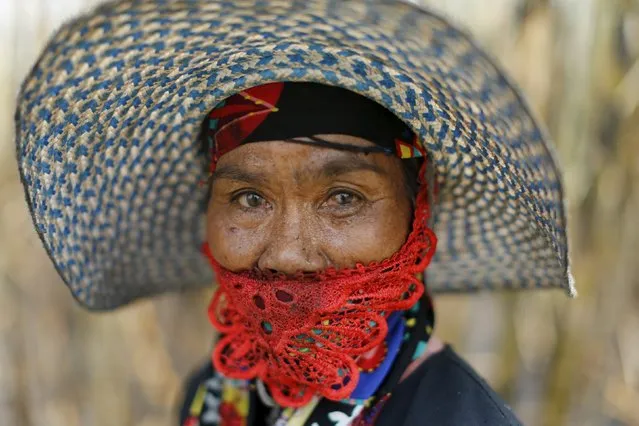
A sugar cane worker poses while working in a field at Pakchong district in Ratchaburi province, Thailand March 22, 2016. (Photo by Jorge Silva/Reuters)

A sugar cane worker poses while working in a field at Pakchong district in Ratchaburi province, Thailand March 22, 2016. The El Nino weather phenomenon has played havoc with crops across Southeast Asia and beyond. Thailand, the world's second-largest sugar exporter, will ship 20 percent less of the sweetener to international markets this year than last, and farmers fear the damage already inflicted on young cane plants could make next year worse. (Photo by Jorge Silva/Reuters)
Details
02 Apr 2016 09:49:00
A tear rolls down the cheek of Karima el-Mahroug, also known as Ruby, a Moroccan woman at the center of ex-Premier Silvio Berlusconi's s*x-for-hire trial, as she reads a statement to reporters during a protest outside the court house, in Milan, Italy, Thursday, April 4, 2013. The Moroccan woman at the center of ex-Premier Silvio Berlusconi's s*x-for-hire trial has denounced what she says is psychological warfare being waged against her by Italian prosecutors. Ruby, read out a lengthy statement Thursday to a gaggle of reporters in front of Milan's courthouse denying she was a prostitute and insisting that prosecutors hear her side of the story. (Photo by Luca Bruno/AP Photo)

A tear rolls down the cheek of Karima el-Mahroug, also known as Ruby, a Moroccan woman at the center of ex-Premier Silvio Berlusconi's s*x-for-hire trial, as she reads a statement to reporters during a protest outside the court house, in Milan, Italy, Thursday, April 4, 2013. The Moroccan woman at the center of ex-Premier Silvio Berlusconi's s*x-for-hire trial has denounced what she says is psychological warfare being waged against her by Italian prosecutors. Ruby, read out a lengthy statement Thursday to a gaggle of reporters in front of Milan's courthouse denying she was a prostitute and insisting that prosecutors hear her side of the story. (Photo by Luca Bruno/AP Photo)
Details
14 May 2013 10:44:00
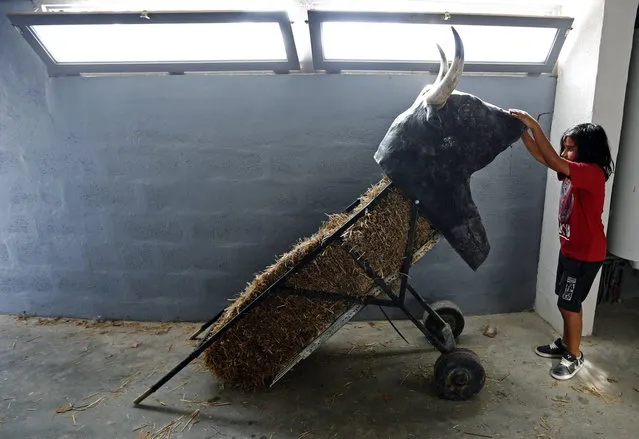
Nino, a ten-year-old toreador apprentice of the French Tauromachy Centre, nicknamed El Nino, touches a practice bull at the bullring of Garons, near Nimes, September 25, 2013. (Photo by Jean-Paul Pelissier/Reuters)

Nino, a ten-year-old toreador apprentice of the French Tauromachy Centre, nicknamed El Nino, touches a practice bull at the bullring of Garons, near Nimes, September 25, 2013. Since 1983, the French Tauromachy Centre in Nimes has trained some 1,000 youths in the art of bullfighting. Twenty of them have gone on to become professional matadors, facing fighting bulls in the arena. Twice a week, students take courses with a matador to learn the movements and gestures of the bullfighter in the ring, but without an animal present. Students train with calves in the surrounding fields during spring, and regularly participate in beginner's bullfights (becerradas) without killing calves. Solal has been taking courses for three years and Nino, for just a year now. Both are normally enrolled in French public schools, but have one thought in mind – bullfighting. They share a passion linked to the city of Nimes, famous for its ferias and bullring. (Photo by Jean-Paul Pelissier/Reuters)
Details
06 Nov 2013 10:12:00
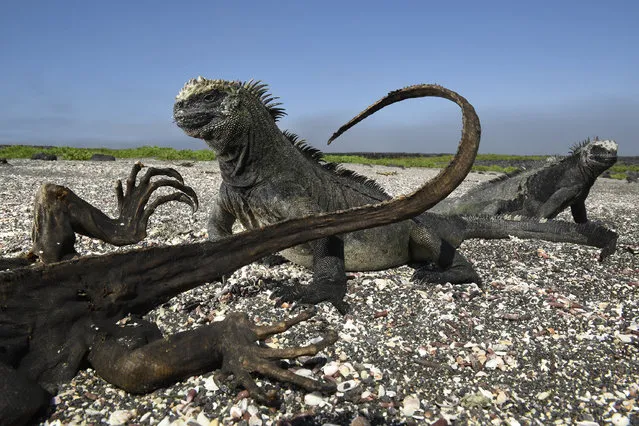
Galapagos – Rocking the Cradle: Four major ocean currents converge along the Galapagos archipelago, creating the conditions for an extraordinary diversity of animal life, April 25, 2016. The islands are home to at least 7,000 flora and fauna species, of which 97 percent of the reptiles, 80 percent of the land birds, 50 percent of the insects and 30 percent of the plants are endemic. The local ecosystem is highly sensitive to the changes in temperature, rainfall and ocean currents that characterize the climatic events known as El Niño and La Niña. These changes cause marked fluctuations in weather and food availability. Many scientists expect the frequency of El Niño and La Niña to increase as a result of climate change, making the Galapagos a possible early-warning location for its effects. (Photo by Thomas P. Peschak for National Geographic/World Press Photo)

Galapagos – Rocking the Cradle: Four major ocean currents converge along the Galapagos archipelago, creating the conditions for an extraordinary diversity of animal life, April 25, 2016. The islands are home to at least 7,000 flora and fauna species, of which 97 percent of the reptiles, 80 percent of the land birds, 50 percent of the insects and 30 percent of the plants are endemic. (Photo by Thomas P. Peschak for National Geographic/World Press Photo)
Details
16 Apr 2018 00:01:00
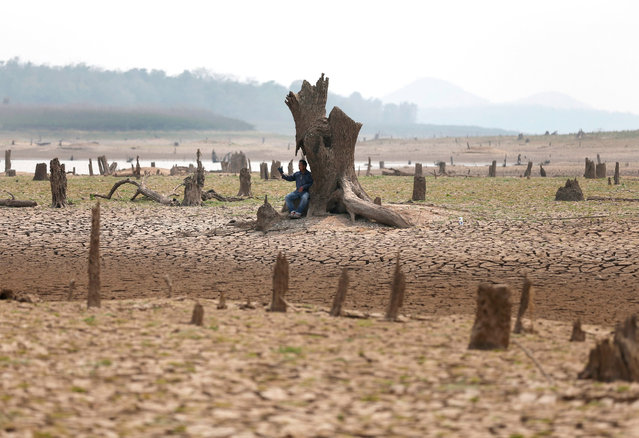
A photo made available on 14 March 2016 shows a Thai villager takes selfie photograph on drought parched land at the dried up Mae Chang reservoir in Lampang province, northern Thailand, 12 March 2016. The ruined village including ancient temple had been underwater for 34 years since the Mae Chang reservoir was built in 1982, the area has now re-emerged after water in the reservoir dried up caused by the severe drought. Thailand is facing the worst drought in decades hardest hit by El Nino phenomenon combined with seasonal hot weather. (Photo by Rungroj Yongrit/EPA)

A photo made available on 14 March 2016 shows a Thai villager takes selfie photograph on drought parched land at the dried up Mae Chang reservoir in Lampang province, northern Thailand, 12 March 2016. The ruined village including ancient temple had been underwater for 34 years since the Mae Chang reservoir was built in 1982, the area has now re-emerged after water in the reservoir dried up caused by the severe drought. Thailand is facing the worst drought in decades hardest hit by El Nino phenomenon combined with seasonal hot weather. (Photo by Rungroj Yongrit/EPA)
Details
28 Apr 2016 11:51:00
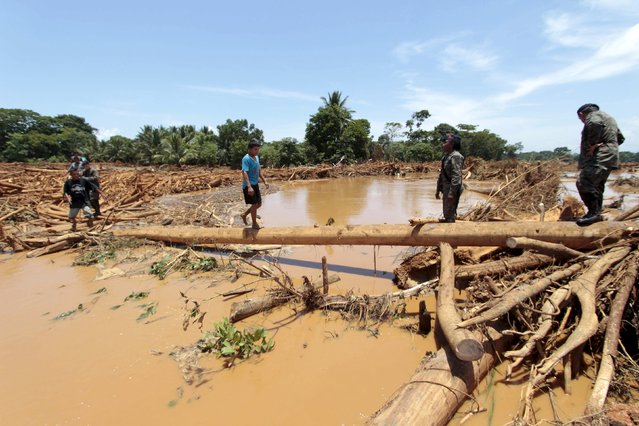
Villagers walk over a tree felled by rain in the village of Punta Caimanes, a place affected by heavy rains in the Izabal region, near Guatemala City, August 8, 2015. (Photo by Josue Decavele/Reuters)

Villagers walk over a tree felled by rain in the village of Punta Caimanes, a place affected by heavy rains in the Izabal region, near Guatemala City, August 8, 2015. Heavy rains have affected eight communities in the municipality of El Estor and five in Livingston, both located in the region of Izabal, with five deaths due to floods, according to local media. (Photo by Josue Decavele/Reuters)
Details
09 Aug 2015 10:50:00
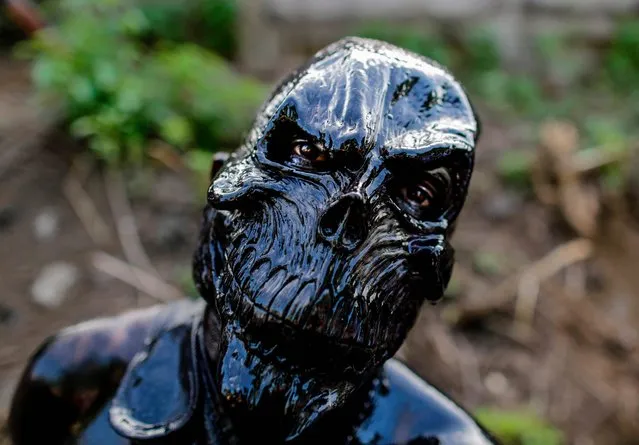
A catholic faithful smeared in burnt oil, takes part in the opening of the ten-day celebration of the Santo Domingo de Guzman festival in Managua, on August 1, 2019. (Photo by Inti Ocon/AFP Photo)

A catholic faithful smeared in burnt oil, takes part in the opening of the ten-day celebration of the Santo Domingo de Guzman festival in Managua, on August 1, 2019. In Central America the black devil, or El Cadejo, is an evil dog-like spirit with glowing red eyes that locals believe eats new born puppies. (Photo by Inti Ocon/AFP Photo)
Details
06 Aug 2019 00:01:00
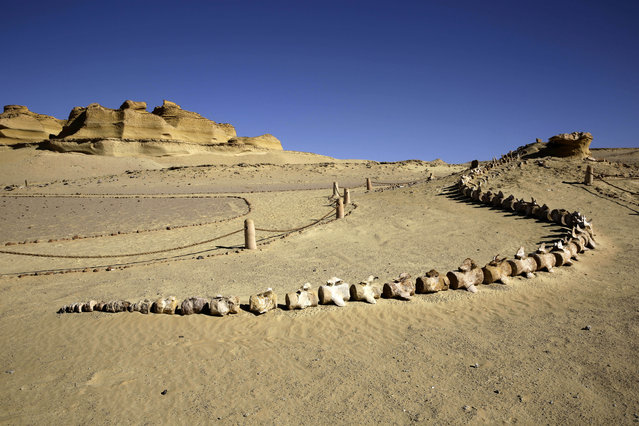
Fossilized whale bones are on display  outside the Wati El Hitan Fossils and Climate Change Museum, a UNESCO natural World Heritage site, on the opening day, in the Fayoum oasis, Egypt, Thursday, January 14, 2016. Egypt has cut the ribbon on the Middle East's first fossil museum housing the world's largest intact skeleton of a "walking whale" in an attempt to attract much-needed tourists driven off by recent militant attacks. The construction of the much-hyped Fossils and Climate Change Museum was covered a 2 billion euros (2. 17 billion dollars) grant from Italy, according to Italian Ambassador Maurizio Massari. (Photo by Thomas Hartwell/AP Photo)

Fossilized whale bones are on display outside the Wati El Hitan Fossils and Climate Change Museum, a UNESCO natural World Heritage site, on the opening day, in the Fayoum oasis, Egypt, Thursday, January 14, 2016. Egypt has cut the ribbon on the Middle East's first fossil museum housing the world's largest intact skeleton of a "walking whale" in an attempt to attract much-needed tourists driven off by recent militant attacks. The construction of the much-hyped Fossils and Climate Change Museum was covered a 2 billion euros (2. 17 billion dollars) grant from Italy, according to Italian Ambassador Maurizio Massari. Its centerpiece is an intact, 37-million-year-old and 20-meter-long skeleton of a legged form of whale that testifies to how modern-day whales evolved from land mammals. The sand-colored, dome-shaped museum is barely discernible in the breathtaking desert landscape that stretches all around. (Photo by Thomas Hartwell/AP Photo)
Details
16 Jan 2016 08:06:00