Loading...
Done
ROBOY: Tendon Driven Humanoid Robot

Roboy has a bright future, as he represents a completely new generation of robots. The pioneer project of the Artificial Intelligence Laboratory (AI Lab) of the University of Zurich started six months ago, with the target of developing one of the most modern humanoid robots within nine months. Now the robot has received a new face and is able to move his arms driven by maxon DC motors. On March 9, 2013, Roboy will be presented to the public at the “Robots on Tour” robotics exhibition held in Zurich on the 25th anniversary of the lab.
Details
06 Mar 2013 10:10:00
Sakia Corona, 8, (C) takes part in a rehearsal of the Contemporary Haitian Dance in a communal center in downtown Havana January 30, 2015. (Photo by Alexandre Meneghini/Reuters)

Sakia Corona, 8, (C) takes part in a rehearsal of the Contemporary Haitian Dance in a communal center in downtown Havana January 30, 2015. Nearly 25 people, from the Haitian Contemporary Dance Company Petit Fey or Small Leaf, in Haitian Creole, rehearse a play called Papa Guede for future presentations in Havana. (Photo by Alexandre Meneghini/Reuters)
Details
02 Feb 2015 10:04:00


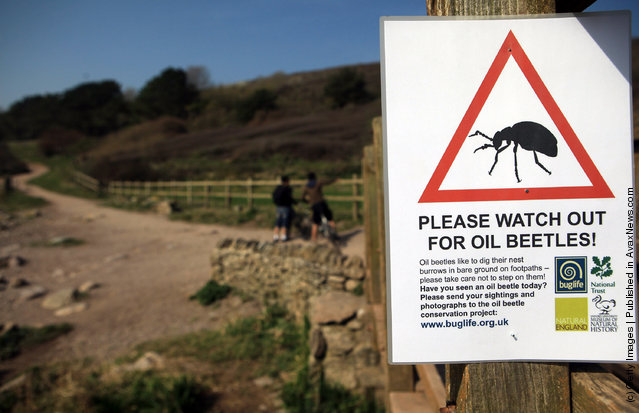
People enjoy the fine weather on the coast at Wembury during the first ever nationwide survey to map the location of the threatened and creatures on March 24, 2011 in near Plymouth, England. Often found on the coast, and particularly in the south west of England, the number of oil beetle species found in the UK has halved in the last 100 years and the survey will help establish the whereabouts of the remaining four species and boost efforts to secure their future. The survey is being launched today by Buglife: The Invertebrate Trust and the National Trust in partnership with Natural England and Oxford University Museum of Natural History. (Photo by Matt Cardy/Getty Images)
Details
25 Mar 2011 15:20:00
King Penguins marching during sunrise, Falkland Islands. (Photo by Wim van den Heever/Caters News)

Penguins majestically march on sand before heading out for a morning swim. Wildlife photographer Wim van den Heever, 45, visited the Falkland Islands this year to shoot pictures and scout the area for future tours. Wim’s breathtaking images show a small group of king penguins before they head out to sea at sunrise. Here: King Penguins marching during sunrise, Falkland Islands. (Photo by Wim van den Heever/Caters News)
Details
13 Oct 2017 06:32:00
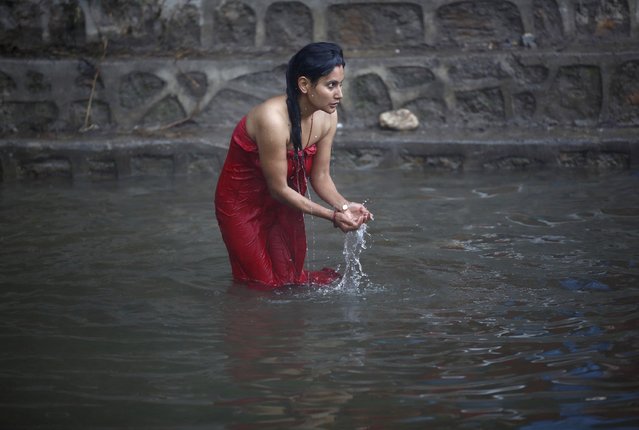
A devotee takes a holy bath in River Saali in Sankhu on the first day of Swasthani Brata Katha festival in Kathmandu January 5, 2015. During the month long festival, devotees recite one chapter of a Hindu tale daily from the 31-chapter sacred Swasthani Brata Katha book that is dedicated to God Madhavnarayan and Goddess Swasthani, alongside various other gods and goddess and the miraculous feats performed by them. (Photo by Navesh Chitrakar/Reuters)

A devotee takes a holy bath in River Saali in Sankhu on the first day of Swasthani Brata Katha festival in Kathmandu January 5, 2015. During the month long festival, devotees recite one chapter of a Hindu tale daily from the 31-chapter sacred Swasthani Brata Katha book that is dedicated to God Madhavnarayan and Goddess Swasthani, alongside various other gods and goddess and the miraculous feats performed by them. (Photo by Navesh Chitrakar/Reuters)
Details
06 Jan 2015 12:22:00
Devotees take a holy bath during the Swasthani Brata Katha festival in Kathmandu January 20, 2015. During the month-long festival, devotees recite one chapter of a Hindu tale daily from the 31-chapter sacred Swasthani Brata Katha book that is dedicated to God Madhavnarayan and Goddess Swasthani, alongside various other gods and goddesses and the miraculous feats performed by them. (Photo by Navesh Chitrakar/Reuters)

Devotees take a holy bath during the Swasthani Brata Katha festival in Kathmandu January 20, 2015. During the month-long festival, devotees recite one chapter of a Hindu tale daily from the 31-chapter sacred Swasthani Brata Katha book that is dedicated to God Madhavnarayan and Goddess Swasthani, alongside various other gods and goddesses and the miraculous feats performed by them. The devotees also go on pilgrimages to various temples, perform religious rituals, take a holy bath in the rivers and fast for a month, especially among women who believe fasting helps in their family's well-being or in getting them a good husband. (Photo by Navesh Chitrakar/Reuters)
Details
21 Jan 2015 13:50:00
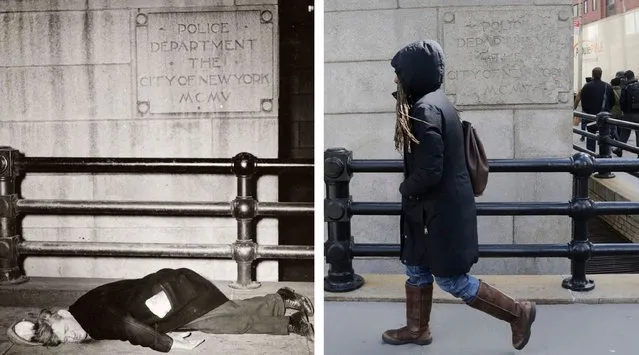
A new book of photos by legendary photographer Weegee shows what industrialized, pre-gentrified New York looked like in the mid-20th century, before the city was crammed with towers and billboards. (Photo by AP Photo/Copyright Weegee/The International Center of Photography, Mark Lennihan)

A new book of photos by legendary photographer Weegee shows what industrialized, pre-gentrified New York looked like in the mid-20th century, before the city was crammed with towers and billboards. Here: this combination shows the 1945 photo “Derelict sleeping on the sidewalk outside police headquarters” by Weegee, provided by the International Center of Photography in New York, and a woman walking on the same spot on Wednesday, March 18, 2015. (Photo by AP Photo/Copyright Weegee/The International Center of Photography, Mark Lennihan)


Details
27 Mar 2015 13:16:00
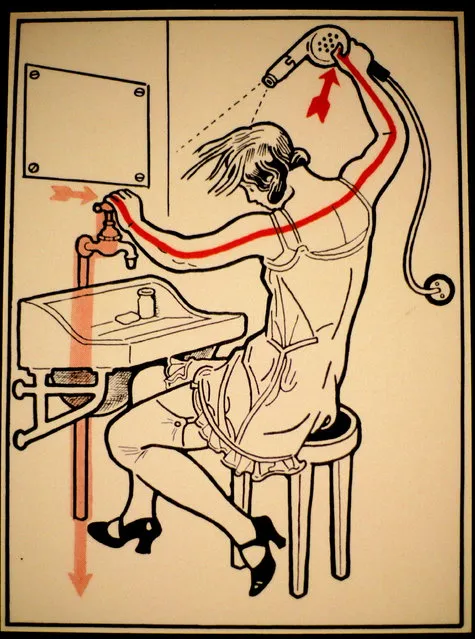
The book “Elektroschutz in 132 Bildern” (Electrical Protection in 132 Pictures) was published in Vienna in the early 1900s by a Viennese physician named Stefan Jellinek (1878-1968, a founder of the Electro-Pathological Museum). The pictures are nice and direct and unambiguous; they teach, graphically, that the surest way to kill yourself with electricity is to form a complete path from source (usually the bright red arrow) to ground (the screened back, pink arrow). Arrowheads provide the path for current flow. (Photo by The Vienna Technical Museum)

The book “Elektroschutz in 132 Bildern” (Electrical Protection in 132 Pictures) was published in Vienna in the early 1900s by a Viennese physician named Stefan Jellinek (1878-1968, a founder of the Electro-Pathological Museum). The pictures are nice and direct and unambiguous; they teach, graphically, that the surest way to kill yourself with electricity is to form a complete path from source (usually the bright red arrow) to ground (the screened back, pink arrow). Arrowheads provide the path for current flow. (Photo by The Vienna Technical Museum)
Details
11 Aug 2014 11:10:00