Loading...
Done
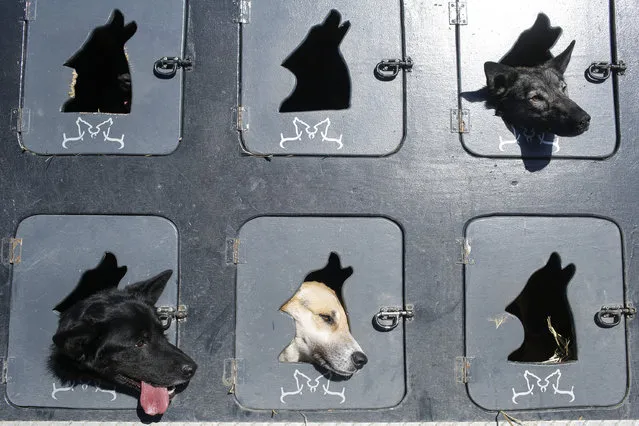
Musher Justin Savidis' dogs wait in the truck before the restart of the Iditarod Trail Sled Dog Race in Willow, Alaska March 6, 2016. Mushers and dog sled teams from around the world embark on the first leg of Alaska's grueling Iditarod Trail Sled Dog Race, starting a nearly 1,000-mile (1,609 km) journey through the state's unforgiving wilderness. (Photo by Nathaniel Wilder/Reuters)

Musher Justin Savidis' dogs wait in the truck before the restart of the Iditarod Trail Sled Dog Race in Willow, Alaska March 6, 2016. Mushers and dog sled teams from around the world embark on the first leg of Alaska's grueling Iditarod Trail Sled Dog Race, starting a nearly 1,000-mile (1,609 km) journey through the state's unforgiving wilderness. (Photo by Nathaniel Wilder/Reuters)
Details
08 Mar 2016 13:26:00
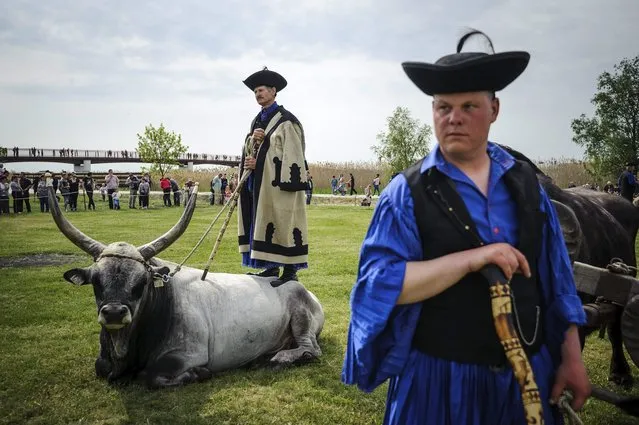
A herdsman stands on the back of a grey bull during a ceremony of driving sheep from their winter habitat to their summer pasture in the puszta or Hungarian steppe of Hortobagy, 183 kms east of Budapest, Hungary, 23 April 2016. Sheep are traditionally driven to their summer pasture at around St. George's Day in the Hortobagy region, because livestock breeding people traditionally consider St. George's Day the beginning of spring. (Photo by Zsolt Czegledi/EPA)

A herdsman stands on the back of a grey bull during a ceremony of driving sheep from their winter habitat to their summer pasture in the puszta or Hungarian steppe of Hortobagy, 183 kms east of Budapest, Hungary, 23 April 2016. Sheep are traditionally driven to their summer pasture at around St. George's Day in the Hortobagy region, because livestock breeding people traditionally consider St. George's Day the beginning of spring. (Photo by Zsolt Czegledi/EPA)
Details
24 Apr 2016 09:27:00
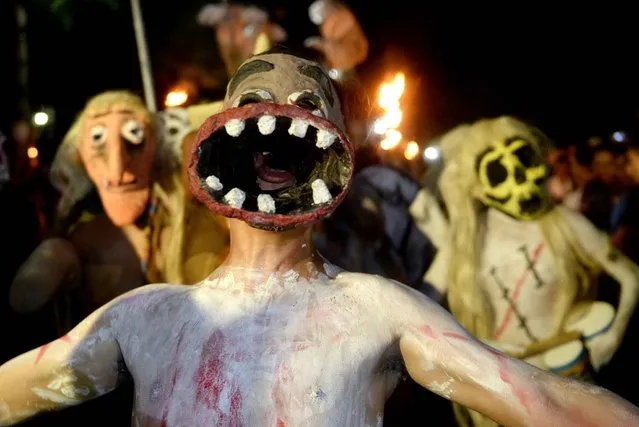
Young revelers take part in a parade called "La Calabiuza" on November 1, 2015, on the eve of the Day of the Dead in Tonacatepeque, 20 kms (13 miles) north of San Salvador. During the celebration, the residents of Tonacatepeque, originally an indigenous community, recall the characters from the mythology of Cuscatlan – pre-Columbian west and central regions of El Salvador – and their dead relatives. (Photo by Marvin Recinos/AFP Photo)

Young revelers take part in a parade called "La Calabiuza" on November 1, 2015, on the eve of the Day of the Dead in Tonacatepeque, 20 kms (13 miles) north of San Salvador. During the celebration, the residents of Tonacatepeque, originally an indigenous community, recall the characters from the mythology of Cuscatlan – pre-Columbian west and central regions of El Salvador – and their dead relatives. (Photo by Marvin Recinos/AFP Photo)
Details
04 Nov 2015 11:50:00
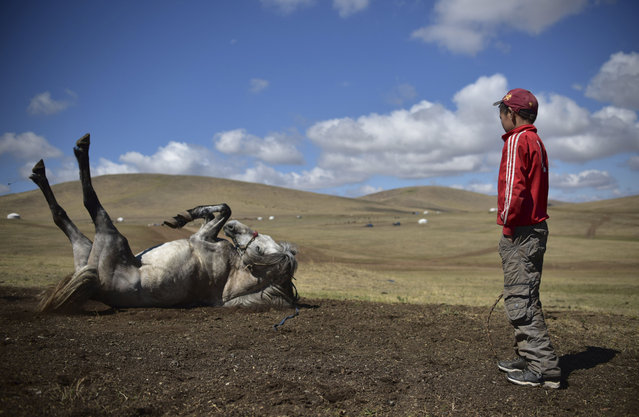
This picture taken on July 8, 2015 shows 13-year-old jockey Purevsurengiin Togtokhsuren (R) watching a horse rolling in the dirt after a training session in Khui Doloon Khudag, some 50 kms west of Ulan Bator. Despite being only 13 years old, Togtokhsuren is riding for the fifth time in the national races for Mongolia's summer festival, known as Naadam, lining up against some 170 other child jockeys. (Photo by Johannes Eisele/AFP Photo)

This picture taken on July 8, 2015 shows 13-year-old jockey Purevsurengiin Togtokhsuren (R) watching a horse rolling in the dirt after a training session in Khui Doloon Khudag, some 50 kms west of Ulan Bator. Despite being only 13 years old, Togtokhsuren is riding for the fifth time in the national races for Mongolia's summer festival, known as Naadam, lining up against some 170 other child jockeys. (Photo by Johannes Eisele/AFP Photo)
Details
17 Nov 2015 08:04:00
In this Saturday, April 8, 2017 photo, a keeper walks camels to the Al Marmoom Camel Racetrack, in al-Lisaili about 40 km (25  miles) southeast of Dubai, United Arab Emirates. (Photo by Kamran Jebreili/AP Photo)

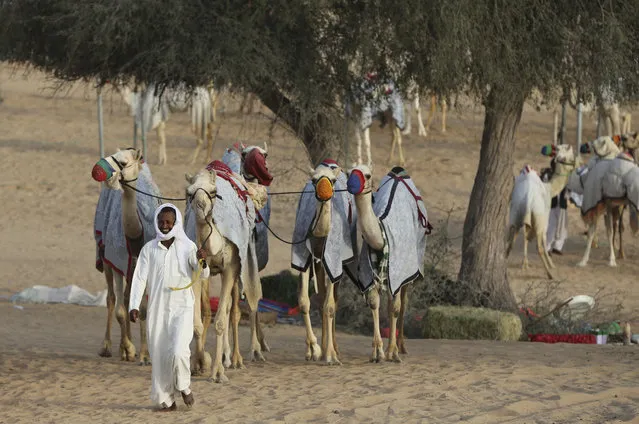
In this Saturday, April 8, 2017 photo, a keeper walks camels to the Al Marmoom Camel Racetrack, in al-Lisaili about 40 km (25 miles) southeast of Dubai, United Arab Emirates. Camel racing is a big-money sport and fast thoroughbreds can fetch well over a million dollars. As rising temperatures across Gulf Arab countries signal the end of the winter camel racing season, Dubai is wrapping up its races with the annual Al Marmoom Heritage Festival that has drawn thousands of camels from across the oil-rich Gulf. (Photo by Kamran Jebreili/AP Photo)
Details
19 Apr 2017 08:44:00
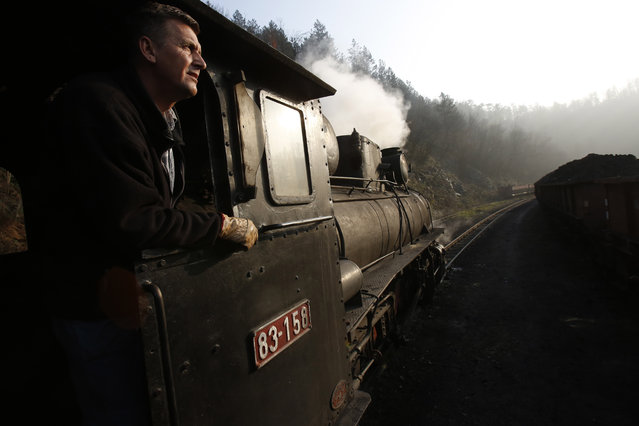
Bosnian worker Sefik Salihovic drives a steam engine in the Bosnian town of Banovici, 140 kms (86.9 miles) north of Sarajevo, on Monday, November 24, 2014. Every day, steam engines over 60 years old, defy their age and still pull wagons of coal from Banovici's coal mine to clients in nearby towns. But in the summer some of them turn into the only tourist attraction this impoverished north Bosnian town has to offer. (Photo by Amel Emric/AP Photo)

Bosnian worker Sefik Salihovic drives a steam engine in the Bosnian town of Banovici, 140 kms (86.9 miles) north of Sarajevo, on Monday, November 24, 2014. Every day, steam engines over 60 years old, defy their age and still pull wagons of coal from Banovici's coal mine to clients in nearby towns. But in the summer some of them turn into the only tourist attraction this impoverished north Bosnian town has to offer. (Photo by Amel Emric/AP Photo)
Details
05 Dec 2014 13:07:00
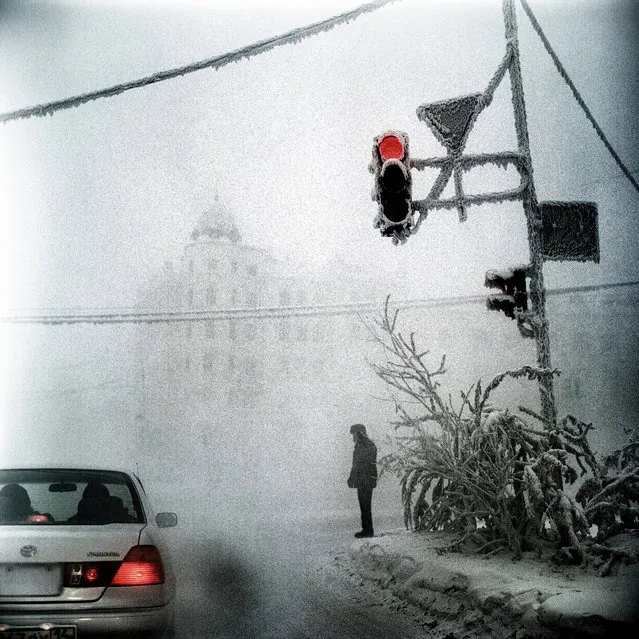
January 2013. A scene in Yakutsk, Siberia, the coldest city in the world. (Photo by Steeve Iuncker/Agence VU)

Yakutsk, a remote city in Eastern Siberia along the Lena River, is the coldest city in the world. Located 1840 km away from Irkoustk and 5000 km away from Moscow, this city founded in 1632 by the Cossacks imposes upon its inhabitants an extreme way of life. And yet, despite particularly harsh conditions, Yakutsk boasts a population of 270,000, or a quarter of the entire population of Siberia. No other place on the planet experiences the temperature extreme found here: in winter, the temperatures regularly fall to minus 40° (the coldest temperature recorded was –64°C) and in summer often reaches temperatures above 30°C. Photo: January 2013. A scene in Yakutsk, Siberia, the coldest city in the world. (Photo by Steeve Iuncker/Agence VU)
Details
29 Apr 2013 10:30:00
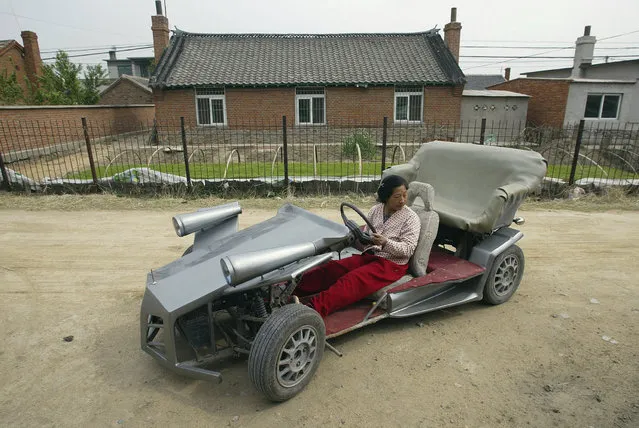
Zhang Jinduo's wife tries on a self-made racing car on the outskirts of Shenyang, Liaoning province May 10, 2008. Zhang, the 53-year-old local farmer made the racing car with the help of his son who is a car mechanic. The car is equipped with a rear-mounted motorcycle engine and can achieve 60-80 km per hour, according to local media. (Photo by Reuters/Stringer)

Zhang Jinduo's wife tries on a self-made racing car on the outskirts of Shenyang, Liaoning province May 10, 2008. Zhang, the 53-year-old local farmer made the racing car with the help of his son who is a car mechanic. The car is equipped with a rear-mounted motorcycle engine and can achieve 60-80 km per hour, according to local media. (Photo by Reuters/Stringer)
Details
17 Sep 2013 08:46:00