Loading...
Done
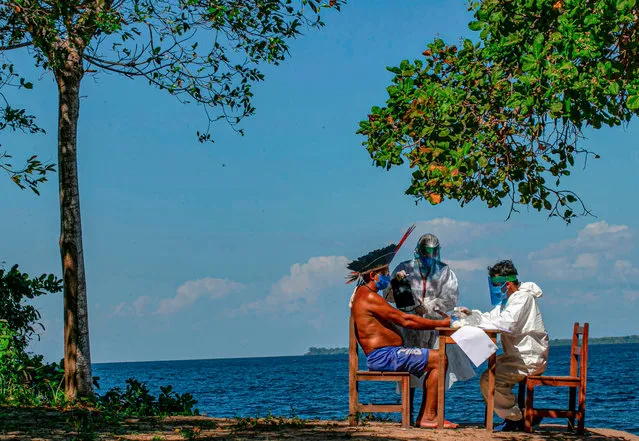
Indigenous nurses from the Special Secretariat for Indigenous Health (Sesai) of the Arapiuns ethnic group and Tapuia ethnic groups perform a rapid COVID-19 test on Chief Domingos from the Arapium tribe on the banks of the lower Tapajos River in the municipality of Santarem in western Para on July 19, 2020. (Photo by Tarso Sarraf/AFP Photo)

Indigenous nurses from the Special Secretariat for Indigenous Health (Sesai) of the Arapiuns ethnic group and Tapuia ethnic groups perform a rapid COVID-19 test on Chief Domingos from the Arapium tribe on the banks of the lower Tapajos River in the municipality of Santarem in western Para on July 19, 2020. (Photo by Tarso Sarraf/AFP Photo)
Details
22 Jul 2020 00:07:00
A Google balloon sails through the air with the Southern Alps mountains in the background, in Tekapo, New Zealand. (Photo by Jon Shenk/Associated Press)

“Google is launching balloons into near space to provide internet access to buildings below on the ground. About 30 of the superpressure balloons are being launched from New Zealand from where they will drift around the world on a controlled path. Attached equipment will offer 3G-like speeds to 50 testers in the country”. – BBC News. Photo: A Google balloon sails through the air with the Southern Alps mountains in the background, in Tekapo, New Zealand. (Photo by Jon Shenk/Associated Press)
Details
16 Jun 2013 10:54:00
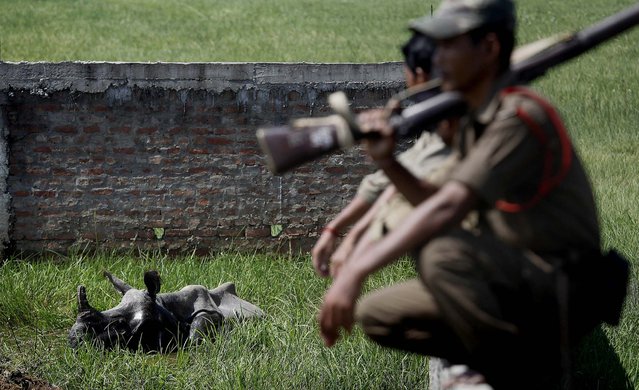
The rhino was finally located on Sunday in a field where it had taken shelter. Forest officials guarded the female one horned rhinoceros until it could be tranquilized and transported back to the Pobitora Wildlife Sanctuary. (Photo by Anupam Nath/Associated Press)

After eight tense days, a female one horned rhinoceros was found and rescued from an area in India that has recently seen four other rhinos killed by poachers.

Photo: The rhino was finally located on Sunday in a field where it had taken shelter. Forest officials guarded the female one horned rhinoceros until it could be tranquilized and transported back to the Pobitora Wildlife Sanctuary. (Photo by Anupam Nath/Associated Press)
Details
11 Oct 2012 09:46:00
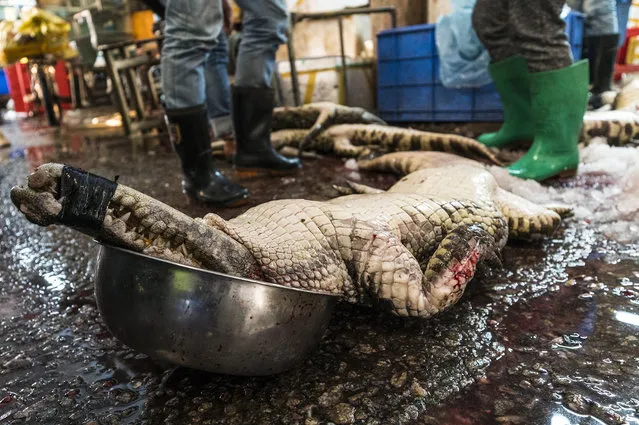
A dead crocodile is seen on Huangsha Seafood Market in Guangzhou, Guandong Province, China, 22 January 2018. Tsukiji Market of China or Huangsha Seafood Market is biggest one in Southern China and one of the biggest in China, as there are literally hundreds of different varieties of fish and seafood scattered throughout the market. Since the proximity of the fish market is so close to the Zhujiang River, it's quite easy for the large fishing vessels and fishermen to unload their fresh catch right at the market, which ensures that the fish and seafood remain fresh. Fish and other seafood are coming there from all around the globe. Seafood Market is full of different kinds of live fish, live shellfish, and live seafood on display in crystal clear tanks and it's common to see 5-star chefs, retailers and expats to source for fresh and high-quality seafood supplies for reasonable prices. While it is a wholesale fish market, since many Guangzhou restaurants and businesses come to purchase their seafood here, the public is welcome to come and even purchase. Many local Chinese have the vendors slice up fresh salmon fillets to take home or carry seafood into one of the nearby specialty restaurants, where they will cook if for them and serve it with vegetables and other side dishes of their choice. One of the biggest attractions for both, tourists and buyers, on market are crocodiles, which are brought there alive in wooden cases with taped jaws so they can?t accidentally bite. They are from crocodile farms from Guangdong, China and from Vietnam. Crocodile meat is popular in most Asian countries and it is consider as delicate one. Crocodiles weight from 10 to 25 kg and bigger ones are about 2 years old. They cost about 70 RMB (8.90 EURO) when bout as whole, or if you buy as parts most expensive and appreciated parts are paws 120 RMB (15.26 EURO) per kg, and tail 100 RMB (12.72 EURO) per kg. (Photo by Aleksandar Plavevski/EPA/EFE)

A dead crocodile is seen on Huangsha Seafood Market in Guangzhou, Guandong Province, China, 22 January 2018. Tsukiji Market of China or Huangsha Seafood Market is biggest one in Southern China and one of the biggest in China, as there are literally hundreds of different varieties of fish and seafood scattered throughout the market. (Photo by Aleksandar Plavevski/EPA/EFE)
Details
17 Apr 2020 00:05:00
Thor, Virginia Tech College of Engineering, Robotics and Mechanisms Laboratory, tries to connect the hose to a firehose connection during the hose task at the Homestead-Miami Speedway, Friday, December 20, 2013, in Homestead, Fla. Seventeen teams from the United States, China, Japan, and Korea are participating in the DARPA Rpbotics Challenge Trials. The event is a test of some of the most advanced robots in the world. (AP Photo/Alan Diaz)

Thor, Virginia Tech College of Engineering, Robotics and Mechanisms Laboratory, tries to connect the hose to a firehose connection during the hose task at the Homestead-Miami Speedway, Friday, December 20, 2013, in Homestead, Fla. (Photo by Alan Diaz/AP Photo)
Details
03 Jan 2014 09:26:00
Military policemen take part in an operation at Cidade de Deus favela in Rio de Janeiro, Brazil, on February 01, 2018. (Photo by Mauro Pimentel/AFP Photo)

Military policemen take part in an operation at Cidade de Deus favela in Rio de Janeiro, Brazil, on February 01, 2018. (Photo by Mauro Pimentel/AFP Photo)
Details
02 Feb 2018 08:16:00
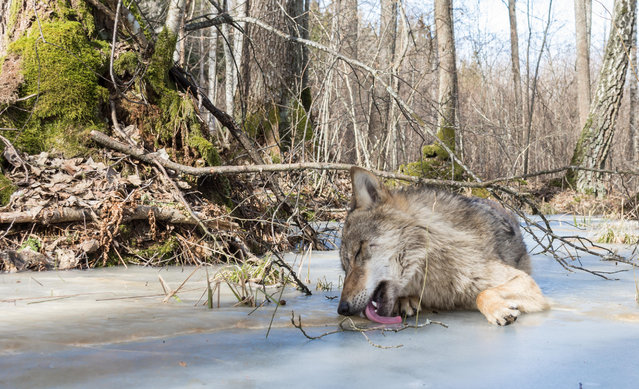
A thirsty timber wolf, Lithuania. (Photo by Erikas Plucas/Alamy Stock Photo)

A thirsty timber wolf, Lithuania, 2018. (Photo by Erikas Plucas/Alamy Stock Photo)
Details
08 Apr 2018 00:03:00
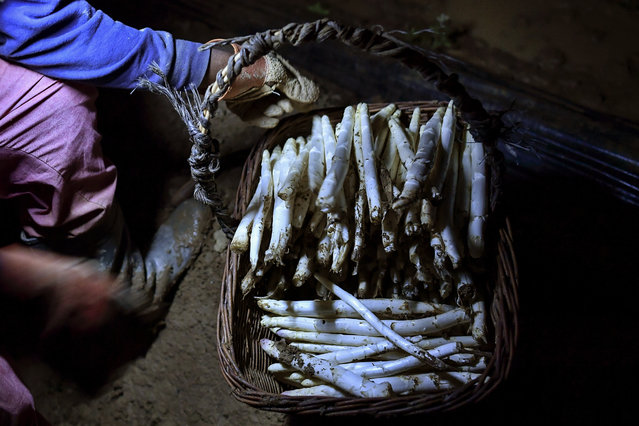
In this Thursday, May 31, 2018 photo, a temporary worker using a lantern collects white asparagus from a field in Caparroso, around 85 km (52 miles) from Pamplona, northern Spain. (Photo by Alvaro Barrientos/AP Photo)

In this Thursday, May 31, 2018 photo, a temporary worker using a lantern collects white asparagus from a field in Caparroso, around 85 km (52 miles) from Pamplona, northern Spain. Dubbed the “white gold” of these northern Spanish farms because of their color and the high price they fetch in markets and restaurants around the world, the stringy delicacy is planted every fall and picked each year between April and June, at the height of the spring. (Photo by Alvaro Barrientos/AP Photo)
Details
09 Jun 2018 00:03:00