Loading...
Done
A child blowing confetti from her hands during a Carnival parade in Cyprus' coastal city of Limassol, Sunday, March 13, 2016. Limassol's long-established parade is Cyprus' biggest and most famous, drawing revelers from across the east Mediterranean island. This year's parade drew huge crowds as people sought lighthearted reprieve from the bailed-out country's recession. The parade marks the start of the 40-day fasting period of Lent in the run-up to the Orthodox Christian Easter. (Photo by Petros Karadjias/AP Photo)

A child blowing confetti from her hands during a Carnival parade in Cyprus' coastal city of Limassol, Sunday, March 13, 2016. Limassol's long-established parade is Cyprus' biggest and most famous, drawing revelers from across the east Mediterranean island. This year's parade drew huge crowds as people sought lighthearted reprieve from the bailed-out country's recession. The parade marks the start of the 40-day fasting period of Lent in the run-up to the Orthodox Christian Easter. (Photo by Petros Karadjias/AP Photo)
Details
14 Mar 2016 10:21:00
This restroom on the rubbly flanks of Jonsknuten in Norway looks up at the peak of the 904m mountain. Yu have to leave the door open to enjoy the view but the chances of being disturbed are minimal. (Photo by Olaf Menz/Lonely Planet)

This restroom on the rubbly flanks of Jonsknuten in Norway looks up at the peak of the 904m mountain. Yu have to leave the door open to enjoy the view but the chances of being disturbed are minimal. (Photo by Olaf Menz/Lonely Planet)
Details
13 Apr 2016 09:00:00


The name Danbo is a pun on the Japanese word for corrugated cardboard “danboru” (ダンボー). There’s also a company in Japan which makes cardboard boxes which has Danbooru in its name.
Details
08 May 2012 02:28:00
Cossack's Song “Не для меня придёт весна”

The song is presented in this publication in two different executions. The first (performed by monastic chorus) – classical, but bad. The second – national, good. Enjoy.

SEE ALSO: “Three Remarkable Cossack Songs + Bonus


Details
13 May 2013 15:54:00
The Costica photo on the left inspired Australia-based photographer Jane Long to create her version, titled “Innocence”. (Photo by Costica Acsinte Archive/Jane Long)

The “Dancing With Costica” series began when Australia-based photographer Jane Long decided to brush up on her retouching skills. After finding the Costica Acsinte Archive on Flickr, she became fascinated with the images and their subjects, wanting to bring them to life and give them a story. Here: the Costica photo on the left inspired Jane Long to create her version, titled “Innocence”. (Photo by Costica Acsinte Archive/Jane Long)
Details
01 Sep 2014 09:48:00
Three Burmese women members of a circus play cards as they wear the brass neck and leg rings traditionally worn by Padaung women since childhood and which cannot be removed, London, January 4, 1935. (Photo by Keystone)

Three Burmese women members of a circus play cards as they wear the brass neck and leg rings traditionally worn by Padaung women since childhood and which cannot be removed, London, January 4, 1935. (Photo by Keystone). P.S. All pictures are presented in high resolution.
Details
29 Aug 2012 11:18:00
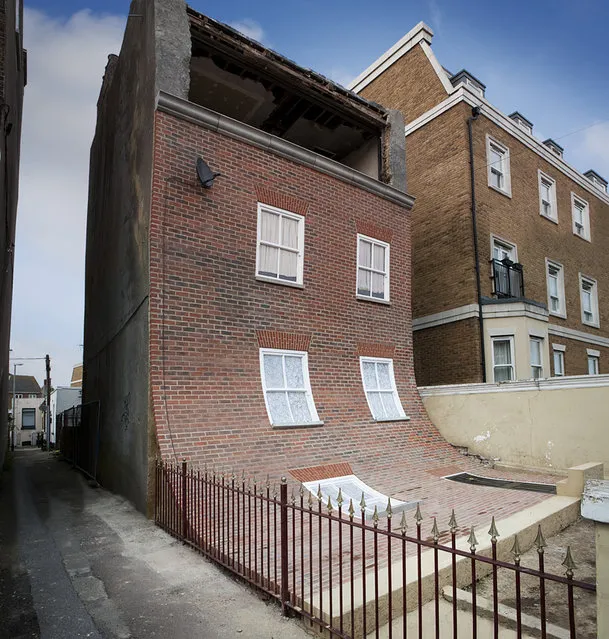
Margate Sliding House Created By Artist Alex Chinneck

British designer Alex Chinneck created the installation - called From the Knees of my Nose to the Belly of my Toes - by removing the facade of a detached four-storey house that had been derelict for eleven years and replacing it with a brand new frontage that leaves the crumbling top storey exposed, then curves outwards so the bottom section lies flat in front of the house.
Details
11 Oct 2013 10:20:00
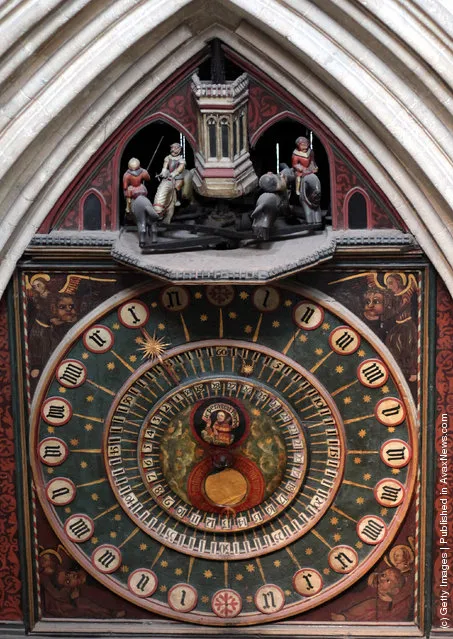
Wells Clock – World's Oldest Mechanical Clock

“Wells Cathedral is a Church of England cathedral in Wells, Somerset, England. Built between 1175 and 1490, Wells Cathedral has been described as “the most poetic of the English Cathedrals”. The Wells clock, an astronomical clock, is located in the north transept. The surviving mechanism, dated to between 1386 and 1392, was replaced in the 19th century, and was eventually moved to the Science Museum in London, where it continues to operate. It is the second-oldest surviving clock in England”. – Wikipedia

Photo: The clock face of world's oldest continually-working mechanical clock is seen as it is hand wound for the very last time on August 21, 2010 in Wells, England. (Photo by Matt Cardy/Getty Images)
Details
10 Aug 2011 11:23:00