Loading...
Done
Ugly Girl

Chinese woman Zhang Jing, known as the “Ugly Girl” smiles after doctors removed the stitches from her fourth session of cosmetic surgery at a hospital on March 23, 2005 in Shanghai, China. Zhang Jing, 26 years old, from Tianjin Municipality, was forced to leave school because her classmates sneered at her appearance during her teenage years. After leaving junior high school, Zhang found herself still unacceptable by society, she struggled to look for a job, but was turned down by one thousand job applications in ten years. Zhang's story was widely reported by the media in 2003, this helped her find a job and get three chances of free plastic surgery. (Photo by China Photos/Getty Images)
Details
31 Aug 2011 10:11:00
Conaster Iongimanus AKA The Icon Star Or Double Star

Iconaster longimanus, the icon star or double star, is a species of starfish in the family Goniasteridae. It is found in the west and central Indo-Pacific Ocean. The genus name comes from the Greek eikon, meaning portrait or image and possibly referring to the way the marginal plates frame the disc, and aster, meaning star. The specific name comes from the Latin longus manus and refers to the long, slender arms.
Details
14 Jul 2014 12:50:00
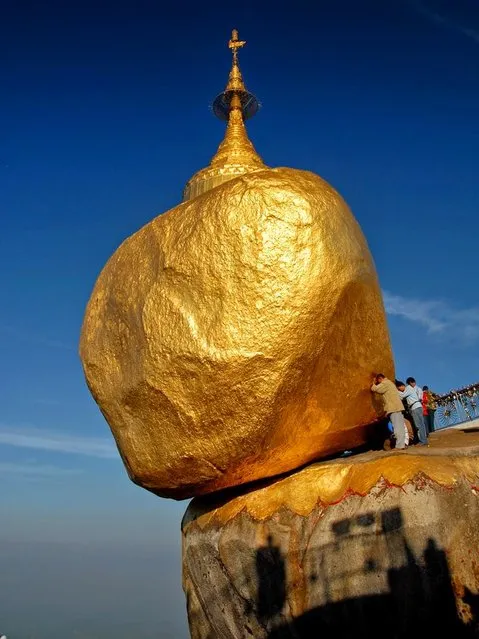
 Kyaiktiyo Pagoda AKA  Golden Rock In Burma

Kyaiktiyo Pagoda, also known as Golden Rock is a well-known Buddhist pilgrimage site in Mon State, Burma. It is a small pagoda (7.3 metres (24 ft)) built on the top of a granite boulder covered with gold leaves pasted on by devotees. According to legend, the Golden Rock itself is precariously perched on a strand of the Buddha's hair. The balancing rock seems to defy gravity, as it perpetually appears to be on the verge of rolling down the hill. The rock and the pagoda are at the top of Mt. Kyaiktiyo. It is the third most important Buddhist pilgrimage site in Burma after the Shwedagon Pagoda and the Mahamuni Pagoda. A glimpse of the "gravity defying" Golden Rock is believed to be enough of an inspiration for any person to turn to Buddhism.
Details
04 Jun 2015 11:42:00
Wave Rock, Arizona

Wave Rock is a natural rock formation that is shaped like a tall breaking ocean wave. The "wave" is about 14 m (46 ft) high and around 110 m (360 ft) long. It forms the north side of a solitary hill, which is known as “Hyden Rock”. This hill, which is a granite inselberg, lies about 3 km (2 mi) east of the small town of Hyden and 296 km (184 mi) east-southeast of Perth, Western Australia. Wave Rock and Hyden Rock are part of a 160 ha (395-acre) nature reserve, Hyden Wildlife Park.
Details
12 Aug 2014 10:21:00
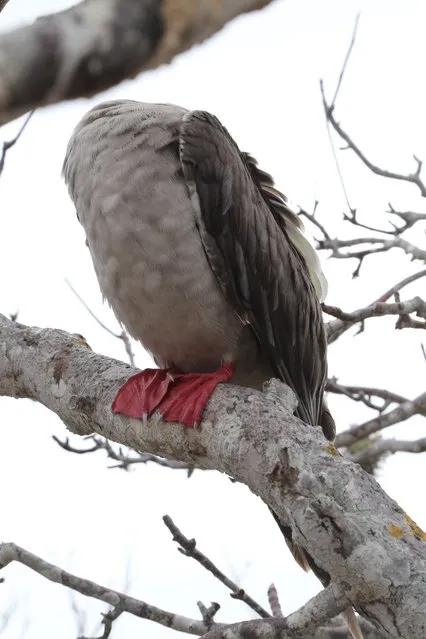
Red-Footed Booby

The red-footed booby is the smallest of all boobies at about 70 centimetres (28 in) in length and with a wingspan of up to 1 metre (3.3 ft). It has red legs, and its bill and throat pouch are coloured pink and blue.

See Also: Blue
Details
05 Oct 2014 10:24:00
Sharks And Dolphins Preying On Mackerel

British photographer Christopher Swann captures the fascinating underwater action that takes place when sharks and dolphins prey on a school of mackerel. We rarely think about how members of the animal kingdom hunt or defend themselves, but the wildlife photographer gives some perspective on these particular creatures off the coast of Azores.
Details
10 Feb 2013 12:04:00


Madurodam is a park and tourist attraction in Scheveningen, The Hague, Netherlands, home to a range of perfect 1:25 scale model replicas of famous Dutch castles, public buildings, and large industrial projects as found at various locations in the country. The park was opened in 1952 and has been visited by tens of millions of visitors since that date.
Details
14 Mar 2013 10:11:00
Freshly shorn alpacas are pictured on a meadow in the village of Winklarn near Regensburg April 22, 2013. The alpacas are always shorn in spring, to make the animals more comfortable for the summer months and to collect the expensive and well known alpaca wool. (Photo by Michaela Rehle/Reuters)

Freshly shorn alpacas are pictured on a meadow in the village of Winklarn near Regensburg April 22, 2013. The alpacas are always shorn in spring, to make the animals more comfortable for the summer months and to collect the expensive and well known alpaca wool. (Photo by Michaela Rehle/Reuters)
Details
23 Apr 2013 07:30:00