Loading...
Done
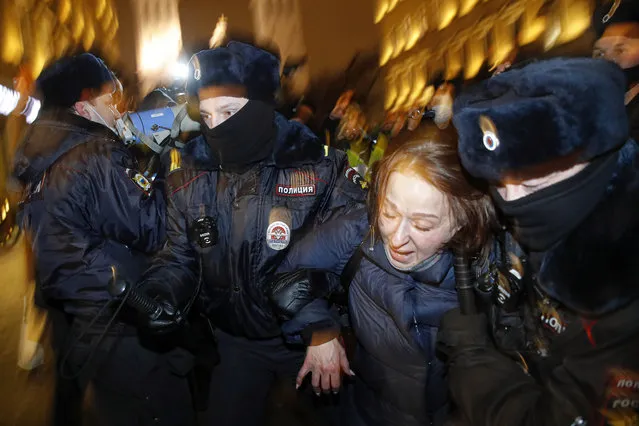
Police officers detain a Navalny supporter during a protest in St. Petersburg, Russia, Tuesday, February 2, 2021. A Moscow court has ordered Russian opposition leader Alexei Navalny to prison for more than 2 1/2 years on charges that he violated the terms of his probation while he was recuperating in Germany from nerve-agent poisoning. Navalny, who is the most prominent critic of President Vladimir Putin, had earlier denounced the proceedings as a vain attempt by the Kremlin to scare millions of Russians into submission. (Photo by Dmitri Lovetsky/AP Photo)

Police officers detain a Navalny supporter during a protest in St. Petersburg, Russia, Tuesday, February 2, 2021. A Moscow court has ordered Russian opposition leader Alexei Navalny to prison for more than 2 1/2 years on charges that he violated the terms of his probation while he was recuperating in Germany from nerve-agent poisoning. Navalny, who is the most prominent critic of President Vladimir Putin, had earlier denounced the proceedings as a vain attempt by the Kremlin to scare millions of Russians into submission. (Photo by Dmitri Lovetsky/AP Photo)
Details
05 Feb 2021 09:38:00
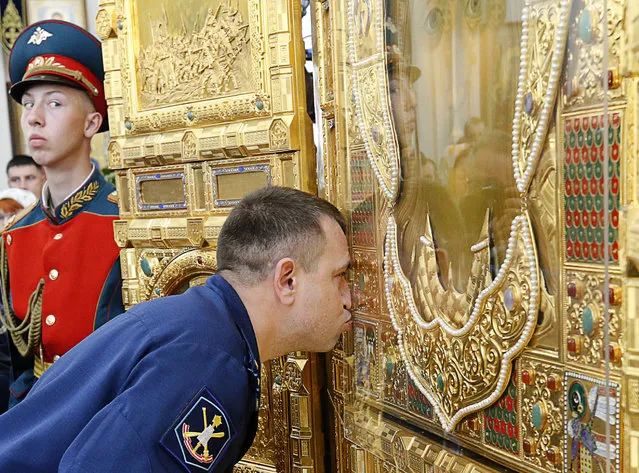
A serviceman kisses the main icon for the Russian Armed Forces' main cathedral, delivered at the Church of Our Lady the Healer in Rostov-On-Don, Russia on May 15, 2018. The Russian Armed Forces' main cathedral is to be built in Patriot Military Park in Kubinka outside Moscow by 2020, the year of the 75th anniversary of the victory of the Soviet Red Army over Nazi Germany in the 1941-45 Great Patriotic War, the Eastern Front of World War II. (Photo by Valery Matytsin/TASS)

A serviceman kisses the main icon for the Russian Armed Forces' main cathedral, delivered at the Church of Our Lady the Healer in Rostov-On-Don, Russia on May 15, 2018. The Russian Armed Forces' main cathedral is to be built in Patriot Military Park in Kubinka outside Moscow by 2020, the year of the 75th anniversary of the victory of the Soviet Red Army over Nazi Germany in the 1941-45 Great Patriotic War, the Eastern Front of World War II. (Photo by Valery Matytsin/TASS)
Details
17 May 2019 00:07:00
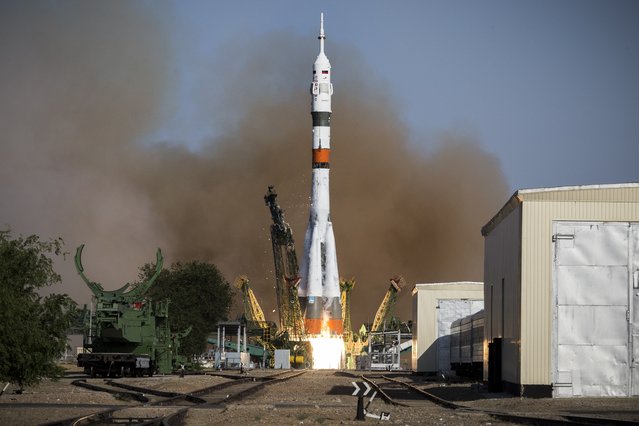
In this photo taken on Thursday, August 22, 2019, and distributed by Roscosmos Space Agency Press Service, the Russian Progress 73 cargo ship blasts off from the launch pad at Russia's space facility in Baikonur, Kazakhstan. The new Russian rocket, that is expected to replace the current model sending manned missions into space, blasted off from Kazakhstan on Thursday, carrying a Soyuz capsule with a humanoid robot. (Photo by Roscosmos Space Agency Press Service via AP Photo)

In this photo taken on Thursday, August 22, 2019, and distributed by Roscosmos Space Agency Press Service, the Russian Progress 73 cargo ship blasts off from the launch pad at Russia's space facility in Baikonur, Kazakhstan. The new Russian rocket, that is expected to replace the current model sending manned missions into space, blasted off from Kazakhstan on Thursday, carrying a Soyuz capsule with a humanoid robot. (Photo by Roscosmos Space Agency Press Service via AP Photo)
Details
23 Aug 2019 00:03:00
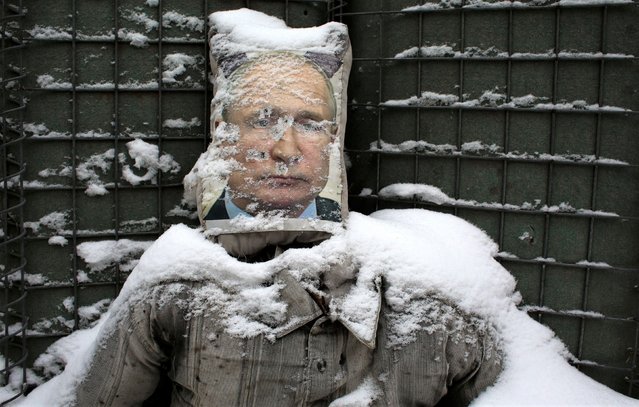
A poster of Russian President Vladimir Putin  is used as target practice along a trench on the frontline with Russia-backed separatists near Zolote village, in the Lugansk region, on January 21, 2022. Ukraine's Foreign Minister Dmytro Kuleba on January 22, 2022, slammed Germany for its refusal to supply weapons to Kyiv, urging Berlin to stop “undermining unity“ and “encouraging Vladimir Putin” amid fears of a Russian invasion. (Photo by Anatolii Stepanov/AFP Photo)

A poster of Russian President Vladimir Putin is used as target practice along a trench on the frontline with Russia-backed separatists near Zolote village, in the Lugansk region, on January 21, 2022. Ukraine's Foreign Minister Dmytro Kuleba on January 22, 2022, slammed Germany for its refusal to supply weapons to Kyiv, urging Berlin to stop “undermining unity“ and “encouraging Vladimir Putin” amid fears of a Russian invasion. (Photo by Anatolii Stepanov/AFP Photo)
Details
01 Feb 2022 07:16:00
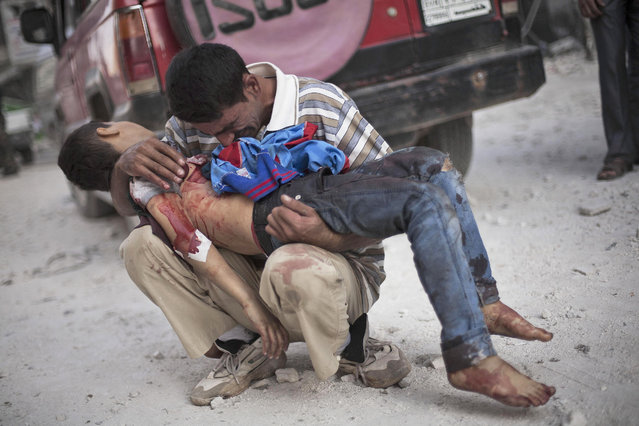
A Syrian man cries while holding the body of his son, killed by the Syrian Army, near Dar El Shifa hospital in Aleppo, Syria, Wednesday, October 3, 2012. (Photo by Manu Brabo/AP Photo)

Manu Brabo was born in Spain in 1981. After studying Photography in The School of Arts and Crafts in Oviedo, he moved to Madrid where he started Journalism in Carlos III University while he was working as a photographer for several humble newspapers and agencies. In 2011, Manu was held captive and then released by by Libyan forces. Brabo, along with fellow AP photographers were awarded the 2013 Pulitzer Prize for Breaking News Photography. Here: a Syrian man cries while holding the body of his son, killed by the Syrian Army, near Dar El Shifa hospital in Aleppo, Syria, Wednesday, October 3, 2012. (Photo by Manu Brabo/AP Photo)
Details
27 Oct 2015 08:04:00
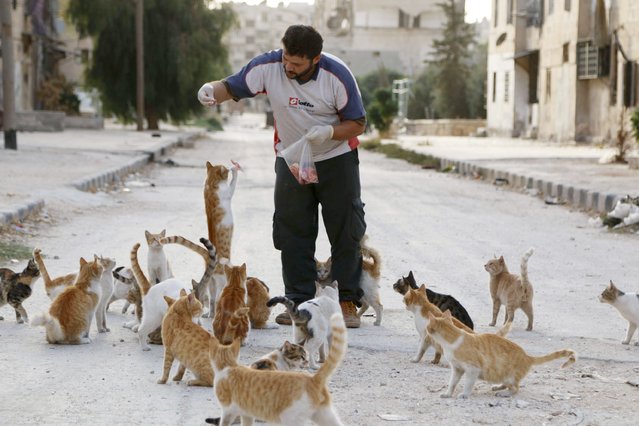
Alaa, an ambulance driver, feeds cats in Masaken Hanano in Aleppo, September 24, 2014. Alaa buys about $4 of meat everyday to feed about 150 abandoned cats in Masaken Hanano, a neigbourhood in Aleppo that has been abandoned because of shelling from forces loyal to Syria's president Bashar Al-Assad on it. Alaa said that he has been feeding and taking care of the cats for over 2 months. (Photo by Hosam Katan/Reuters)

Alaa, an ambulance driver, feeds cats in Masaken Hanano in Aleppo, September 24, 2014. Alaa buys about $4 of meat everyday to feed about 150 abandoned cats in Masaken Hanano, a neigbourhood in Aleppo that has been abandoned because of shelling from forces loyal to Syria's president Bashar Al-Assad on it. Alaa said that he has been feeding and taking care of the cats for over 2 months. (Photo by Hosam Katan/Reuters)
Details
25 Sep 2014 13:29:00
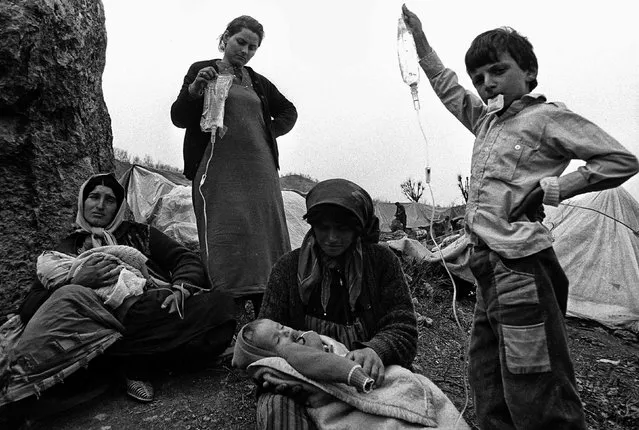
Iraqi Kurdish refugees wait with children in Cukurca refugee camp in Turkey April 8, 1991. Reuters photographers have chronicled Kurdish refugee crises over the years. In 1991 Srdjan Zivulovic documented refugees in Cukurca who had escaped a military operation by Saddam Hussein's government in Iraq aimed at “Arabising” Kurdish areas in the north. (Photo by Srdjan Zivulovic/Reuters)

Iraqi Kurdish refugees wait with children in Cukurca refugee camp in Turkey April 8, 1991. Reuters photographers have chronicled Kurdish refugee crises over the years. In 1991 Srdjan Zivulovic documented refugees in Cukurca who had escaped a military operation by Saddam Hussein's government in Iraq aimed at “Arabising” Kurdish areas in the north. Hundreds of thousands fled into Turkey and Iran. Images shot in recent months show familiar scenes as crowds of people flee Islamic State militants in Syria. There are as many as 30 million Kurds, spread through Turkey, Iraq, Syria and Iran. Most Kurds are Sunni Muslims, but tend to feel more loyalty to their Kurdishness, rather than their religion. (Photo by Srdjan Zivulovic/Reuters)
Details
14 Nov 2014 14:09:00
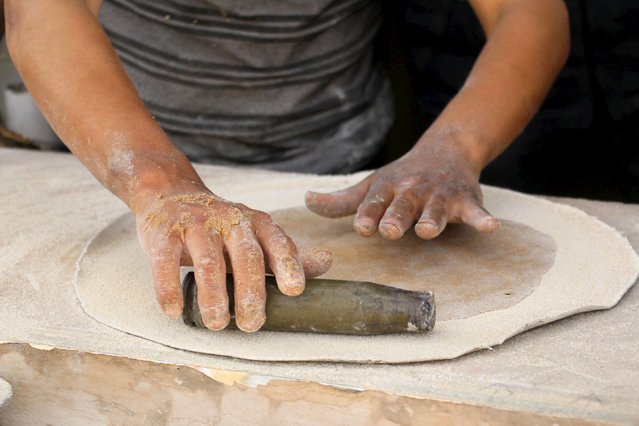
A boy uses remnants of ordnance as he prepares dough inside Abu Khaled's shop in the Douma neighborhood of Damascus April 28, 2015. Abu Khaled opened a shop for making “barley bread” using remnants of weapons including rockets, tank shells and other ordnance fired by forces loyal to Syria's President Bashar al-Assad. (Photo by Amer Almohibany/Reuters)

A boy uses remnants of ordnance as he prepares dough inside Abu Khaled's shop in the Douma neighborhood of Damascus April 28, 2015. Abu Khaled opened a shop for making “barley bread” using remnants of weapons including rockets, tank shells and other ordnance fired by forces loyal to Syria's President Bashar al-Assad. (Photo by Amer Almohibany/Reuters)
Details
09 Aug 2015 11:13:00