Loading...
Done
Lombard Street: The Crookedest Street In The World

“Lombard Street is an east-west street in San Francisco, California. Lombard Street is best known for the one-way section on Russian Hill between Hyde and Leavenworth Streets, in which the roadway has eight sharp turns (or switchbacks) that have earned the street the distinction of being the crookedest street in the world”. – Wikipedia

Photo: A single car drives down a typically crowded Lombard Street, San Francisco's crooked street, April 29, 2003 in San Francisco. (Photo by Justin Sullivan/Getty Images)
Details
07 Oct 2011 09:58:00
Antelope Canyon Arizona USA

Antelope Canyon is the most-visited and most-photographed slot canyon in the American Southwest. It is located on Navajo land near Page, Arizona. Antelope Canyon includes two separate, photogenic slot canyon sections, referred to individually as Upper Antelope Canyon or The Crack; and Lower Antelope Canyon or The Corkscrew.
Details
28 Jul 2012 14:41:00
Stockholm metro

The Stockholm metro (Swedish: Stockholms tunnelbana) is a metro system in Stockholm, Sweden. The first line opened in 1950, and today the system has 100 stations in use, of which 47 are underground and 53 above ground. There are seven lines numbered from 10 to 19, in three groups identified by a color: the Green, Red and Blue lines. Each color line has two or three numbered lines on shared sections through the Stockholm City Centre.
Details
12 Sep 2012 05:10:00
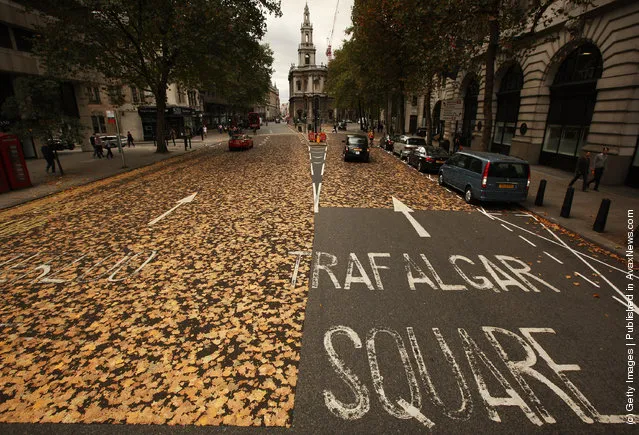
Autumn Leaves Trapped In Road Surface Following Late Summer Heatwave

Leaves are stuck to the road surface on October 5, 2011 in London, England. A combination of late Summer high temperatures and an early fall of leaves onto a sticky non-slip section of road tarmac has created a leafy collage. (Photo by Peter Macdiarmid/Getty Images)
Details
06 Oct 2011 12:41:00
[Lake Natron in Tanzania

Lake Natron is a salt lake located in northern Tanzania, close to the Kenyan border, in the eastern branch of the East African Rift. The lake is fed by the Southern Ewaso Ng'iro River and also by mineral-rich hot springs. It is quite shallow, less than three meters (10 feet) deep, and varies in width depending on its water level, which changes due to high levels of evaporation, leaving concentrations of salt and other minerals, notably sodium carbonate (natron).
Details
05 Jun 2013 10:29:00
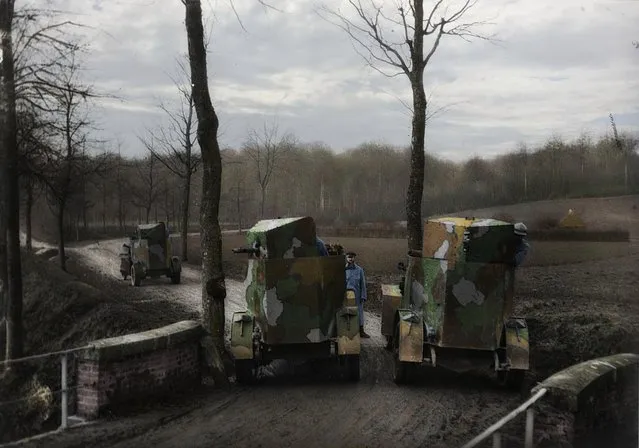
The expertly colourised shots were brought to life by French bank technician, Frédéric Duriez (51). The images were provided by the Valois collection which belongs to the BDIC. “By colourising these photos, I reduce the time that separates us today from this conflict”, said Frédéric. “A black and white photo does not attract the attention of young people, if you colour it, then people will look at it with curiosity. After this, we see the greater the misery and distress of these French fighters”. The total number of casualties in WW1 was more that 38 million. By the end of the war, over eight-million men had been called up to fight in the French army. France suffered 4.2 million casualties during the war with 1.3 million people dead. Here: Car cannon sections in firing position, Auxi-le-Château. (Photo by Frédéric Duriez/BDIC/Mediadrumworld.com)

The expertly colourised shots were brought to life by French bank technician, Frédéric Duriez (51). The images were provided by the Valois collection which belongs to the BDIC. “By colourising these photos, I reduce the time that separates us today from this conflict”, said Frédéric. Here: Car cannon sections in firing position, Auxi-le-Château. (Photo by Frédéric Duriez/BDIC/Mediadrumworld.com)
Details
03 May 2017 08:41:00
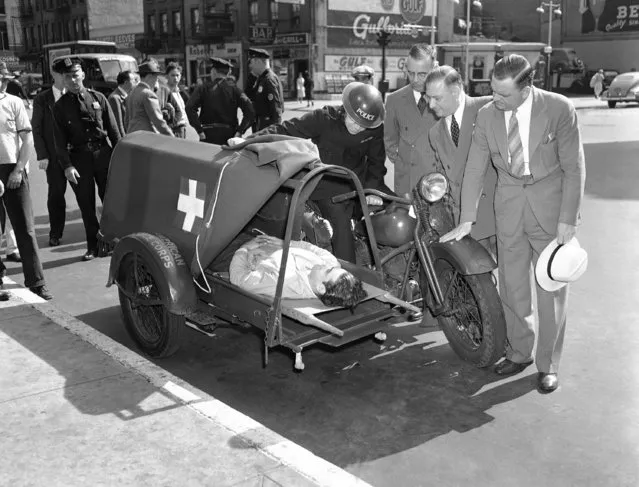
Developed for the British American Ambulance Corps, this new motorcycle ambulance is capable of speeding wounded soldiers 90 miles an hour from the front lines to field hospitals. Its springs are synchronized with the patient?s heartbeat to avoid increasing fever when traveling over various Terrain. Viewing it in New York  August 27, 1941, are left to right: constable Herbert Scott of England, driver; William E. Detlor, whose firm developed the vehicle; M. W. Stand, inspector-general of Civilian Defense, and Maj. Edward Riekert, also. (Photo by AP Photo)

Developed for the British American Ambulance Corps, this new motorcycle ambulance is capable of speeding wounded soldiers 90 miles an hour from the front lines to field hospitals. Its springs are synchronized with the patient's heartbeat to avoid increasing fever when traveling over various Terrain. Viewing it in New York August 27, 1941, are left to right: constable Herbert Scott of England, driver; William E. Detlor, whose firm developed the vehicle; M. W. Stand, inspector-general of Civilian Defense, and Maj. Edward Riekert, also. (Photo by AP Photo)
Details
28 Aug 2015 11:51:00
In this Wednesday, April 12, 2017, photo, waitresses wait outside a restaurant in Pyongyang, North Korea. A generational divide is quietly growing in North Korea, often hidden behind relentless propaganda. On the streets there are young women in not-quite mini-skirts and teenage boys with baseball hats cocked sideways, K-pop style. (Photo by Wong Maye-E/AP Photo)

In this Wednesday, April 12, 2017, photo, waitresses wait outside a restaurant in Pyongyang, North Korea. A generational divide is quietly growing in North Korea, often hidden behind relentless propaganda. On the streets there are young women in not-quite mini-skirts and teenage boys with baseball hats cocked sideways, K-pop style. (Photo by Wong Maye-E/AP Photo)
Details
21 Aug 2017 07:25:00