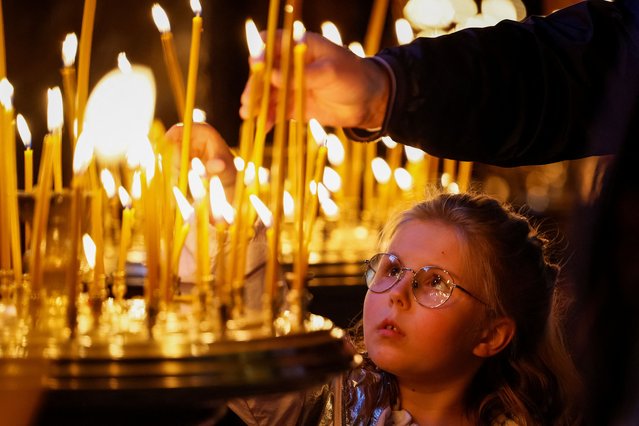
A girl lights a candle during an Easter service in the Volodymyrsky Cathedral, amid Russia's attack on Ukraine, in Kyiv, Ukraine, on May 4, 2024. (Photo by Alina Smutko/Reuters)
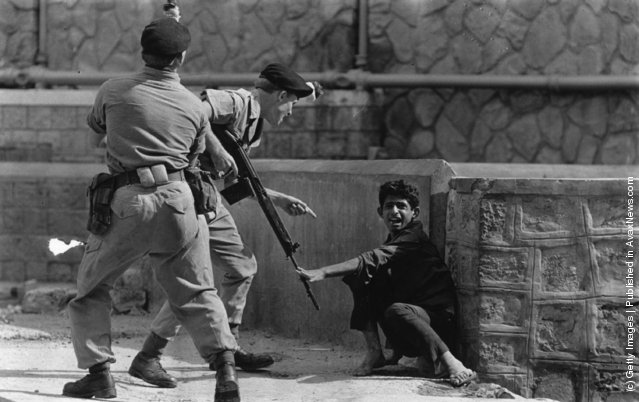
An Aden civilian crouching in terror as British soldiers threaten him during Arabian demonstrations in Crater. (Photo by Express Newspapers/Getty Images). 1967
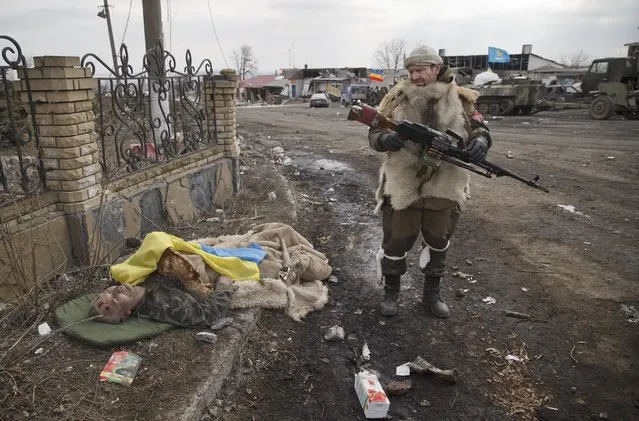
A Russia-backed rebel looks at the flag covered body of an Ukrainian serviceman in Debaltseve, Ukraine, February 20, 2015. The struggle for the strategic rail hub, Debaltseve, a sleepy town with a pre-war population of 25,000 people, left the town in ruins and became one of the darkest pages in the ongoing conflict in eastern Ukraine, which has already killed more than 6,000 people. (Photo by Vadim Ghirda/AP Photo/File)
Takeoka Chisaka, Hiroshima, Japan. “One morning in August 1945, I was walking home from the night shift at a factory in Hiroshima. As I reached my door, there was a huge explosion. When I came to, my head was bleeding and I had been blasted 30m away. The atomic bomb had detonated. When I found my mother, her eyes were badly burned. A doctor said they had to come out, but he didn’t have the proper tools so used a knife instead. It was hellish. I became a peace-worker after the war. In the 1960s, at a meeting at the UN, I met one of the people who created the atomic bomb. He apologised”. (Photo and caption by Sasha Maslov)
Chamrock, an Irish wolfhound, sports a green coat as he waits for the start of the St. Patrick's Day parade on March 17, 2012 in Chicago, Illinois. Tens of thousands took advantage of record high temperatures and sunny weather to attend the city's annual St. Patrick's Day celebration. (Photo by Brian Kersey/Getty Images)
Sports Finalist – Ian MacNicol. Michalina Kwasniewska of Poland competes in the Women's high jump during day one of The European Athletics U23 Championships 2013 on July 11, 2013 in Tampere, Finland. (Photo by Ian MacNicol/Agence France-Presse)
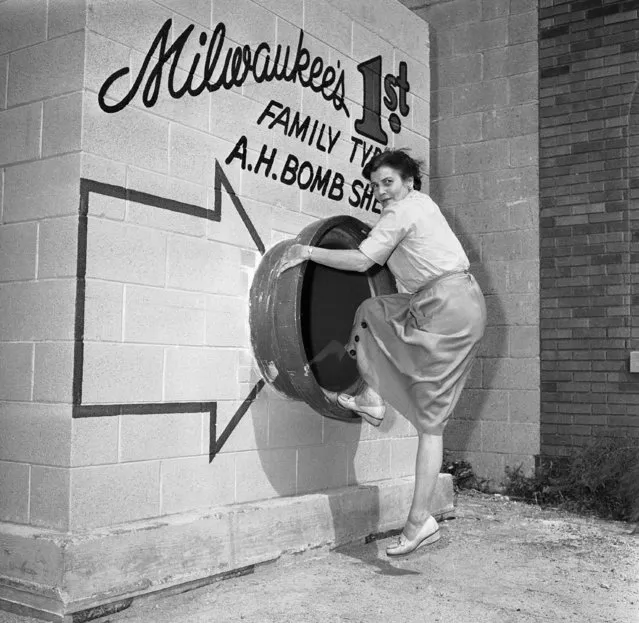
Mrs. Marie Graskamp of Milwaukee shows the different positions one might assume when entering the bomb shelter in Milwaukee September 3, 1958. This circular entrance is about three feet in diameter. This is the entrance (according to the builders) that would connect to the cellar of a home assuming the shelter was in the ground for added protection. If a bombing should occur, all members of family would proceed to the cellar and then through the circular port into the shelter. (Photo by AP Photo)